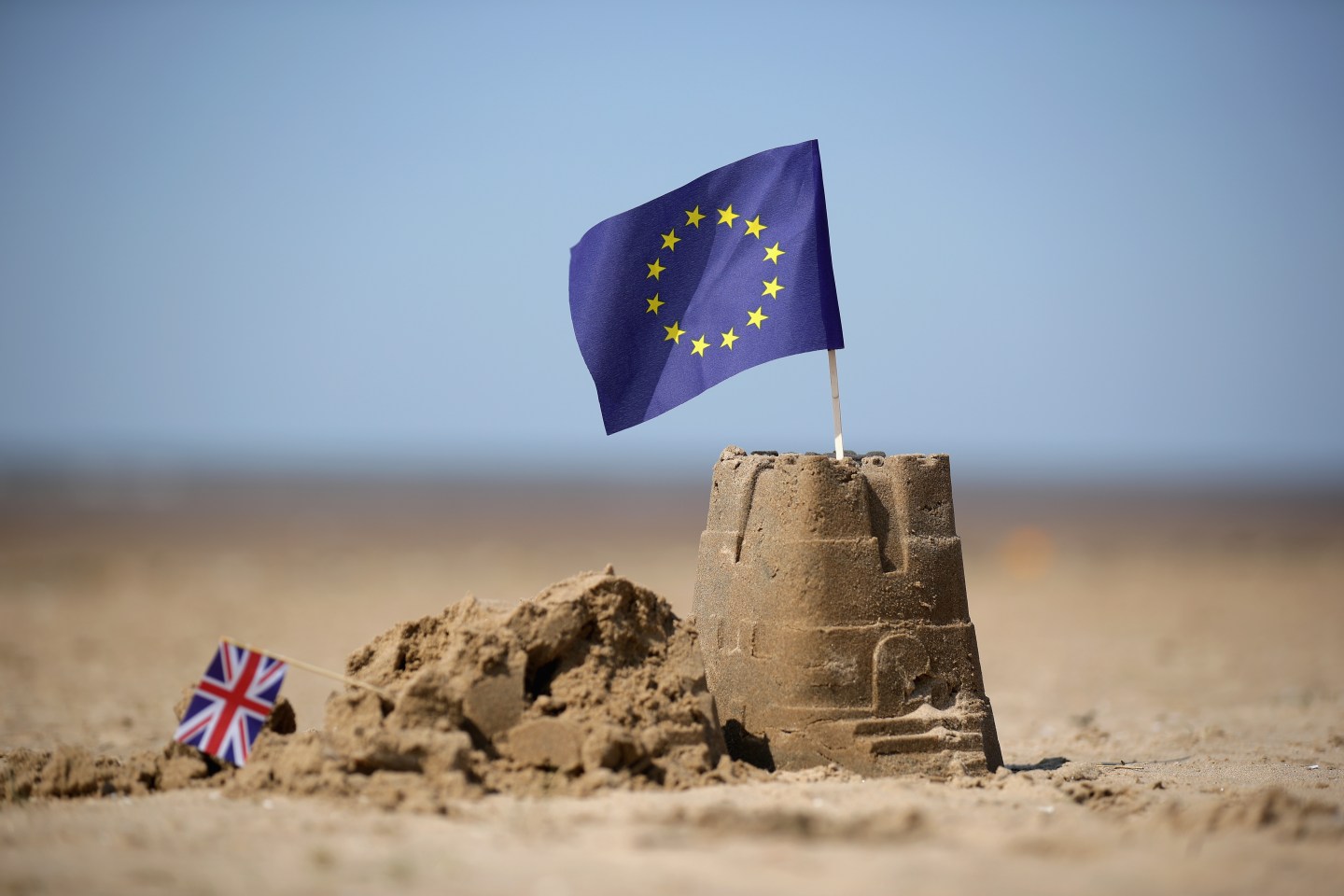
The leaders who successfully championed Brexit must choose between two broad routes in establishing the UK’s new role in the world trading community: EU-Lite or rebel.
Under the first “EU-lite” solution, Britain would forge a comprehensive free-trade deal with European Community that would maintain its barrier-free access to the single market. But that option would force the pro-Brexit leaders to renege on a pillar of their victory, promises to curb immigration and escape costly regulations dictated from Brussels.
Adopting the second, the “rebel” stance, would require Britain to laboriously negotiate piecemeal, industry-by-industry deals with the EU, as well as new arrangements with dozens of other countries. The result would be a crazy-quilt of tariffs and restrictions that would punish British industry, especially its banks.
And here is the pity of Brexit: Both options would saddle the U.K. with far weaker growth than if it had changed nothing, and remained a full member of the EU.
In effect, EU-lite is a big, costly boomerang operation that takes Britain mostly back to where it was before the vote, after what may be as much as two years of wrangling with Brussels and an interval of heavy uncertainty that’s already pounding foreign investment.
The rebel route, though, is worse, because the outcome is a lot more unpredictable, and threatens to make it far costlier for banks and chemical manufacturers to sell their services and products on world markets. “Britain needs to offset a big economic shock, and that shock will slow growth for a while even if it manages to get back to the kind of free trade agreements it had before,” says Raoul Ruparel, co-director of Open Europe, a think-tank that campaigns for major reforms in Britain’s relationship with the EU, and that took a neutral stance in the campaign. “People underestimated the commitment required for a positive outcome. If a comprehensive agreement doesn’t happen, the economic hit will remain, and Britain will grow slower in the future.”
The pro-Brexit forces are already squabbling over the right road to take. During the campaign, former London Mayor Boris Johnson made taking control over immigration a centerpiece for the pro-Brexit campaign. But in a post-vote op-ed in London’s Daily Telegraph, Johnson declared, “There will continue to be be free trade, and access to the single market.”
But Johnson’s two positions contradict one another. The free movement people is as much an essential EU principle as free movement of goods. Hence, it’s highly unlikely the soon-to-be 27-nation bloc would open its markets if the U.K. insists on restricting immigration of French or Polish workers. Even now, Johnson’s Conservative allies are acknowledging that open borders for goods and services won’t happen without open borders for people. Still, for now, it appears that Johnson is leaning towards EU-lite.
That shift is worrying leave-advocate Nigel Farage, chief of the right-wing U.K. Independence Party, who accuses Johnson of “backsliding” by claiming that free trade is a bigger issue than immigration. Farage warns that Johnson may be seeking “a different kind of deal with the EU that would keep us within free movement [of people].” Put Farage in the rebel camp.
The better, EU-lite option involves becoming a member of the European Economic Area, but remaining outside the EU. The EEA constitutes the EU’s single market of 28 nations, plus three non-EU members: Norway, Iceland, and Liechtenstein. Those countries also form a trading bloc called EFTA (European Free Trade Association) that’s forged its own trade agreements with around 35 nations. By joining the EEA/EFTA, Britain would retain most of both the costs and privileges of EU membership, but would an EU vote, or influence over policies it would be forced to follow.
Under the EEA option, the U.K. would gain the same access to the single market it enjoys today, for all industries. But it would also be required to allow free immigration of EU (as well as EFTA) citizens. It would also need to follow an estimated 94% of the EU’s environmental and labor rules that impose estimated extra annual costs of $44 billion, including the Working Time Directive that limits the work week to 48 hours, a provision reviled by British industry.
In exchange for access, Britain would continue making big payments to Brussels, perhaps far more than it pays today. Eliminating that burden was a rallying cry for the Brexiteers, but it won’t happen.
Today, the U.K. is contributing around $26 billion a year to the EU. Roughly three decades ago, though, then-Prime Minister Margaret Thatcher negotiated a rebate program that now returns $8 billion annually to the British Exchequer. The EU also sends Britain an additional $7 billion in subsidies to farmers under the Common Agricultural Policy, the EU’s biggest budget item by far.
So the UK’s net contribution to Brussels is roughly $11 billion. That’s roughly $170 per resident. Norway, currently, as an EEA member pays about 19% less for each resident than Britain. Michael O’Leary, CEO of Ryanair, Europe’s largest airline, predicts that the EU will force Britain to pay at least as much as Norway, and perhaps more, for a total approaching the gross number of $26 billion, or roughly $400 per Britain––with no rebates or CAP subsidies.
“The EU won’t do it out of spite,” says O’Leary. “The reason they’ll be so difficult is a political calculation to prevent contagion. They don’t want the French or Dutch to think they can get a better deal by leaving the EU.”
If it joins the EEA, the U.K. would be freed from the CAP program. But it won’t save any money. That’s because Johnson has already pledged to support the U.K.’s farmers by keeping subsidies at the same levels required by CAP when Britain exits the EU. So if O’Leary’s predictions are accurate the U.K. will be paying $26 billion a year to Brussels and getting nothing back, and in addition, replacing the CAP payments with another $7 billion from its own treasury. Instead of net outflows of $11 billion, the UK would be paying nearly three times the amount for the privilege of single market access.
What about the rebel route?
In the rebel case, the U.K. could exercise total control over immigration, and could scuttle the EU’s restrictive labor and environmental regulations. It would also be freed of the big payments to Brussels, though it would need to continue spending billions aiding the farmers. Keep in mind that those EU regs are enshrined in U.K. law. To shed them, and hence reap the advertised savings, Parliament would need to repeal work rules prized by the unions. Once again, none of the pro-Brexit politicians favor repealing those longstanding protections.
Second, Britain would seek a Free Trade Agreement, or FTA, with the EU. The EU has dozens of them with such nations as Canada, Mexico, and South Korea. An FTA does not grant unfettered, tariff-free access to the common market. Britain would negotiate separate deals for dozens of industries. Some would benefit from low tariffs and barriers, and others would find themselves far less competitive than today. The U.K. could probably achieve good deals for most manufactured products, including cars, food and beverage, and machinery. That’s because EU nations sell far more of those goods to the U.K. than the U.K. sells across the continent.
It’s a far different story where Britain is strongest––in services, especially banking and insurance. In financial services, the U.K. has a $14 billion trade surplus with the rest of the EU. An EEA membership would give the U.K. the absolute right to collect deposits, make loans, sell mutual funds, and the like anywhere in the EU, from Paris to Warsaw, all from a base in London. But if the U.K. instead decides to rebel, U.K. firms would be forced to open separate banking subsidiaries in the U.K. with separate workforces and capital. That would make doing business across Europe far more expensive, and could even end Britain’s dominance of European finance. “The EU would have little incentive to grant the UK a free market deal in financial services,” says Ruparel.
Besides the barriers in services, the U.K.’s labor costs would rise because of restrictions on immigration. Open immigration has both raised Britain’s competitiveness on world markets by enhancing productivity and restraining wage costs, and kept prices of everyday items in check. Over 80% of the recent arrivals from Eastern Europe are employed, versus less than 75% for British citizens. But in the rebel scenario, Britain would trade away that advantage for strict border controls.
It’s a poor trade. So poor that the most likely outcome is that Britain takes the EU-lite route. That path will wind through through lots of turmoil and uncertainty, scare off foreign investors, and perhaps push the U.K. into recession. In the end, the UK will come full circle, ending up pretty much where it started. The quicker it makes the loop, the better.