• Home
  • Latest
  • Fortune 500
  • Finance
  • Tech
  • Leadership
  • Lifestyle
  • Rankings
  • Multimedia

Trendingnow

1

The millennial generation is split in 2: an older crowd with boomer-style comfort, a younger set going 'back to the early 1900s'

2

'The demographic dividend of the last 40 years is ending': J.P. Morgan says the world is running out of the two things that kept interest rates down

3

Jensen Huang made his $172 billion fortune on AI chips. His family's $75 million gift to Vanderbilt argues art decides what technology is for

1

The millennial generation is split in 2: an older crowd with boomer-style comfort, a younger set going 'back to the early 1900s'

2

'The demographic dividend of the last 40 years is ending': J.P. Morgan says the world is running out of the two things that kept interest rates down

3

Jensen Huang made his $172 billion fortune on AI chips. His family's $75 million gift to Vanderbilt argues art decides what technology is for
CommentaryBrazil

What’s Next For Brazil and President Dilma Rousseff

By
Anthony W. Pereira
Anthony W. Pereira
Down Arrow Button Icon
By
Anthony W. Pereira
Anthony W. Pereira
Down Arrow Button Icon
April 17, 2016, 10:16 PM ET
APTOPIX Brazil Protests
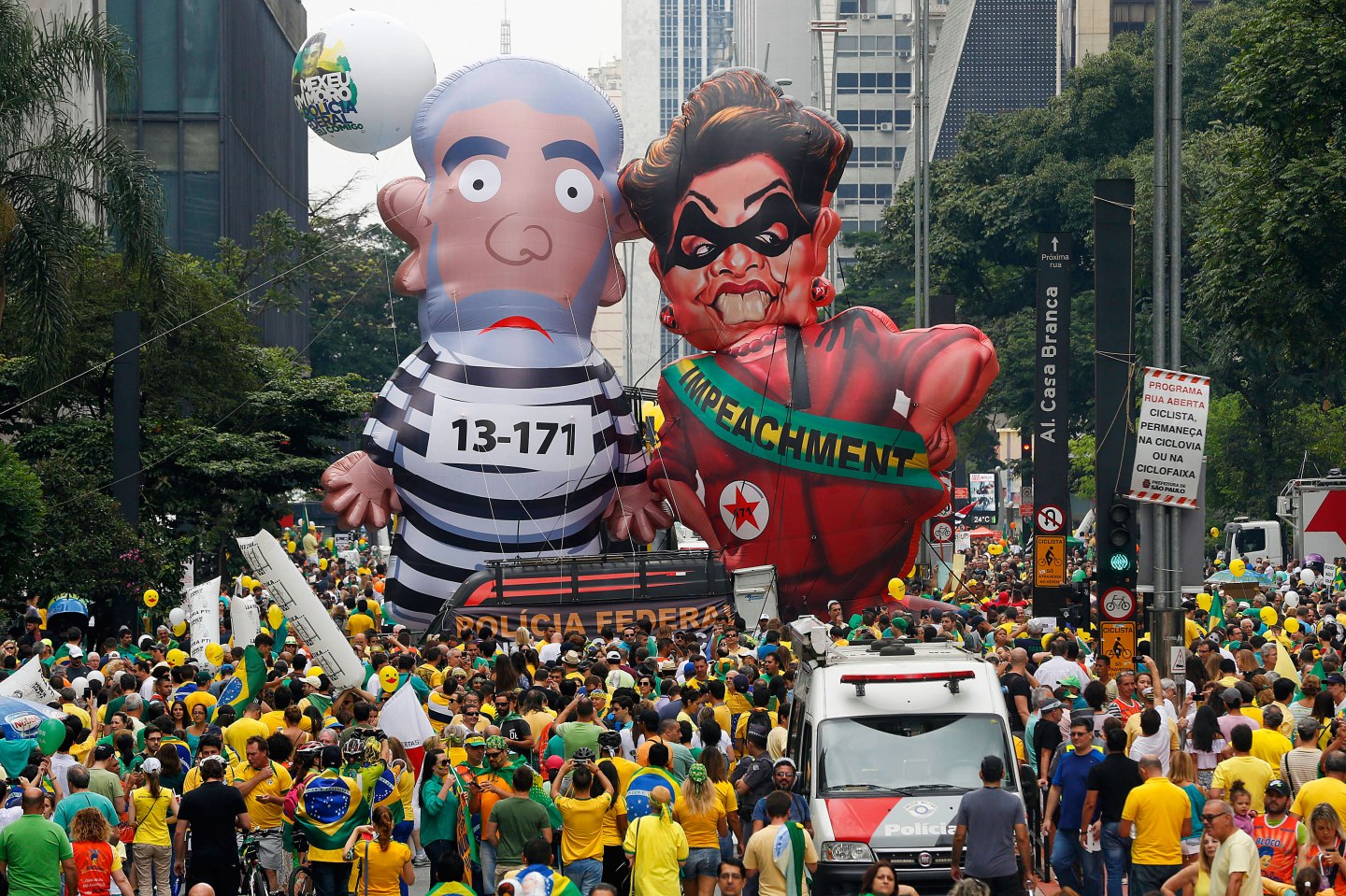
Demonstrators parade large inflatable dolls depicting Brazil's former President Luiz Inacio Lula da Silva in prison garb and current President Dilma Rousseff dressed as a thief, with a presidential sash that reads "Impeachment," in Sao Paulo, Brazil, Sunday, March 13, 2016. The corruption scandal at the state-run oil giant Petrobras has ensnared key figures from Rousseff’s Workers’ Party, including her predecessor and mentor, Lula da Silva, as well as members of opposition parties. (AP Photo/Andre Penner)Photograph by Andre Penner — AP
Add Fortune on Google for similar content.

Brazil is experiencing its worst political stalemate since the transition to democracy in 1985. The lower house of Congress on Sunday voted to impeach President Dilma Rousseff of the Workers’ Party (PT). Now the Senate is likely to take up the impeachment, forcing Dilma to step aside for up to 180 days while Vice President Michel Temer assumes the presidency. If Dilma is impeached by the Senate, this will be the first time this has happened in Brazilian history. It could mean the end of 14 years of PT control of the presidency. But it is just the beginning of what are likely to be bigger dramas shaping Brazil’s future.

Politically, Brazil is both polarized and paralyzed. It is experiencing the worst recession in more than 80 years. A large-scale investigation into corruption in the partially state-owned oil company Petrobras has angered the public.

How did Brazil get here? President Dilma’s impeachment is the result of long-term change in three areas: in executive-Congressional relations; in the connections between citizens and the government, especially as expressed on the streets and in elections; and in the capacity and autonomy of the Federal judiciary, prosecutors’ offices, and the Federal police.

When President Dilma’s predecessor, Luiz Inácio “Lula” da Silva won the presidency in 2002, it was historically significant. A center-left coalition replaced a center-right coalition, proving that Brazilian democracy could accommodate the coming to power of a leftist party (albeit in coalition with other parties).

Lula managed to win re-election in 2006. But in doing so, he lost most of his middle class supporters, and gained low-income ones, in part because his policies of raising the minimum wage, expanding social programs, and increasing access to credit, technical training and university education lifted the purchasing power of the poor. Since then, every presidential election in Brazil has exhibited a strong class cleavage – the higher up the income scale the voter is, the less likely he or she will vote for the PT candidate. Another switch occurred inside government. Instead of monopolizing key cabinet posts, the PT in Lula’s second term shared the spoils of office broadly, especially with its principal partner, the ideologically and programmatically amorphous PMDB (Brazilian Democratic Movement Party).

These changes made PT governments vulnerable. First, because their electoral support was concentrated amongst poor voters, they were subject to the criticism of the mainstream media, middle class shapers of opinion, and business associations. They were accused of buying the votes of the less educated, less white, less prosperous part of the electorate, and not deferring to those who saw their social prominence as entitling them to a disproportionate share of political power. And second, PT governments needed the support of their partner the PMDB, as well as other allied parties, since the PT’s own share of seats in Congress never exceeded 20%.

Near the end of his second term, Lula decided that his successor would be his Chief of Staff, Dilma Rousseff. Dilma had no previous electoral experience. In a move that confirmed the triumph of Lulismo (Lula-ism) over PTismo (PT-ism), the PT confirmed Lula’s choice in an uncontested internal election. Dilma won the 2010 presidential election fairly easily.

Her re-election in 2014 was narrower. This was due, in part, to the limitations of the PT governments’ policies. They had significantly reduced poverty and somewhat ameliorated income inequality, largely through policies that gave the poor more disposable income. These policies, however, were not accompanied by commensurate increases in spending on, and improvements in the quality of basic public goods, especially education, health care, and public transportation.

In 2014 the recession, partly a result of the end of the commodities boom, had not yet begun to bite, and household income for most people was still rising. But President Dilma’s victory felt like a loss. Calls for her impeachment began in November 2014, right after her election. She reacted by adopting the economic policies of her opponents, introducing budget cuts that hurt her base of support. The recession deepened, unemployment increased and inflation neared 10%. President Dilma also lost control of Congress, which consists of 28 different parties.

The impeachment case against President Dilma centers around creative accounting, in which the Federal government delayed payments to state banks in order to make the budget deficit look smaller than it really was. Because such techniques are quite common, and were used by previous presidents, this is a controversial case in constitutional terms, and looks like the application of a double standard. However, revelations of corruption under PT rule weakened her position.

In March 2014, prosecutors working for a Federal judge in Curitiba traced a money laundering operation at a car wash back to the partially state-owned oil company Petrobras. Major construction firms were alleged to have overcharged for contracts. The kickbacks were then funneled back to Petrobras executives for their personal enrichment, but also to politicians and parties for their electoral campaigns. These practices went well beyond the PT and involve most of the major parties.

The anti-corruption investigations involve a network of Federal judges, prosecutors at the Federal and state levels in the Federal and state public ministries, and the Federal Police. Some of the increased capacity of these institutions is the result of government policy under the PT. The Federal Police, for example, were expanded, professionalized, and given more resources under President Lula. Other changes are the result of the rise of a new generation of judges and prosecutors who want to vigorously prosecute politicians for practices that in the past were widespread. At times these judicial actors have overstepped their bounds. But overall, the impact of their actions could be positive, by bringing to light previously opaque campaign financing practices.

Where does this leave Brazil? The impeachment trial in the Senate is likely to capture a large television audience. There is a lot at stake for the major players. For President Dilma, impeachment would be a sad end to her political career. For Vice President Michel Temer, it could result in a presidency with a great deal of uncertainty and difficulty. For ex-President Lula, currently acting as an “informal minister” for his successor, it would be a mixed blessing. He could see his protégé stripped of office and his legacy tarnished. But he could also run for president in 2018 (provided he is not prosecuted or otherwise barred from running). With Rousseff gone, he could do this as a member of the opposition, blaming the Temer government for the economy’s ills and posing as a leader capable of righting an injustice committed against his party and the former president.

The present stalemate also raises questions about Brazil’s future. For example, what sort of precedent does the impeachment of President Rousseff set for the country? Can a government with a minimum of cohesion be formed under present conditions in Brazil? How quickly can the economy recover? Can the decreases in poverty and inequality, which have been stalled for the last three years, continue? Do the anti-Dilma protestors only want the removal of the PT from the presidency, or do they also want to roll back the social gains of the less well off? Will the anti-corruption investigations flourish under a non-PT government, or will they lose support when not directed at the PT? And how can the electoral system be reformed so that campaign financing is more transparent?

The answers to these questions are not obvious. They might come into view during the rest of the year, which will see the Olympic Games take place in Rio de Janeiro in August and September and municipal elections in October. For better or worse, Brazil is likely to be the object of international attention for many months to come.

Anthony W. Pereira is a Professor and Director of the Brazil Institute at King’s College London.

About the Author
By Anthony W. Pereira
See full bioRight Arrow Button Icon
Add Fortune on Google for similar content.

Latest in Commentary

Finance
Lorem ipsum dolor sit amet, consectetur adipiscing elit, sed do eiusmod tempor incididunt ut labore et dolore magna aliqua. Ut enim ad minim veniam
By Fortune Editors
October 20, 2025
Finance
Lorem ipsum dolor sit amet, consectetur adipiscing elit, sed do eiusmod tempor incididunt ut labore et dolore magna aliqua. Ut enim ad minim veniam
By Fortune Editors
October 20, 2025
Finance
Lorem ipsum dolor sit amet, consectetur adipiscing elit, sed do eiusmod tempor incididunt ut labore et dolore magna aliqua. Ut enim ad minim veniam
By Fortune Editors
October 20, 2025
Finance
Lorem ipsum dolor sit amet, consectetur adipiscing elit, sed do eiusmod tempor incididunt ut labore et dolore magna aliqua. Ut enim ad minim veniam
By Fortune Editors
October 20, 2025
Finance
Lorem ipsum dolor sit amet, consectetur adipiscing elit, sed do eiusmod tempor incididunt ut labore et dolore magna aliqua. Ut enim ad minim veniam
By Fortune Editors
October 20, 2025
Finance
Lorem ipsum dolor sit amet, consectetur adipiscing elit, sed do eiusmod tempor incididunt ut labore et dolore magna aliqua. Ut enim ad minim veniam
By Fortune Editors
October 20, 2025

Most Popular

Finance
Lorem ipsum dolor sit amet, consectetur adipiscing elit, sed do eiusmod tempor incididunt ut labore et dolore magna aliqua. Ut enim ad minim veniam
By Fortune Editors
October 20, 2025
Finance
Lorem ipsum dolor sit amet, consectetur adipiscing elit, sed do eiusmod tempor incididunt ut labore et dolore magna aliqua. Ut enim ad minim veniam
By Fortune Editors
October 20, 2025
Finance
Lorem ipsum dolor sit amet, consectetur adipiscing elit, sed do eiusmod tempor incididunt ut labore et dolore magna aliqua. Ut enim ad minim veniam
By Fortune Editors
October 20, 2025
Finance
Lorem ipsum dolor sit amet, consectetur adipiscing elit, sed do eiusmod tempor incididunt ut labore et dolore magna aliqua. Ut enim ad minim veniam
By Fortune Editors
October 20, 2025
Finance
Lorem ipsum dolor sit amet, consectetur adipiscing elit, sed do eiusmod tempor incididunt ut labore et dolore magna aliqua. Ut enim ad minim veniam
By Fortune Editors
October 20, 2025
Finance
Lorem ipsum dolor sit amet, consectetur adipiscing elit, sed do eiusmod tempor incididunt ut labore et dolore magna aliqua. Ut enim ad minim veniam
By Fortune Editors
October 20, 2025
Fortune Secondary Logo
Rankings
  • 100 Best Companies
  • Fortune 500
  • Global 500
  • Fortune 500 Europe
  • Most Powerful Women
  • World's Most Admired Companies
  • See All Rankings
  • Lists Calendar
Sections
  • Finance
  • Fortune Crypto
  • Features
  • Leadership
  • Health
  • Commentary
  • Success
  • Retail
  • Mpw
  • Tech
  • Lifestyle
  • CEO Initiative
  • Asia
  • Politics
  • Conferences
  • Europe
  • Newsletters
  • Personal Finance
  • Environment
  • Magazine
  • Education
Customer Support
  • Frequently Asked Questions
  • Customer Service Portal
  • Privacy Policy
  • Terms Of Use
  • Single Issues For Purchase
  • International Print
Commercial Services
  • Advertising
  • Fortune Brand Studio
  • Fortune Analytics
  • Fortune Conferences
  • Business Development
  • Group Subscriptions
About Us
  • About Us
  • Press Center
  • Work At Fortune
  • Terms And Conditions
  • Site Map
  • About Us
  • Press Center
  • Work At Fortune
  • Terms And Conditions
  • Site Map
  • Facebook icon
  • Twitter icon
  • LinkedIn icon
  • Instagram icon
  • TikTok icon
  • YouTube icon

Latest in Commentary

Roderick Wong, MD is Managing Partner and Chief Investment Officer of RTW Investments
Commentary250 Years of Innovation
When 10,000 doctors stood up and cheered for a cancer drug — America’s innovation machine made it possible
By Roderick WongJuly 25, 2026
12 hours ago
t
CommentaryCommunity
Ronald Reagan center director: How to talk politics with family, friends and neighbors, without losing them
By Frederick J. Ryan, Jr.July 25, 2026
12 hours ago
m
Commentarydisruption
The Messi Test and how the Spaniards messed with it: what the World Cup final taught me about the jobs AI can’t touch
By Bhaskar ChakravortiJuly 25, 2026
12 hours ago
alex
CommentaryEntrepreneurship
I sold my startup for millions without a single dollar in revenue. Here’s why that’s the point
By Alexander Kardos-NyheimJuly 25, 2026
16 hours ago
craig
CommentaryPharmaceutical Industry
Big pharma’s patent cliff meets a new biotech Cold War: We need to outrun China, not outlaw it
By Craig GarthwaiteJuly 24, 2026
1 day ago
tim
Commentarysmartphones and mobile devices
NYU Stern pricing expert: There’s a hidden ‘AI tax’ hitting Apple, Dell — and your next phone
By Srikanth JagabathulaJuly 24, 2026
2 days ago

Most Popular

The millennial generation is split in 2: an older crowd with boomer-style comfort, a younger set going 'back to the early 1900s'
Real Estate
The millennial generation is split in 2: an older crowd with boomer-style comfort, a younger set going 'back to the early 1900s'
By Nick LichtenbergJuly 25, 2026
12 hours ago
'The demographic dividend of the last 40 years is ending': J.P. Morgan says the world is running out of the two things that kept interest rates down
Economy
'The demographic dividend of the last 40 years is ending': J.P. Morgan says the world is running out of the two things that kept interest rates down
By Eleanor PringleJuly 24, 2026
2 days ago
Jensen Huang made his $172 billion fortune on AI chips. His family's $75 million gift to Vanderbilt argues art decides what technology is for
Big Tech
Jensen Huang made his $172 billion fortune on AI chips. His family's $75 million gift to Vanderbilt argues art decides what technology is for
By Sydney LakeJuly 23, 2026
3 days ago
An 11-year-old is cleaning his neighbors' trash cans for $10 each—he now has 100K followers as teens face the worst summer job market since 1948
Success
An 11-year-old is cleaning his neighbors' trash cans for $10 each—he now has 100K followers as teens face the worst summer job market since 1948
By Orianna Rosa RoyleJuly 25, 2026
14 hours ago
The $39 trillion U.S. national debt isn’t as high as Japan’s and Singapore’s relative to economy size—and yet it's still worse somehow
Economy
The $39 trillion U.S. national debt isn’t as high as Japan’s and Singapore’s relative to economy size—and yet it's still worse somehow
By Sasha RogelbergJuly 23, 2026
2 days ago
Jensen Huang just used his first ever X post to warn the AI industry not to make the mistake that software narrowly avoided in the 1980s
AI
Jensen Huang just used his first ever X post to warn the AI industry not to make the mistake that software narrowly avoided in the 1980s
By Nick LichtenbergJuly 24, 2026
1 day ago

© 2026 Fortune Media IP Limited. All Rights Reserved. Use of this site constitutes acceptance of our Terms of Use and Privacy Policy | CA Notice at Collection and Privacy Notice | Do Not Sell/Share My Personal Information
FORTUNE is a trademark of Fortune Media IP Limited, registered in the U.S. and other countries. FORTUNE may receive compensation for some links to products and services on this website. Offers may be subject to change without notice.