• Home
  • Latest
  • Fortune 500
  • Finance
  • Tech
  • Leadership
  • Lifestyle
  • Rankings
  • Multimedia
Commentary

Why the EU-Turkey Migrant Deal Is a Moral Disaster

By
Bridget Anderson
Bridget Anderson
and
Bethany Cianciolo
Bethany Cianciolo
Down Arrow Button Icon
By
Bridget Anderson
Bridget Anderson
and
Bethany Cianciolo
Bethany Cianciolo
Down Arrow Button Icon
March 17, 2016, 1:00 AM ET
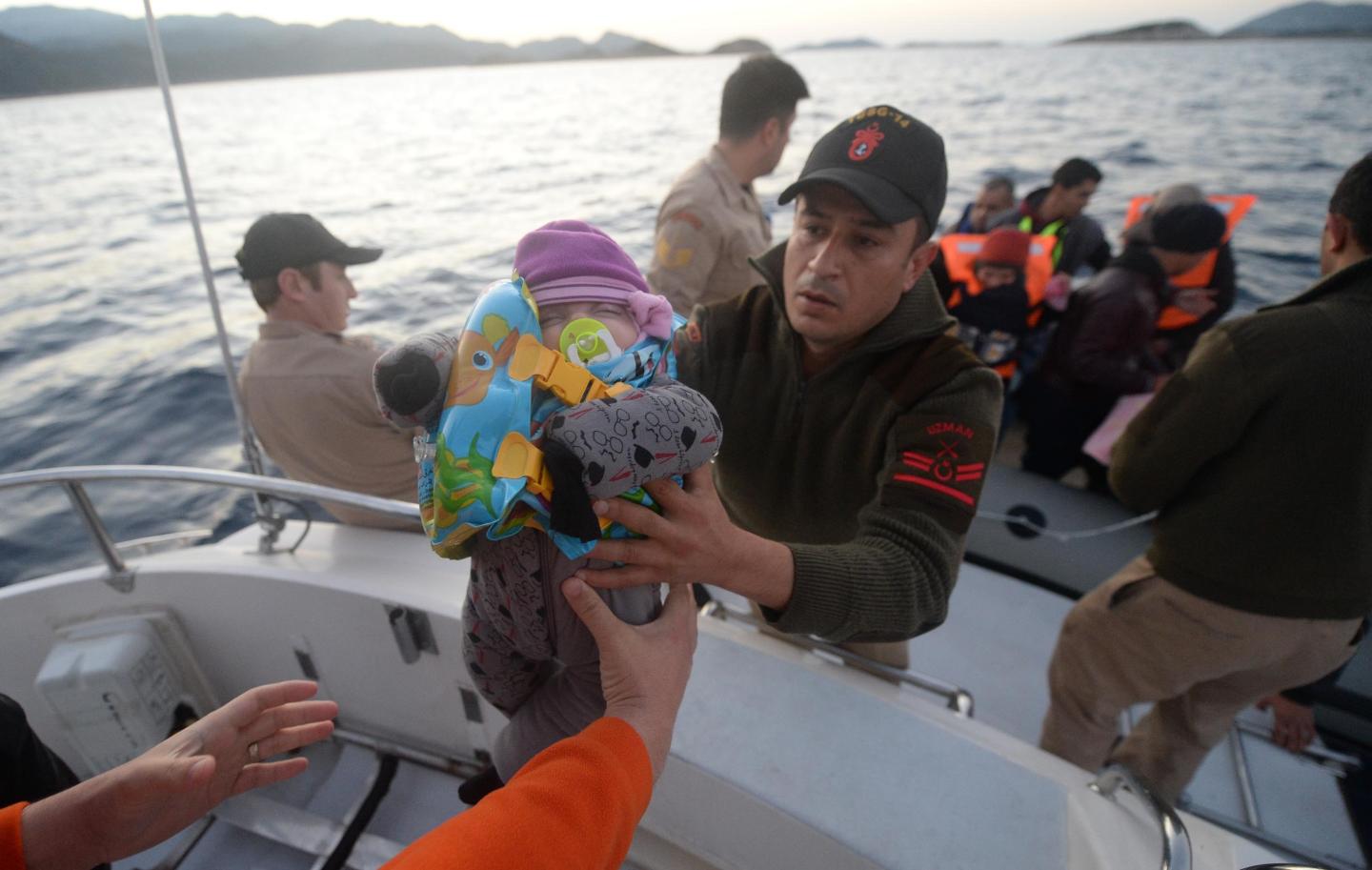
Turkey Rescues 174 refugees in Turkey's Antalya
ANTALYA, TURKEY - MARCH 12: Turkish Coast guard member carries a baby into rescue boat after total of 174 Syrian refugees captured by Turkish coast guard while they were illegally trying to reach Greece's, in shores of Antalya, southern province of Turkey on March 12, 2016. (Photo by Suleyman Elcin/Anadolu Agency/Getty Images)Photograph by Suleyman Elcin — Anadolu Agency via Getty Images

Last week, European and Turkish leaders agreed on the outline of an arrangement that would allow a sort of human conveyor belt in which “irregular” migrants would be returned from Greece to Turkey. For every Syrian returned under this agreement, one Syrian refugee in a Turkish camp would be resettled. Some of the UK’s tabloid newspapers dubbed it the “migrant merry-go-round”—but there is nothing merry about this deal whatsoever.

It proposes a collective expulsion that debases the value of respect for human rights that Western Europe has prided itself on since the end of World War II, and that the narrative of the EU has been constructed around. This is compounded by swapping desperate human beings one for one, treating people as if they are commensurable and tradable, which is morally bankrupt. Each of those people on boats has their own history. It is desperation—not ignorance or foolhardiness—that pushes them to risk their lives. People who have no hope of getting resettled because they are the wrong nationality will continue to risk their lives because they have no alternatives.

This agreement has, rightly, been attacked by the United Nations High Commissioner for Refugees (UNHCR), as it undermines the principles of asylum law. The fundamental core of these is the concept of “non-refoulement,” or prohibiting the return of a person who is seeking asylum to the country from which he or she fled.

Legally, Turkey cannot be considered a safe haven in the same way that European states are. Turkey has ratified the U.N. Convention on the Status of Refugees, which recognizes and defines the status of “refugee” and also sets out the responsibilities of states when people make such claims. However, Turkey stipulated a “geographical limitation,” claiming only those fleeing “events in Europe” can get full refugee status.

In its 2013 law Law on Foreigners and International Protection (LFIP), it maintained a soft version of the geographical limitation claim. Those arriving in Turkey “as a result of events from outside European countries” will be given “conditional refugee status” or “subsidiary protection.” Syrians and stateless Palestinians can be granted “temporary protection.” But all of these statuses deny the possibility of ever achieving Turkish citizenship or long-term legal integration.

People fleeing violence, like all of us, are looking to build lives—not to live in extended states of temporariness, surviving day to day. Half of the Syrians in Turkey are children. Syrian parents may be looking at the statelessness of Palestinians in camps in Lebanon and Jordan and foreseeing a bleak future for their children.

But this new agreement between Turkey and the EU goes further than just undermining law. It undermines the very idea of safe haven that goes back centuries. This agreement involves rejecting people without listening to their asylum claims, including people coming from states that we know are riven with poverty and conflict, such as Iraq and Afghanistan. Europe is deeply implicated in the violence that has produced the conditions people are now fleeing.


This crisis is ultimately not about refugees and migrants. It is a crisis that has come about because of a European Union with human rights policies built on sand. To put it simply, what the world is witnessing is not a refugee crisis facing Europe, but a European crisis facing refugees.

The construction of razor wire-topped border fences across the continent, the rushed introduction of criminal penalties to allow the incarceration of those fleeing persecution (and those who assist them), the media rhetoric so focused on terrorism and sexual violence: These all speak of a continent facing an existential crisis.

For a generation, Europe has wrapped itself in what now appears to be a myth: that it is a continent of decency and human rights, aware of its brutal past, but older and wiser, accepting all races and faiths, and guiding the world toward a more open and hopeful future.

But the current European identity crisis—and particularly this agreement with Turkey—threatens to reveal this myth Europe has wrapped itself in as the emperor’s new clothes: a wishful nothing the continent was too vain or too scared to scrutinize, and that hides nothing of the naked weakling below.

This is not how it has to be. The governments of Germany and Sweden have taken their responsibilities to protect people seriously. The rest of the EU—if the idea of the European Union truly means something—can, and should, stand together to help refugees rather than put up fences and push them away.

Bridget Anderson is a professor of migration and citizenship and research director at The University of Oxford’s Centre on Migration, Policy and Society (COMPAS).

About the Authors
By Bridget Anderson
See full bioRight Arrow Button Icon
By Bethany Cianciolo
See full bioRight Arrow Button Icon

Latest in Commentary

Finance
Lorem ipsum dolor sit amet, consectetur adipiscing elit, sed do eiusmod tempor incididunt ut labore et dolore magna aliqua. Ut enim ad minim veniam
By Fortune Editors
October 20, 2025
Finance
Lorem ipsum dolor sit amet, consectetur adipiscing elit, sed do eiusmod tempor incididunt ut labore et dolore magna aliqua. Ut enim ad minim veniam
By Fortune Editors
October 20, 2025
Finance
Lorem ipsum dolor sit amet, consectetur adipiscing elit, sed do eiusmod tempor incididunt ut labore et dolore magna aliqua. Ut enim ad minim veniam
By Fortune Editors
October 20, 2025
Finance
Lorem ipsum dolor sit amet, consectetur adipiscing elit, sed do eiusmod tempor incididunt ut labore et dolore magna aliqua. Ut enim ad minim veniam
By Fortune Editors
October 20, 2025
Finance
Lorem ipsum dolor sit amet, consectetur adipiscing elit, sed do eiusmod tempor incididunt ut labore et dolore magna aliqua. Ut enim ad minim veniam
By Fortune Editors
October 20, 2025
Finance
Lorem ipsum dolor sit amet, consectetur adipiscing elit, sed do eiusmod tempor incididunt ut labore et dolore magna aliqua. Ut enim ad minim veniam
By Fortune Editors
October 20, 2025

Most Popular

Finance
Lorem ipsum dolor sit amet, consectetur adipiscing elit, sed do eiusmod tempor incididunt ut labore et dolore magna aliqua. Ut enim ad minim veniam
By Fortune Editors
October 20, 2025
Finance
Lorem ipsum dolor sit amet, consectetur adipiscing elit, sed do eiusmod tempor incididunt ut labore et dolore magna aliqua. Ut enim ad minim veniam
By Fortune Editors
October 20, 2025
Finance
Lorem ipsum dolor sit amet, consectetur adipiscing elit, sed do eiusmod tempor incididunt ut labore et dolore magna aliqua. Ut enim ad minim veniam
By Fortune Editors
October 20, 2025
Finance
Lorem ipsum dolor sit amet, consectetur adipiscing elit, sed do eiusmod tempor incididunt ut labore et dolore magna aliqua. Ut enim ad minim veniam
By Fortune Editors
October 20, 2025
Finance
Lorem ipsum dolor sit amet, consectetur adipiscing elit, sed do eiusmod tempor incididunt ut labore et dolore magna aliqua. Ut enim ad minim veniam
By Fortune Editors
October 20, 2025
Finance
Lorem ipsum dolor sit amet, consectetur adipiscing elit, sed do eiusmod tempor incididunt ut labore et dolore magna aliqua. Ut enim ad minim veniam
By Fortune Editors
October 20, 2025
Fortune Secondary Logo
Rankings
  • 100 Best Companies
  • Fortune 500
  • Global 500
  • Fortune 500 Europe
  • Most Powerful Women
  • Future 50
  • World’s Most Admired Companies
  • See All Rankings
Sections
  • Finance
  • Fortune Crypto
  • Features
  • Leadership
  • Health
  • Commentary
  • Success
  • Retail
  • Mpw
  • Tech
  • Lifestyle
  • CEO Initiative
  • Asia
  • Politics
  • Conferences
  • Europe
  • Newsletters
  • Personal Finance
  • Environment
  • Magazine
  • Education
Customer Support
  • Frequently Asked Questions
  • Customer Service Portal
  • Privacy Policy
  • Terms Of Use
  • Single Issues For Purchase
  • International Print
Commercial Services
  • Advertising
  • Fortune Brand Studio
  • Fortune Analytics
  • Fortune Conferences
  • Business Development
  • Group Subscriptions
About Us
  • About Us
  • Editorial Calendar
  • Press Center
  • Work At Fortune
  • Diversity And Inclusion
  • Terms And Conditions
  • Site Map
Fortune Secondary Logo
  • About Us
  • Editorial Calendar
  • Press Center
  • Work At Fortune
  • Diversity And Inclusion
  • Terms And Conditions
  • Site Map
  • Facebook icon
  • Twitter icon
  • LinkedIn icon
  • Instagram icon
  • Pinterest icon

Latest in Commentary

wolfgang
CommentaryLeadership
Europe doesn’t lack tech talent. Its leaders lack execution
By Wolfgang OelsMarch 3, 2026
20 hours ago
zuck
Commentarycyber
Boards aren’t ready for the AI age: What happens when your CEO gets deepfaked?
By James RichardsonMarch 3, 2026
22 hours ago
Europedigital transformation
Why Europe can lead in trusted, industrialized AI
By Dave McCannMarch 2, 2026
2 days ago
heitmann
CommentaryEntrepreneurship
Here’s how to build something that lasts, from the founder of a $300 million bootstrapped company that’s been growing for 28 years straight
By Tim HeitmannMarch 1, 2026
3 days ago
world's fair
CommentaryRobots
Something big is happening in AI, but panic is the wrong reaction
By Peter CappelliFebruary 28, 2026
4 days ago
putin
CommentaryRussia
Exclusive analysis: we looked at the 400 western firms still in Russia. Their paltry size strips Putin’s bluff bare naked
By Jeffrey Sonnenfeld, Stephen Henriques, Jake Waldinger and Giuseppe ScottoFebruary 27, 2026
5 days ago

Most Popular

placeholder alt text
Economy
Interest on the $38.8 trillion national debt has tripled since 2020, and it already costs taxpayers more than defense and Medicaid
By Nick LichtenbergMarch 2, 2026
1 day ago
placeholder alt text
Middle East
Iran’s Islamic Revolutionary Guard controls a sprawling business empire that dominates the economy
By Jason MaMarch 2, 2026
2 days ago
placeholder alt text
Personal Finance
Current price of silver as of Tuesday, March 3, 2026
By Joseph HostetlerMarch 3, 2026
17 hours ago
placeholder alt text
Personal Finance
Current price of gold as of March 2, 2026
By Danny BakstMarch 2, 2026
2 days ago
placeholder alt text
Middle East
U.S. military gives Iran a taste of its own medicine with cheap copycat Shahed drones, while concern shifts to munitions supply in extended conflict
By Jason MaMarch 1, 2026
2 days ago
placeholder alt text
AI
American schools weren’t broken until Silicon Valley used a lie to convince them they were—now reading and math scores are plummeting
By Sasha RogelbergMarch 1, 2026
2 days ago

© 2026 Fortune Media IP Limited. All Rights Reserved. Use of this site constitutes acceptance of our Terms of Use and Privacy Policy | CA Notice at Collection and Privacy Notice | Do Not Sell/Share My Personal Information
FORTUNE is a trademark of Fortune Media IP Limited, registered in the U.S. and other countries. FORTUNE may receive compensation for some links to products and services on this website. Offers may be subject to change without notice.