• Home
  • News
  • Fortune 500
  • Tech
  • Finance
  • Leadership
  • Lifestyle
  • Rankings
  • Multimedia
TechMilitary

U.S. Navy Is Turning Anti-Aircraft and Cruise Missiles into Ship Killers

By
Clay Dillow
Clay Dillow
Down Arrow Button Icon
By
Clay Dillow
Clay Dillow
Down Arrow Button Icon
March 9, 2016, 1:31 PM ET
U.S. Navy

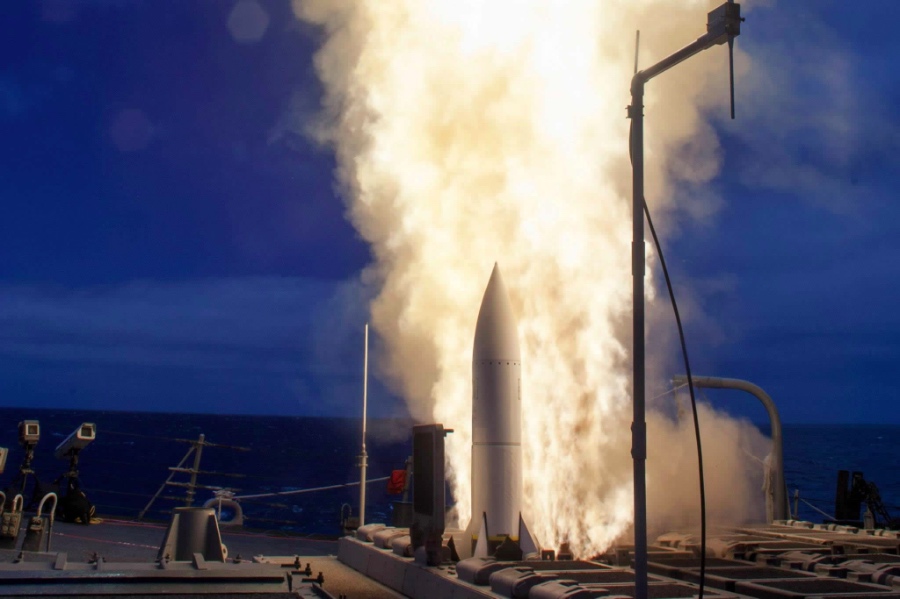
In January, the Reuben James took one for the team. Parked off the coast of Hawaii one moment, the decommissioned U.S. Navy frigate was struck by a supersonic Standard Missile-6 missile the next, sending the Reuben James to the bottom of the ocean. By all meaningful measures, it was a successful test of an anti-ship missile.

But the SM-6 isn’t an anti-ship missile—or at least it wasn’t designed as one.

The Standard Missile-6, built by Raytheon (RTN) and carried by U.S. Navy destroyers and cruisers around the globe, is a defensive weapon designed chiefly to defend those ships and the aircraft carriers they accompany from incoming attack aircraft and missiles. That test, the details of which were made public this week, marks the first time an SM-6 air defense interceptor has destroyed a surface target at sea.

It also marks a significant milestone in the Navy’s efforts to develop something it calls “distributed lethality,” or the ability to strike at naval targets from any ship at any location at any time. Facing new threats at sea, the Navy wants to make its adversaries (read: China) worry about every ship in the fleet as a lethal threat, not just the aircraft carriers that are the Navy’s crown jewels.

Get Data Sheet, Fortune’s daily newsletter about the business of technology.

Just as significantly, the test also marks the latest move in a Pentagon effort to push existing weapons to do more with a minimum of re-engineering or upgrading.

That effort is borne both of budget constraints and concerns about new threats at sea for which U.S. Navy hasn’t had to prepare since the end of the Cold War. In the years since then, the Navy has placed its money and its focus on weapons that can strike targets on land and actively defend its aircraft carriers (which can themselves launch aircraft to strike targets on land and at sea) from airborne threats. Destroyers and cruisers are now typically loaded down with a complement of SM-6 air defense missiles and Tomahawk land attack cruise missiles, creating something of a capability shortfall where ship-to-ship combat is concerned.

That shortfall has become a liability particularly as China continues to expand its maritime warfare capabilities both by growing its navy and increasing its military presence in the South China Sea. As a result, the SM-6 isn’t the only U.S. naval asset getting an expanded mission profile.

In February 2015, a U.S. Navy ship-based Tomahawk missile—originally designed to strike targets on land—punched a hole in a moving barge, demonstrating that system’s ability to carry out ship-to-ship warfare as well. The current Pentagon budget request sets aside $484 to convert a portion of the Navy’s stores of Tomahawk missiles into ship-killing cruise missiles that can strike targets at ranges up to 1,000 miles.

Read more: Europe is the latest battlefield for American missile defense sales

Raytheon has already delivered some 250 SM-6 missiles to the U.S. Navy, which first deployed them in 2013. The Pentagon’s five-year budget has earmarked another $2.9 billion for 625 more of the missiles, Secretary of Defense Ash Carter said in February.

In tests separate from the one that sunk the Reuben James, SM-6 missiles recently destroyed five targets in “over-the-horizon” tests in which the missiles relied on their own onboard radar—rather than targeting information provided by the launching ship—to track and destroy targets in flight. It was the longest range test of the SM-6, to date.

While the SM-6 doesn’t have the same kind of range as the subsonic Tomahawk, its supersonic speed makes it tougher for adversaries to shoot down, giving existing U.S. naval ships two complementary and effective ship-killing options.

Critically, the Navy didn’t have to fund and develop an entirely new surface warfare missile that ships would then have to make room for at the expense of their air defense interceptors and land attack cruise missiles.


About the Author
By Clay Dillow
See full bioRight Arrow Button Icon

Latest in Tech

Big TechApple
Apple rocked by executive departures, with chip chief at risk of leaving next
By Mark Gurman and BloombergDecember 6, 2025
2 hours ago
Nvidia CEO Jensen Huang said China is better equipped for an AI data center buildout than the U.S.
AITech
Nvidia CEO says data centers take about 3 years to construct in the U.S., while in China ‘they can build a hospital in a weekend’
By Nino PaoliDecember 6, 2025
4 hours ago
Arts & EntertainmentMedia
Former Amazon Studios boss warns the Netflix-Warner Bros. deal will make Hollywood ‘a system that circles a single sun’
By Jason MaDecember 6, 2025
5 hours ago
Jay Clayton
LawCrime
25-year DEA veteran charged with helping Mexican drug cartel launder millions of dollars, secure guns and bombs
By Dave Collins, Michael R. Sisak and The Associated PressDecember 6, 2025
6 hours ago
Elon Musk
LawSocial Media
Elon Musk’s X fined $140 million by EU for breaching digital regulations
By Kelvin Chan and The Associated PressDecember 6, 2025
6 hours ago
Sarandos
InvestingM&A
Netflix’s $5.8 billion breakup fee for Warner among largest ever
By Elizabeth Fournier and BloombergDecember 6, 2025
6 hours ago

Most Popular

placeholder alt text
Economy
Two months into the new fiscal year and the U.S. government is already spending more than $10 billion a week servicing national debt
By Eleanor PringleDecember 4, 2025
2 days ago
placeholder alt text
Big Tech
Mark Zuckerberg rebranded Facebook for the metaverse. Four years and $70 billion in losses later, he’s moving on
By Eva RoytburgDecember 5, 2025
1 day ago
placeholder alt text
Success
Nvidia CEO Jensen Huang admits he works 7 days a week, including holidays, in a constant 'state of anxiety' out of fear of going bankrupt
By Jessica CoacciDecember 4, 2025
2 days ago
placeholder alt text
Success
‘Godfather of AI’ says Bill Gates and Elon Musk are right about the future of work—but he predicts mass unemployment is on its way
By Preston ForeDecember 4, 2025
2 days ago
placeholder alt text
Success
Nearly 4 million new manufacturing jobs are coming to America as boomers retire—but it's the one trade job Gen Z doesn't want
By Emma BurleighDecember 4, 2025
2 days ago
placeholder alt text
Asia
Despite their ‘no limits’ friendship, Russia is paying a nearly 90% markup on sanctioned goods from China—compared with 9% from other countries
By Jason MaNovember 29, 2025
7 days ago
Rankings
  • 100 Best Companies
  • Fortune 500
  • Global 500
  • Fortune 500 Europe
  • Most Powerful Women
  • Future 50
  • World’s Most Admired Companies
  • See All Rankings
Sections
  • Finance
  • Leadership
  • Success
  • Tech
  • Asia
  • Europe
  • Environment
  • Fortune Crypto
  • Health
  • Retail
  • Lifestyle
  • Politics
  • Newsletters
  • Magazine
  • Features
  • Commentary
  • Mpw
  • CEO Initiative
  • Conferences
  • Personal Finance
  • Education
Customer Support
  • Frequently Asked Questions
  • Customer Service Portal
  • Privacy Policy
  • Terms Of Use
  • Single Issues For Purchase
  • International Print
Commercial Services
  • Advertising
  • Fortune Brand Studio
  • Fortune Analytics
  • Fortune Conferences
  • Business Development
About Us
  • About Us
  • Editorial Calendar
  • Press Center
  • Work At Fortune
  • Diversity And Inclusion
  • Terms And Conditions
  • Site Map

© 2025 Fortune Media IP Limited. All Rights Reserved. Use of this site constitutes acceptance of our Terms of Use and Privacy Policy | CA Notice at Collection and Privacy Notice | Do Not Sell/Share My Personal Information
FORTUNE is a trademark of Fortune Media IP Limited, registered in the U.S. and other countries. FORTUNE may receive compensation for some links to products and services on this website. Offers may be subject to change without notice.