• Home
  • Latest
  • Fortune 500
  • Finance
  • Tech
  • Leadership
  • Lifestyle
  • Rankings
  • Multimedia
Commentary

Donald Trump’s Tax Plan Could Tack $10 Trillion onto America’s Debt

By
Robert Pozen
Robert Pozen
Down Arrow Button Icon
By
Robert Pozen
Robert Pozen
Down Arrow Button Icon
March 8, 2016, 1:00 AM ET
US-POLITICS-TRUMP
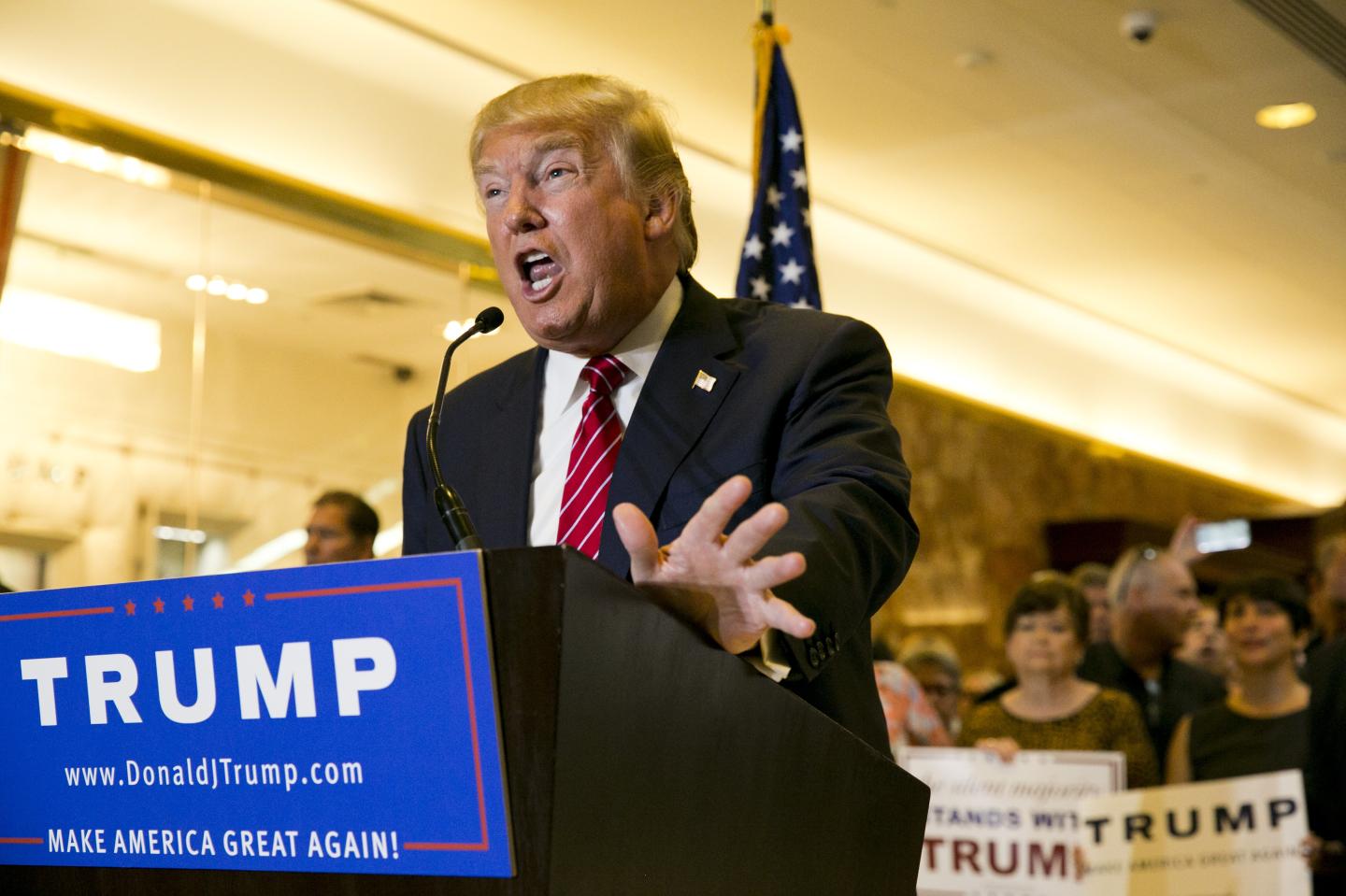
Republican presidential hopeful Donald Trump announces his tax plan during a press conference at Trump Tower in New York on September 28, 2015. AFP PHOTO/DOMINICK REUTER (Photo credit should read DOMINICK REUTER/AFP/Getty Images)Photograph by Dominick Reuter — AFP/Getty Images

As voters in Idaho, Michigan, Mississippi and Hawaii head to the polls on Tuesday for the GOP primary, they should take a closer look at the frontrunner’s tax plan and what that could mean for their wallets.

Donald Trump’s plan would sharply reduce the top tax rate on individual income from 39.6% to 25% and broadly reduce rates for individuals with lower incomes. His plan would also lower the tax rate on corporate income from 35% to 15%, and apply this 15% to other “business income.”

While his plan limits certain tax preferences and deductions, it does not include any reductions in federal spending. As a result, the Trump plan increases the federal deficit over the next decade by $10 trillion or $12 trillion, according to several estimates that do not include macroeconomic changes in GDP, investment and employment. Of course, these so-called “static” estimates do not reflect the potential tax revenue from the economic growth resulting from lower tax rates. However, even under “dynamic” scoring, which takes into account a broad range of macroeconomic effects of tax proposals, his tax cuts would still expand the federal deficit over the next decade by $10 trillion — on top of the $10 trillion increase in the federal deficit already projected under current law.

Let’s consider two prominent analyses of the Trump tax plan — one by the Tax Foundation and the other by the Tax Policy Center. Despite their different methodologies, they both estimate that the Trump plan would cut tax revenues by over $10 trillion in the next decade.

Starting with a “static” analysis, the Foundation estimates that the Trump plan would cut tax revenues by $12 trillion. Then, using “dynamic” scoring, the Foundation says that the lower tax rates will generate higher GDP growth and more jobs. Nevertheless, the Foundation still concludes that the Trump tax plan will reduce tax revenues by $10.18 trillion over the next decade.

Most importantly, the Foundation’s prediction of more economic growth is based on a dubious assumption about the Trump plan —”provided that the tax cut could be appropriately financed. ” In other words, the Foundation assumes that Trump’s plan would offset its huge tax cuts by similar reductions in federal spending. Yet, Trump’s plan contains no such spending reductions.

By contrast, the Center uses a model that allows for individual behavior responses but not macroeconomic effects, such as GDP and employment growth. The Center initially estimates that the Trump plan would decrease tax revenues by $9.5 trillion over 10 years. The Center then increases this estimate to $11.2 trillion to reflect the incremental interest that the US Treasury would pay on the additional $9.5 trillion in national debt — since the Trump plan has no cuts in federal spending.

Could Trump find $9.5 trillion in spending cuts to finance his tax cuts?
He seems to oppose lower benefits for Medicare and Social Security. If entitlement cuts are out of bounds, then he would need to slash all discretionary federal spending by 80%. This means debilitating cuts in defense budgets and key domestic programs like education and research.

Although the Center does not do a “dynamic scoring” of Trump’s plan, the Center recognizes the potential economic growth resulting from the lower tax rates in the plan. Nevertheless, the Center explains that unless Trump’s enormous tax cuts are offset with very large spending cuts, “they’d increase the national debt and drive up interest rates, thus neutralizing their economic benefits.” The Center’s concerns about the impact of budget deficits on the national debt are echoed by the Congressional Budget Office (CBO). In a recent report based on current law, the CBO estimates that the cumulative deficit would be $9.4 trillion between 2017 and 2026.

This would bring the total national debt to approximately $30 trillion — without the tax cuts in the Trump plan. A high and rising national debt would raise the interest rates on US Treasuries, which would in turn decrease savings and increase borrowing costs in the private sector. Both would lower economic growth in normal times. Moreover, the CBO worries about the risk of another financial crisis — where “investors would become unwilling to finance the government’s borrowing needs unless they were compensated with very high interest rates.”

So even though interest rates are super low today, we should all share CBO’s concerns about our fast-growing national debt over the next decade. We cannot afford an additional $10 trillion in national debt from tax cuts without a related proposal to constrain federal spending. We need a more balanced package of lower tax rates, fewer tax preferences and appropriate spending limits.

Robert C. Pozen is a Senior Lecturer at the MIT Sloan School and Chair of the Advisory Board of the Urban-Brookings Tax Policy Center.

About the Author
By Robert Pozen
See full bioRight Arrow Button Icon

Latest in Commentary

Finance
Lorem ipsum dolor sit amet, consectetur adipiscing elit, sed do eiusmod tempor incididunt ut labore et dolore magna aliqua. Ut enim ad minim veniam
By Fortune Editors
October 20, 2025
Finance
Lorem ipsum dolor sit amet, consectetur adipiscing elit, sed do eiusmod tempor incididunt ut labore et dolore magna aliqua. Ut enim ad minim veniam
By Fortune Editors
October 20, 2025
Finance
Lorem ipsum dolor sit amet, consectetur adipiscing elit, sed do eiusmod tempor incididunt ut labore et dolore magna aliqua. Ut enim ad minim veniam
By Fortune Editors
October 20, 2025
Finance
Lorem ipsum dolor sit amet, consectetur adipiscing elit, sed do eiusmod tempor incididunt ut labore et dolore magna aliqua. Ut enim ad minim veniam
By Fortune Editors
October 20, 2025
Finance
Lorem ipsum dolor sit amet, consectetur adipiscing elit, sed do eiusmod tempor incididunt ut labore et dolore magna aliqua. Ut enim ad minim veniam
By Fortune Editors
October 20, 2025
Finance
Lorem ipsum dolor sit amet, consectetur adipiscing elit, sed do eiusmod tempor incididunt ut labore et dolore magna aliqua. Ut enim ad minim veniam
By Fortune Editors
October 20, 2025

Most Popular

Finance
Lorem ipsum dolor sit amet, consectetur adipiscing elit, sed do eiusmod tempor incididunt ut labore et dolore magna aliqua. Ut enim ad minim veniam
By Fortune Editors
October 20, 2025
Finance
Lorem ipsum dolor sit amet, consectetur adipiscing elit, sed do eiusmod tempor incididunt ut labore et dolore magna aliqua. Ut enim ad minim veniam
By Fortune Editors
October 20, 2025
Finance
Lorem ipsum dolor sit amet, consectetur adipiscing elit, sed do eiusmod tempor incididunt ut labore et dolore magna aliqua. Ut enim ad minim veniam
By Fortune Editors
October 20, 2025
Finance
Lorem ipsum dolor sit amet, consectetur adipiscing elit, sed do eiusmod tempor incididunt ut labore et dolore magna aliqua. Ut enim ad minim veniam
By Fortune Editors
October 20, 2025
Finance
Lorem ipsum dolor sit amet, consectetur adipiscing elit, sed do eiusmod tempor incididunt ut labore et dolore magna aliqua. Ut enim ad minim veniam
By Fortune Editors
October 20, 2025
Finance
Lorem ipsum dolor sit amet, consectetur adipiscing elit, sed do eiusmod tempor incididunt ut labore et dolore magna aliqua. Ut enim ad minim veniam
By Fortune Editors
October 20, 2025
Fortune Secondary Logo
Rankings
  • 100 Best Companies
  • Fortune 500
  • Global 500
  • Fortune 500 Europe
  • Most Powerful Women
  • Future 50
  • World’s Most Admired Companies
  • See All Rankings
Sections
  • Finance
  • Fortune Crypto
  • Features
  • Leadership
  • Health
  • Commentary
  • Success
  • Retail
  • Mpw
  • Tech
  • Lifestyle
  • CEO Initiative
  • Asia
  • Politics
  • Conferences
  • Europe
  • Newsletters
  • Personal Finance
  • Environment
  • Magazine
  • Education
Customer Support
  • Frequently Asked Questions
  • Customer Service Portal
  • Privacy Policy
  • Terms Of Use
  • Single Issues For Purchase
  • International Print
Commercial Services
  • Advertising
  • Fortune Brand Studio
  • Fortune Analytics
  • Fortune Conferences
  • Business Development
About Us
  • About Us
  • Editorial Calendar
  • Press Center
  • Work At Fortune
  • Diversity And Inclusion
  • Terms And Conditions
  • Site Map
Fortune Secondary Logo
  • About Us
  • Editorial Calendar
  • Press Center
  • Work At Fortune
  • Diversity And Inclusion
  • Terms And Conditions
  • Site Map
  • Facebook icon
  • Twitter icon
  • LinkedIn icon
  • Instagram icon
  • Pinterest icon

Latest in Commentary

taylor
CommentaryMarketing
How fandom became culture’s power center — and a blueprint for Gen Z’s economic influence
By Reid LitmanFebruary 21, 2026
9 hours ago
igor
CommentaryMarkets
If the recent AI and crypto shocks upset you, you’re tracking the wrong cycle
By Igor PejicFebruary 21, 2026
11 hours ago
ceos
CommentaryTariffs and trade
We heard CEOs rip into Trump’s tariffs behind the scenes and the Supreme Court just vindicated them
By Jeffrey Sonnenfeld, Steven Tian and Stephen HenriquesFebruary 20, 2026
23 hours ago
AI
CommentaryCareers
Something big is happening in AI, but that’s the only thing Matt Shumer got right
By Neil Chilson and Kevin FrazierFebruary 20, 2026
1 day ago
wealth
CommentaryMillionaires
Are you a ‘hidden millionaire?’
By Joanna RotenbergFebruary 20, 2026
1 day ago
laid off
CommentaryJobs
The billion-dollar justification: why AI giants need you to fear for your job
By David StoutFebruary 19, 2026
2 days ago

Most Popular

placeholder alt text
Economy
Fed confirms it obeyed U.S. Treasury request for an unusual ‘rate check,’ weakening the dollar against foreign currencies
By Jim EdwardsFebruary 19, 2026
2 days ago
placeholder alt text
Innovation
The U.S. spent $30 billion to ditch textbooks for laptops and tablets: The result is the first generation less cognitively capable than their parents
By Sasha RogelbergFebruary 21, 2026
11 hours ago
placeholder alt text
Big Tech
Peter Thiel and other tech billionaires are publicly shielding their children from the products that made them rich
By Marco Quiroz-GutierrezFebruary 21, 2026
10 hours ago
placeholder alt text
AI
‘I’m deeply uncomfortable’: Anthropic CEO warns that a cadre of AI leaders, including himself, should not be in charge of the technology’s future
By Sasha RogelbergFebruary 19, 2026
2 days ago
placeholder alt text
Arts & Entertainment
Gen Zers and millennials flock to so-called analog islands 'because so little of their life feels tangible'
By Michael Liedtke and The Associated PressFebruary 20, 2026
1 day ago
placeholder alt text
AI
Sam Altman says the quiet part out loud, confirming some companies are ‘AI washing’ by blaming unrelated layoffs on the technology
By Sasha RogelbergFebruary 19, 2026
2 days ago

© 2026 Fortune Media IP Limited. All Rights Reserved. Use of this site constitutes acceptance of our Terms of Use and Privacy Policy | CA Notice at Collection and Privacy Notice | Do Not Sell/Share My Personal Information
FORTUNE is a trademark of Fortune Media IP Limited, registered in the U.S. and other countries. FORTUNE may receive compensation for some links to products and services on this website. Offers may be subject to change without notice.