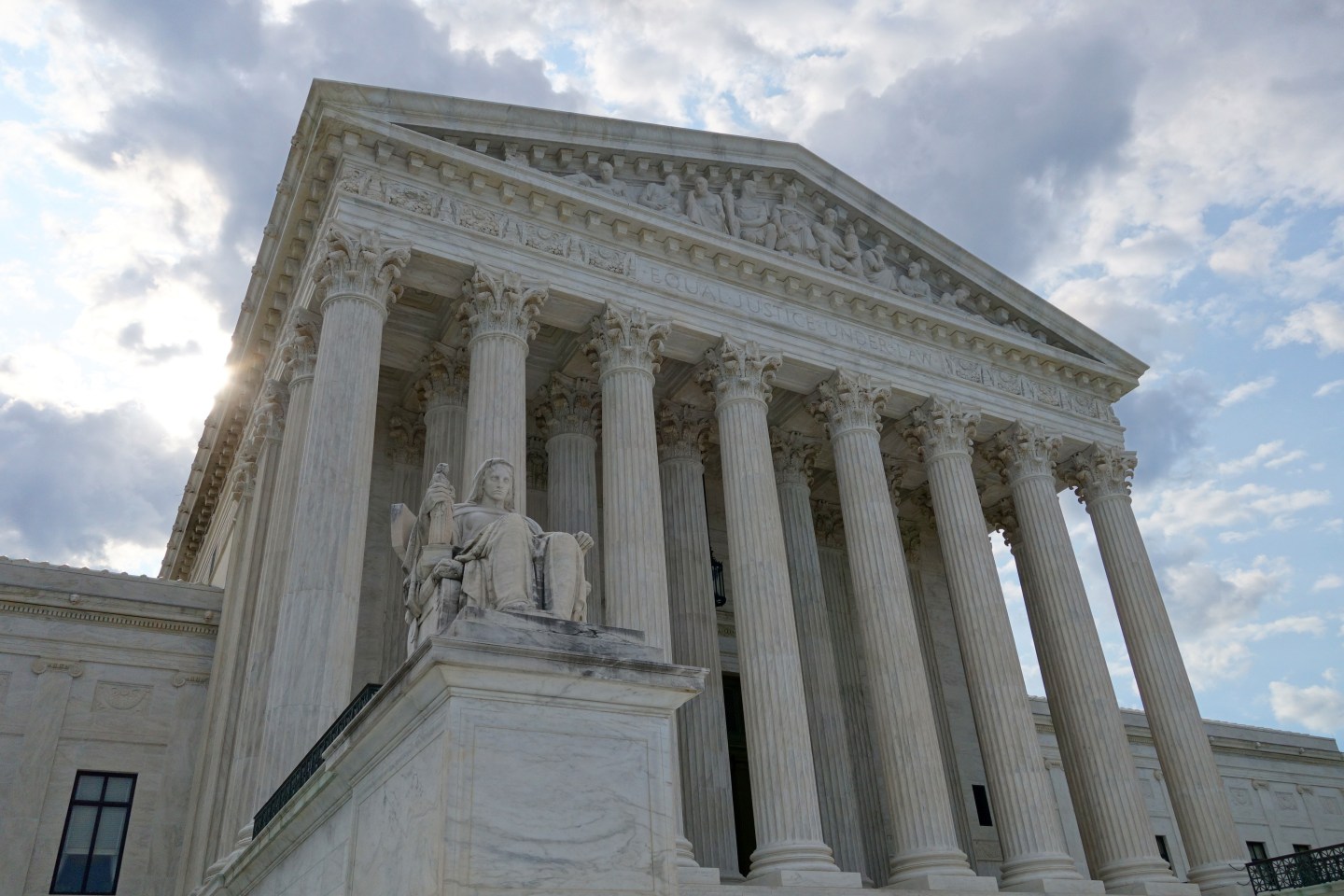
For the third time in 12 years, several dozen Fortune 500 companies, this time including Apple (AAPL), Microsoft (MSFT), and Procter & Gamble (PG), are asking the Supreme Court to preserve universities’ right to use affirmative action in their admissions.
Though the companies’ own affirmative action policies are not directly implicated in the case being argued Wednesday before the Court—which reviews how the University of Texas at Austin selects its freshman class—about 50 prominent businesses have argued in two amicus briefs that they won’t be able to get the diverse workforces they need unless colleges, business schools, and engineering institutions can take race into account to achieve diversity goals.
“[The companies] have found through practical experience that a workforce trained in a diverse environment is critical to their business success,” according to a brief for a list of corporations including Cisco (CSCO), General Electric (GE), and Wal-Mart (WMT). (The lead attorneys on that brief were David DeBruin and Matt Hellman of Jenner & Block.)
“Employers can only hire people … who have been admitted to, and succeeded in pursuing, the essential educational prerequisites,” argue DuPont (DD), IBM (IBM), and Intel (INTC) in a separate brief. “Any decision by this Court which would foreclose university admissions officers from thinking about race (and gender) and the urgent need to correct our historic underutilization, would deal a serious blow to [the signatory] businesses and their efforts to remedy this critical problem.” (The lead attorney on the DuPont brief was Donald Ayer of Jones Day.)
The plaintiff in the case is Abigail Noel Fisher of Sugar Land, Texas, a white woman who was denied admission to the University of Texas in 2008. She claims that she would have been accepted if not for the school’s affirmative action program, and that the college therefore unconstitutionally discriminated against her because of her race.
Though amicus briefs from Fortune 500 corporations championing diversity might strike skeptics as a public relations stunt—Wal-Mart and other signatories have certainly faced their share of race and gender discrimination suits over the years—Justice Sandra Day O’Connor cited and relied upon a very similar such brief (as well as another on behalf of military officers) in writing a key 2003 precedent, Grutter v. Bollinger, which involved the University of Michigan Law School. She found that the views expressed by such pillars of contemporary American society helped establish that the university had a “compelling interest” in taking race into account—a prerequisite to justifying race-conscious decision-making by state officials.
Grutter was decided by a 5-4 margin, however, and in light of personnel changes on the court since then, its survival is precarious.
The University of Texas has an unusual admissions system, which might limit the breadth of any ruling that comes out of the case. In 1996 the U.S. Court of Appeals for the Fifth Circuit struck down an affirmative action program the University of Texas was using at that time. In response, and in an effort to guarantee some measure of diversity at the school, the Texas legislature passed a law establishing that all state high school students finishing in the top ten percent of their class would automatically be entitled to admission. (Due to the remnants of housing segregation and countless other factors, many public high schools have overwhelmingly minority populations.)
Then, after the Grutter decision in 2003, the university revisited its admissions policies. It continued to follow the 10-percent law, but it also permitted itself to look at students “holistically,” taking race into account in an effort to achieve a diverse student body.
Fisher claims this “holistic” approach discriminated against her and, further, that it was unnecessary, given that the 10-percent law already guaranteed some measure of diversity.
The lower federal courts ruled against Fisher. Two years ago, the Supreme Court heard Fisher’s case for the first time. On that occasion it ruled very narrowly and sent the case back to the Fifth Circuit for further consideration.
The appellate court ruled against Fisher again. The Supreme Court then agreed to hear her case again—resulting in Wednesday’s arguments.
Justice Anthony Kennedy is expected to be the decisive vote in the case, as he so often is in politically sensitive cases. It is widely assumed that the other four justices of the Court’s conservative wing consider affirmative action to be categorically unconstitutional. (In a 2007 ruling rejecting race-conscious school desegregation measures voluntarily adopted by a Seattle school district, Chief Justice John Roberts, Jr., famously wrote, “The way to stop discrimination on the basis of race is to stop discriminating on the basis of race.)
But even if Kennedy votes with the more liberal wing of the Court, it will likely result in only a 4-4 tie, because Justice Elena Kagan has recused herself from the case—as she did two years ago. (She had some involvement with it when she was Solicitor General.) Though a 4-4 tie would affirm the Fifth Circuit ruling—i.e., the university would win—no opinion would be written, and the result would have no precedential weight.)
If Kennedy votes with the conservative faction, on the other hand—resulting in a 5-3 ruling—it will clearly become more difficult for state universities to continue to employ affirmative action programs and, depending on how broadly the court rules, such programs could conceivably be banned altogether. A ruling is expected some time before the term ends in late June.
Though the outcome will directly affect only public educational institutions, a broad condemnation of affirmative action here would also likely impact private universities. That’s because most of the latter receive federal funds, making them subject to the anti-discrimination provisions of Title VI of the Civil Rights Act.
Here is an alphabetical list of the companies that have signed an amicus brief supporting the University of Texas in the case:
3M Company
Aetna
American Express Co.
Apple
ArcelorMittal USA
Ariel Investments
Caterpillar
CBS Corp.
Cisco Systems
Cummins
Deloitte
DuPont
Eastman Kodak Company
eBay
Entergy Corp.
Exelon Corp.
Gap
General Electric Co.
IBM
Illinois Tool Works
Intel
Johnson & Johnson
Johnson Controls
Kaiser Foundation Hospitals
Marriott International
Merck & Co.
Microsoft Corporation
Northern Trust Corp.
Northrop Grumman Corp.
PayPal Holdings
PepsiCo
Pfizer
Prudential Financial
Seton Family of Hospitals
Shell Oil Co.
Sprint Corp.
Starbucks Corp.
State Street Corp.
Steelcase
Takeda Pharmaceuticals U.S.A.
The Procter & Gamble Co.
Union Pacific Railroad Co.
United Airlines
United Technologies Corp.
Viacom
Wal-Mart
W.W. Grainger, Inc.
Xerox Corp.