• Home
  • Latest
  • Fortune 500
  • Finance
  • Tech
  • Leadership
  • Lifestyle
  • Rankings
  • Multimedia
Commentary

How America’s Response to Syrian and Jewish Refugees Is Eerily Similar

By
Peter A. Shulman
Peter A. Shulman
Down Arrow Button Icon
By
Peter A. Shulman
Peter A. Shulman
Down Arrow Button Icon
November 21, 2015, 9:03 AM ET
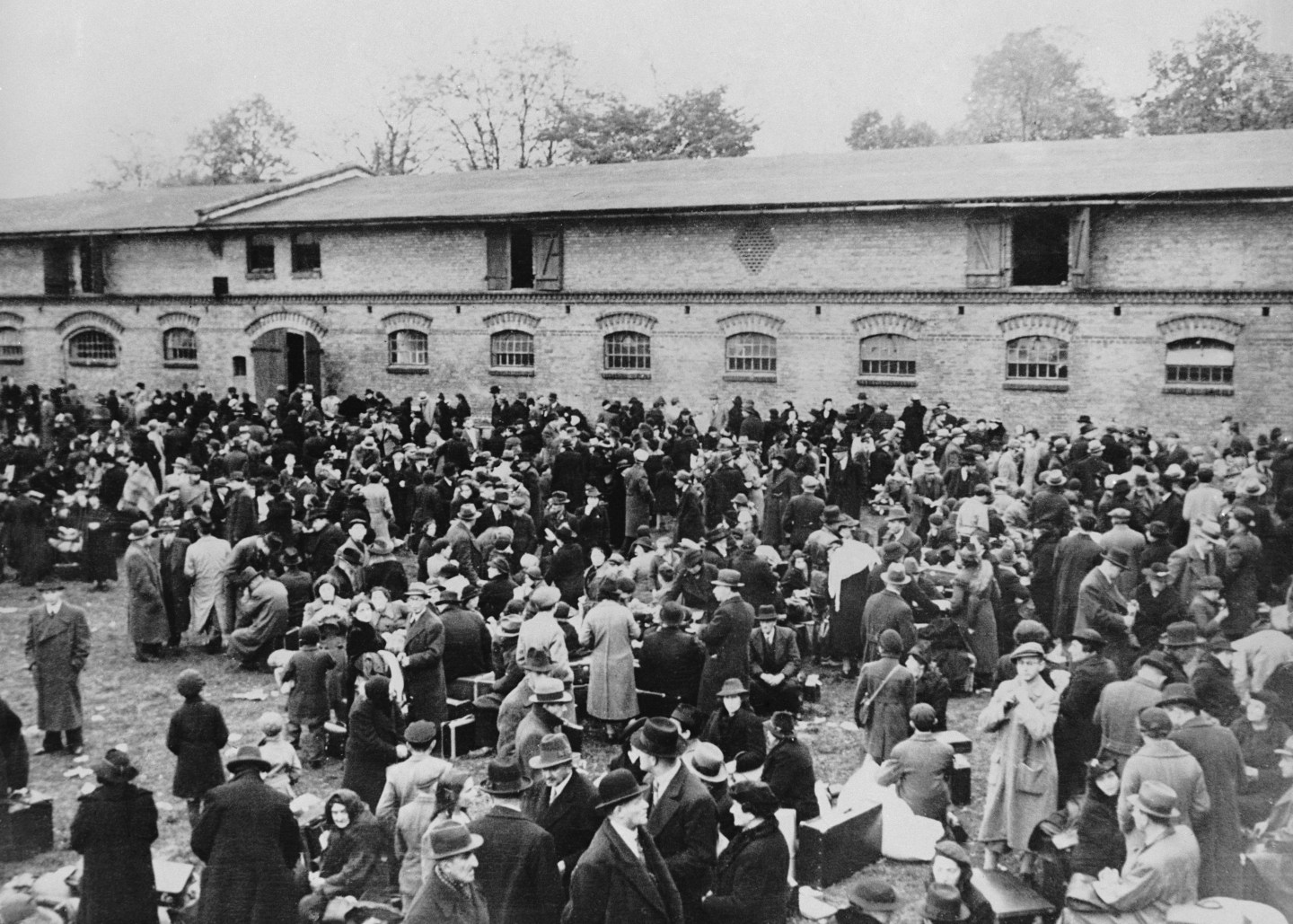
Caption:A group of 7,000 Jewish people expelled from Germany by the German Nazi authorities and living in Zbaszyn on the Polish-German border, 3rd November 1938. More than a thousand are staying in a stable and others are in huts provided by the authorities. The German action is in response to the Polish government�s removal of the Polish citizenship of Jews living outside the country. A total of 17,000 German Jews were expelled from Germany over this issue. (Photo by Keystone/Hulton Archive/Getty Images)
Caption:A group of 7,000 Jewish people expelled from Germany by the German Nazi authorities and living in Zbaszyn on the Polish-German border, 3rd November 1938. More than a thousand are staying in a stable and others are in huts provided by the authorities. The German action is in response to the Polish government�s removal of the Polish citizenship of Jews living outside the country. A total of 17,000 German Jews were expelled from Germany over this issue. (Photo by Keystone/Hulton Archive/Getty Images) Photograph by by Keystone/Hulton Archive/Getty Images

Following last Friday’s terror attacks in Paris, Republican presidential candidates began criticizing America’s ongoing efforts to resettle Syrian and Iraqi refugees. Jeb Bush and Ted Cruz suggested admitting only Christians. A dozen others gave reasons to block refugee resettlement altogether. On Monday, a flood of governors began announcing their intentions to block refugees from entering their states and by Thursday, the House of Representatives had effectively voted to freeze admissions of new refugees. If adopted into law, the already small trickle of Iraqi and Syrian refugees reaching America—already subjected to painstaking screenings taking as long as two years—could dwindle to nearly nothing.

The events of this week seem eerily familiar to an earlier episode of American refugee history: the refusal to admit most Jewish refugees fleeing Nazi-controlled Europe on the eve of World War II.

After Hitler’s seizure of power in 1933, many Jews had attempted to leave Germany. Those seeking haven in the United States, however, encountered strict immigration restrictions put in place in the early 1920s during a panic about the changing ethnic makeup of the country. Yet as life for European Jews continued to deteriorate, few Americans wished to relax their immigration quotas. In fact, by the late 1930s, scrutiny of immigrants had grown so great that these limited quotas actually remained unfilled. In the spring of 1939, a bill to admit 20,000 Jewish refugee children fell apart without even a vote.

Opposition to Jewish refugees was not simply timeless bigotry. With today’s talk of “Judeo-Christian” values, it is easy to forget the genuine alienness and threat to national security these refugees represented. In the pages of Fortune magazine, pioneering pollster Elmo Roper brought these fears to light.

In part, the perceived security threat was social and economic. In July, 1939, a Roper poll (click here to download) probed “general opinion on the Jewish question.” Over half the respondents believed Jews were different from other Americans. Ten percent accepted Jews in American life so long as they “don’t try to mingle socially where they are not wanted.” Nearly a third pointed to Jews’ “different business methods” and asked that “some measures be taken to prevent Jews from getting too much power in the business world.” Another ten percent supported “a policy to deport Jews from this country to some new homeland as fast as it can be done without inhumanity.”

Behind these numbers lay a toxic fear of Jewish subversion. For decades, Jews had been linked to various strains of un-American threats: socialism, communism, and anarchism, of course, but also (paradoxically) a kind of hyper-capitalism. Many believed that the real threat to the United States lay not from abroad, but within. During Franklin Roosevelt’s administration, Jews held so many influential positions that New Deal opponents spoke of the “Jew Deal.”

Jewish power was money power. When Fortune asked Americans in April, 1939, for reasons behind anti-Semitism, responses included an inventory of stereotypes: “Jews control and monopolize enterprize,” they were “unfair and dishonest in business,” they were “too grasping, covetous, avaricious, cheap”—and on and on.

Asked in a Gallup poll in April, 1938 whether “the persecution of the Jews in Europe has been their own fault,” a full 48% of Americans answered “partly.” Another 10% said “entirely.”

Meanwhile, mainstream Christian publications called for Jewish conversion. For many, Jews, clannish and untrustworthy, could never become fully American. “The simple and naked fact is that Judaism rests upon an impossible basis,” observed an editorial in The Christian Century, a mainstream periodical. “It is trying to pluck the fruits of democracy without yielding itself to the processes of democracy.”

Jewish refugees also were seen as presenting threats to physical security. State department officials worried that Nazi saboteurs might disguise themselves among the refugee throngs. Or perhaps Nazis might extort refugees, under threat to family remaining in Germany, to spy for the Reich. Franklin Roosevelt himself exclaimed that “it is rather a horrible story but in some of the other countries that refugees out of Germany have gone to, especially Jewish refugees, they have found a number of definitely proven spies.”

Unquestionably, the two situations have their differences. Yet perhaps the biggest difference is simply that most Jews seeking safety from Nazis could not escape, while today, it is not too late to help those most desperate for security.

In light of his survey’s findings, Roper appealed to America’s better angels. “Are we humanitarians to the point of giving asylum to the oppressed in the old U.S. tradition that prevailed before the present immigration laws?” Let us hope that today, unlike in the 1930s, we can answer this question with a resounding “yes.”

Peter A. Shulman is an associate professor of history at Case Western Reserve University where his research focuses on 19th and 20th century American history. His recent book, Coal and Empire: The Birth of Energy Security in Industrial America, explores how Americans came to think about energy in terms of national security in the 19th century around coal and his next project will explore the history of ideas about intelligence in America. He can reached at Twitter @pashulman.




About the Author
By Peter A. Shulman
See full bioRight Arrow Button Icon
0

Most Popular

Finance
Lorem ipsum dolor sit amet, consectetur adipiscing elit, sed do eiusmod tempor incididunt ut labore et dolore magna aliqua. Ut enim ad minim veniam
By Fortune Editors
October 20, 2025
Finance
Lorem ipsum dolor sit amet, consectetur adipiscing elit, sed do eiusmod tempor incididunt ut labore et dolore magna aliqua. Ut enim ad minim veniam
By Fortune Editors
October 20, 2025
Finance
Lorem ipsum dolor sit amet, consectetur adipiscing elit, sed do eiusmod tempor incididunt ut labore et dolore magna aliqua. Ut enim ad minim veniam
By Fortune Editors
October 20, 2025
Finance
Lorem ipsum dolor sit amet, consectetur adipiscing elit, sed do eiusmod tempor incididunt ut labore et dolore magna aliqua. Ut enim ad minim veniam
By Fortune Editors
October 20, 2025
Finance
Lorem ipsum dolor sit amet, consectetur adipiscing elit, sed do eiusmod tempor incididunt ut labore et dolore magna aliqua. Ut enim ad minim veniam
By Fortune Editors
October 20, 2025
Finance
Lorem ipsum dolor sit amet, consectetur adipiscing elit, sed do eiusmod tempor incididunt ut labore et dolore magna aliqua. Ut enim ad minim veniam
By Fortune Editors
October 20, 2025
Fortune Secondary Logo
Rankings
  • 100 Best Companies
  • Fortune 500
  • Global 500
  • Fortune 500 Europe
  • Most Powerful Women
  • Future 50
  • World’s Most Admired Companies
  • See All Rankings
Sections
  • Finance
  • Fortune Crypto
  • Features
  • Leadership
  • Health
  • Commentary
  • Success
  • Retail
  • Mpw
  • Tech
  • Lifestyle
  • CEO Initiative
  • Asia
  • Politics
  • Conferences
  • Europe
  • Newsletters
  • Personal Finance
  • Environment
  • Magazine
  • Education
Customer Support
  • Frequently Asked Questions
  • Customer Service Portal
  • Privacy Policy
  • Terms Of Use
  • Single Issues For Purchase
  • International Print
Commercial Services
  • Advertising
  • Fortune Brand Studio
  • Fortune Analytics
  • Fortune Conferences
  • Business Development
  • Group Subscriptions
About Us
  • About Us
  • Editorial Calendar
  • Press Center
  • Work At Fortune
  • Diversity And Inclusion
  • Terms And Conditions
  • Site Map
Fortune Secondary Logo
  • About Us
  • Editorial Calendar
  • Press Center
  • Work At Fortune
  • Diversity And Inclusion
  • Terms And Conditions
  • Site Map
  • Facebook icon
  • Twitter icon
  • LinkedIn icon
  • Instagram icon
  • Pinterest icon

Most Popular

placeholder alt text
Health
Palantir and other tech companies are stocking offices with nicotine products to increase worker productivity
By Catherina GioinoMarch 4, 2026
1 day ago
placeholder alt text
Success
Uber CEO says his ‘really demanding’ work culture includes expecting employees to answer his emails over the weekend: ‘Don’t come here if you want to coast’
By Emma BurleighMarch 4, 2026
1 day ago
placeholder alt text
Real Estate
Meet a burned out 28-year-old who pays $168 a month in China's faux Venice to retire early from her Shanghai finance gig
By Albee Zhang and The Associated PressMarch 2, 2026
3 days ago
placeholder alt text
Success
Tech investor Bill Gurley says workers who went through the ‘college conveyor belt’ and chased safe jobs are at high risk of AI automation
By Emma BurleighMarch 3, 2026
2 days ago
placeholder alt text
Newsletters
The Iran war is giving rise to a centuries-old economic theory—and laying waste to the WTO-based world order
By Diane BradyMarch 5, 2026
10 hours ago
placeholder alt text
Middle East
Despite a $200 billion price tag, Trump admits the Iran war could just swap one bad leader for another
By Tristan BoveMarch 4, 2026
1 day ago

© 2026 Fortune Media IP Limited. All Rights Reserved. Use of this site constitutes acceptance of our Terms of Use and Privacy Policy | CA Notice at Collection and Privacy Notice | Do Not Sell/Share My Personal Information
FORTUNE is a trademark of Fortune Media IP Limited, registered in the U.S. and other countries. FORTUNE may receive compensation for some links to products and services on this website. Offers may be subject to change without notice.