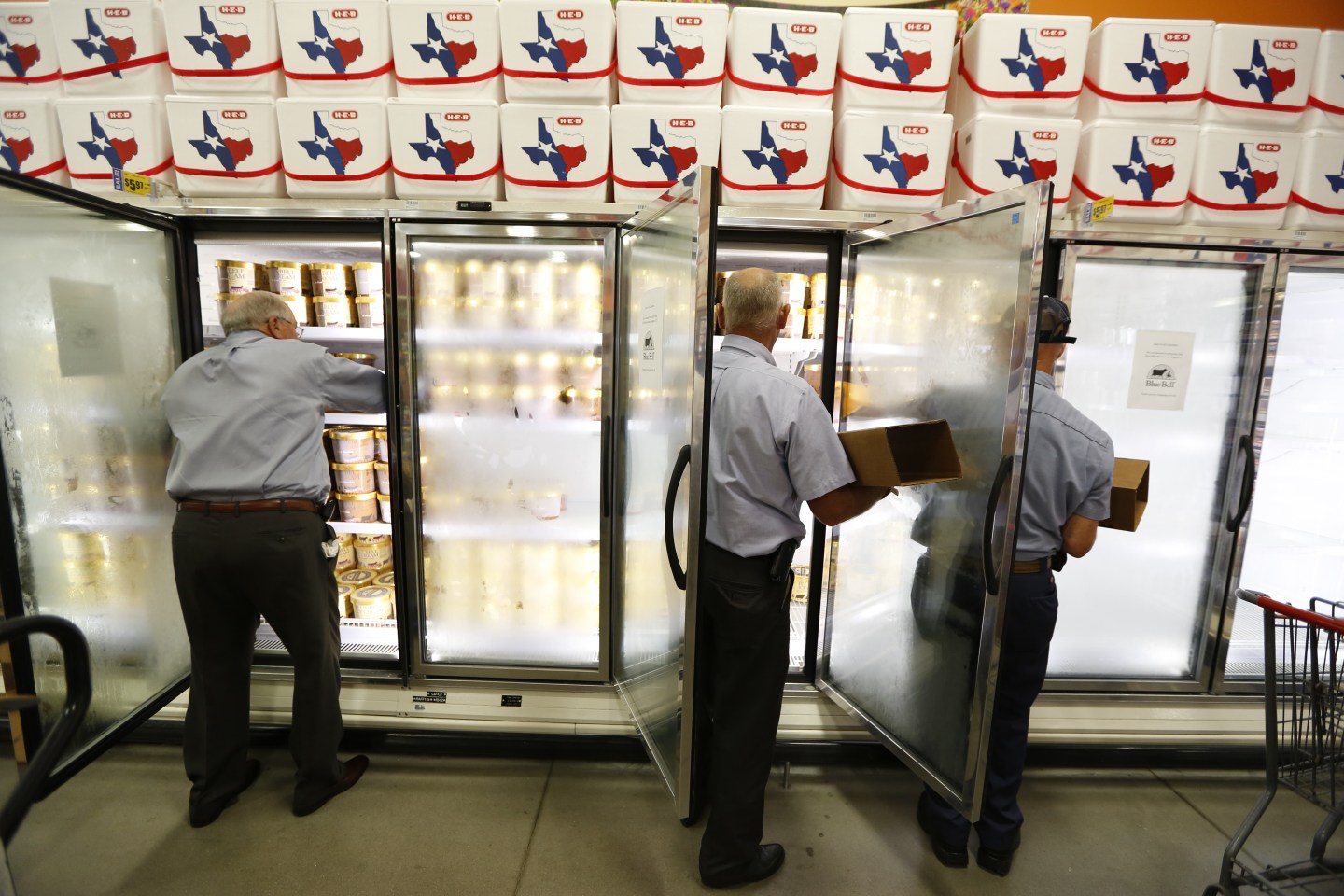
The tale of deadly, unsanitary conditions at Blue Bell ice cream’s manufacturing plants—the subject of a Fortune report last month—just keeps getting uglier.
In a series of reports that began airing last night, CBS News interviewed two laid-off workers who described antiquated machinery run amuck, oil dripping into the food mix, and melted ice cream left pooling on the factory floor because supervisors didn’t want to slow production.
The Centers for Disease Control and Prevention earlier this year linked Blue Bell desserts to 10 listeria infections, including three deaths in Kansas. The outbreak eventually forced the company, which responded to the problem slowly, to shut down production in April and recall all its products—eight million gallons of ice cream—from 23 states. Government inspection reports later confirmed that Blue Bell’s plants had an array of sanitary problems dating back for years.
Citing pending litigation, Blue Bell declined CBS requests for comment on this week’s reporting. It provided the following statement to Fortune: “While we do not usually comment on matters involving current or former company employees, the isolated views expressed by two former Blue Bell employees on CBS News do not reflect the experience of the vast majority of our employees, who know we take the cleanliness of our facilities and the quality of our products very seriously. Over the years, we have welcomed an average of 200,000 visitors a year to tour our Brenham plant and see our operation for themselves…. Our top priority and commitment is to produce high quality, safe, delicious ice cream for our customers.” After instituting new practices—which include extensive testing of product before its release for sale—Blue Bell resumed production at its Oklahoma and Alabama plants, and began returning to store shelves in a handful of markets on Aug. 31.
But its flagship plant in Brenham, Texas, site of the private company’s corporate headquarters, remains idle. And that’s where the two former employees that CBS interviewed worked until May, when they were among 1450 workers Blue Bell laid off after halting production.
Terry Schultz, employed for seven months in Brenham, told CBS he worked on one of the machines directly implicated in the listeria outbreak. “A lot of time, I walked in there, and there was just ice cream all over the floor,” Schultz said. “Sometimes these machines, they would just go haywire, and it would just, the product would just continually run through the conveyor belt, and it would just drop right onto the floor.”
Although moisture provides a receptive environment for bacteria, Schultz said supervisors left it pooling on the factory floor, rather than slow production to clean up. He says that when he complained, one supervisor replied: “Is that all you’re going to do is come in here and bitch every afternoon?” His conclusion: “Production was probably more important than cleanliness.”
Sold only in Texas until 1989, Blue Bell had expanded aggressively in recent years, becoming the nation’s third-largest ice cream brand.
The second worker, Gerald Bland, said he worked for five years at Blue Bell, where he operated a fruit feeder. He told CBS he was instructed to pour ice cream and fruit juice dripping off the machine throughout the day into barrels of ice cream mix. In addition, according to Bland, “You’d see oil on top from the fruit feeder leaking that would still go right into the barrel.” He says that practice stopped about a year before the plant’s shutdown.
In the CBS interviews, the men also described dripping water and condensation throughout the plant (“The whole place would fog up to the point where you couldn’t see anything in that place,” says Schultz) and re-use of damp, dirty cardboard packing sleeves—all fertile environments for bacteria growth.
The CBS report follows an earlier, similar account of unsanitary conditions in the Brenham plant from 14 former employees, published last month in the Houston Chronicle. In interviews, workers described a shortage of water pressure and hot water, making it impossible to properly clean and sanitize production equipment; dirty product packaging; condensation dripping from air vents onto popsicles; and improper worker-safety equipment and procedures. (One employee lost parts of three fingers.)
In an Oct. 1 statement posted on its website, Blue Bell—now sold only in South Texas and part of Alabama—announced it would begin phase two of its five-step “market re-entry plan” on Nov. 2, expanding distribution to Dallas-Fort Worth, Waco, and parts of Oklahoma. It quoted Ricky Dickson, vice president for sales and marketing, saying that “tremendous consumer response and support” had slowed Blue Bell’s ability to expand sales faster and further.
Stated Dickson: “We are working as hard as we can to keep stores in phase one stocked without jeopardizing the new quality and safety procedures we have implanted to ensure our products are safe and of the highest quality.”
Update: This article has been updated to include a statement given to Fortune by Blue Bell.