• Home
  • Latest
  • Fortune 500
  • Finance
  • Tech
  • Leadership
  • Lifestyle
  • Rankings
  • Multimedia

Trendingnow

1

The millennial generation has split, new Fed research shows: Those over 35 are edging toward boomer-style wealth, while everyone else falls behind

2

Mark Cuban says he has the solution to growing income inequality, and it's to reward every employee—from CEO to janitor—with company stock

3

Scott Bessent casually says the U.S. has more than $1 trillion in gold—and that it doesn’t matter for the dollar

1

The millennial generation has split, new Fed research shows: Those over 35 are edging toward boomer-style wealth, while everyone else falls behind

2

Mark Cuban says he has the solution to growing income inequality, and it's to reward every employee—from CEO to janitor—with company stock

3

Scott Bessent casually says the U.S. has more than $1 trillion in gold—and that it doesn’t matter for the dollar
CommentaryTrans-Pacific Parternship

Leaving China out of the TPP is a terrible mistake

By
Felipe Caro
Felipe Caro
,
Christopher S. Tang
Christopher S. Tang
, and
Bethany Cianciolo
Bethany Cianciolo
Down Arrow Button Icon
By
Felipe Caro
Felipe Caro
,
Christopher S. Tang
Christopher S. Tang
, and
Bethany Cianciolo
Bethany Cianciolo
Down Arrow Button Icon
October 6, 2015, 4:33 PM ET
U.S.-led Pacific free trade deal concluded
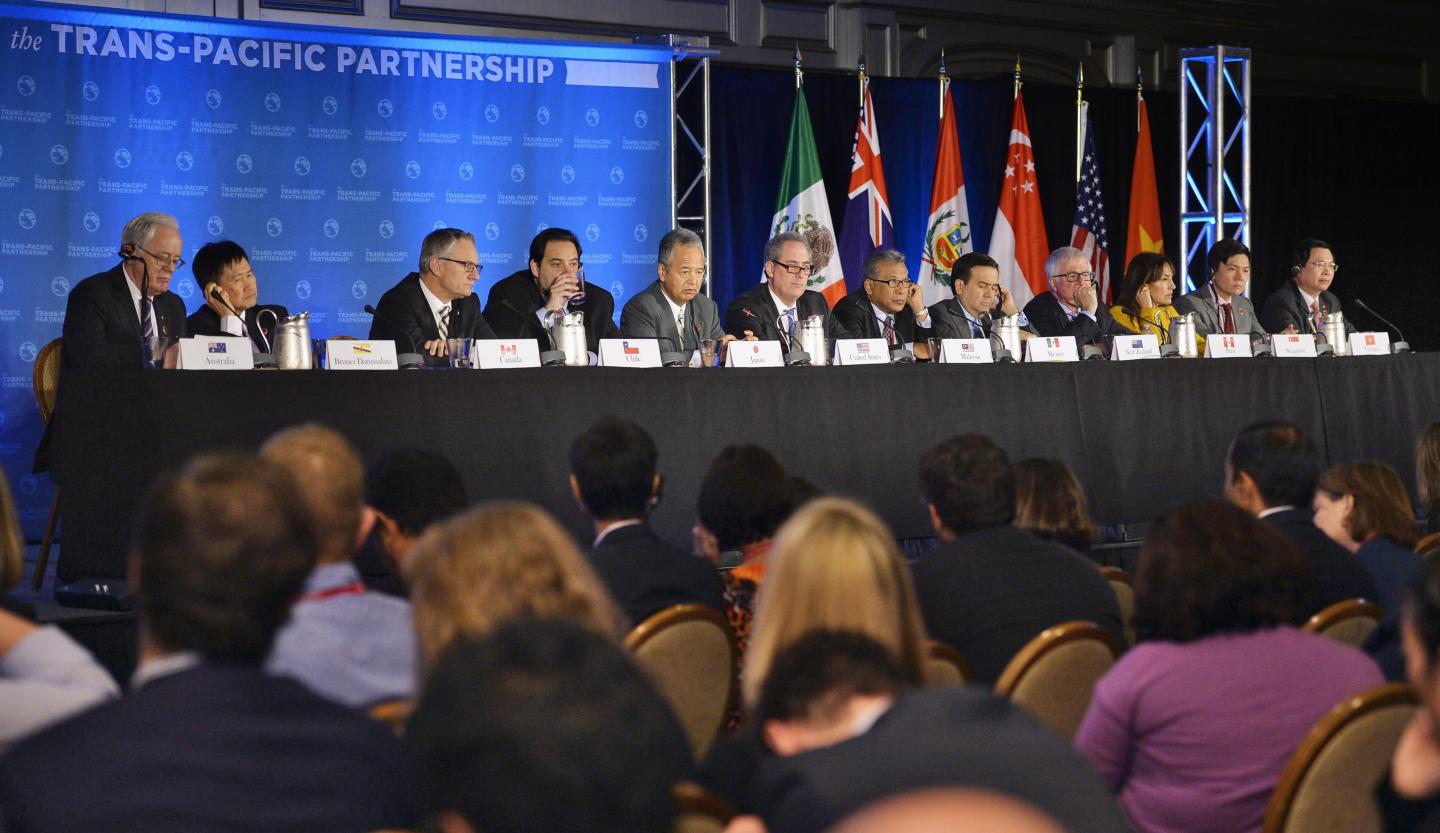
Representatives of Pacific Rim countries attend a press conference in Atlanta on Oct. 5, 2015, after they concluded a sweeping free trade deal. After years of talks, the United States, Japan and the 10 other countries reached a broad agreement on the Trans-Pacific Partnership initiative, which covers around 40 percent of the global economy. (Kyodo) ==KyodoPhotograph by Kyodo/AP
Add Fortune on Google for similar content.

Trade ministers from the U.S. and 11 other countries around the Pacific may have reached a long-awaited trade deal on Monday, but plenty of questions and obstacles remain as Congress considers whether to approve the Trans-Pacific Partnership.

Those trying to drum up support say the TPP would help the U.S. counter China’s influence over the Pacific because it’s not a partner of the trade deal. This argument might sound good on Capitol Hill and in other policy forums, but it’s incredibly flawed for many reasons.

For one, it’s naive to believe that China can be locked out of a preferential trading network. Despite its present currency and stock market corrections (all part of the transition to a “normal” market­based economy), China recently overtook the U.S. as the world’s leading trading nation and it is determined to become the world’s largest economy this decade.

By the end of 2014, China had invested $870 billion worldwide in an effort to expand its sources for raw materials and industrial components. For example, China’s investments in Bangladesh ($3.8 billion) and Pakistan ($17.8 billion) outstripped the loans those countries received from the IMF, which gives it a greater say in those countries’ economies and political debates.

What’s more, China has asked for a share of Angola’s oil reserves in exchange for its investment in that nation’s road development. This is in addition to its well-known, aggressive investments in mining companies across Africa. China is also pushing to create an international bank that would help finance infrastructure projects across the Asia Pacific; the Asian Infrastructure Investment Bank has the support of 47 regional and 20 non­regional members, including TPP nations, such as Australia, Brunei, Malaysia, New Zealand, Singapore and Vietnam.

Since 2005, China has been creating its own free trade agreements with many of the same countries involved in TPP, such as Brunei, Chile, Malaysia, New Zealand, Singapore, Peru and Vietnam. This is a crucial point in understanding the flawed logic behind any belief that China could be excluded from a preferred crossPacific trading community.

The result of all these diplomatic thrusts and counter moves could very well be the absurd and confusing emergence of two overlapping trading blocs that need each other economically, but distrust each other intensely. Wouldn’t it be far better to increase economic efficiency and improve political understanding with Beijing by constructing a TPP that includes China as a charter member?

And if one looks at the world’s supply chain, it’s clear that it’s impossible to leave China out of the world’s biggest trade deals. Given its investments in other developing countries, China has the capability to design, develop, and produce products that can easily make their way into the U.S. market via TPP intermediaries, thereby reducing tariffs it might otherwise have to pay.

For example, to satisfy certain country­of­origin conditions stipulated in TPP, China can manage the supply chain operations of cotton shirts by importing cotton from Pakistan (via its existing free trade agreement with China) and conduct “upstream” operations, such as fabric design, knitting and dyeing at home. Then China can ship the fabric to Vietnam (via an existing free trade agreement with China). At the same time, Japan can ship the buttons to Vietnam (via the TPP). Vietnam can perform “downstream” operations (sewing) and then ship the finished shirts via TPP agreement to Australia, Japan and the United States, cutting off the 5%, 10.9% and 16.5% import duties that would have applied if China had dealt directly with these countries.

Even if China failed to establish trade deals with the remaining five TPP nations and stays out of the partnership itself, the country can leverage its supply chains to facilitate multilateral trade with minimum tariffs. In fact, some mid­size Chinese companies, such as Texhong Textile, have opened facilities in Vietnam in anticipation of the TPP. Much as some of Wal­Mart’s (WMT) internal sourcing from Chinese operations to American consumers are considered Chinese exports to America, Texhong’s internal sourcing of semi-finished garments from China to Vietnam and then onto the U.S. will appear as trade between the three countries, covered by free trade agreements.

Worse than just being unrealistic and uninformed, excluding China from the TPP exacerbates political tensions between the world’s two leading economic powers. Even as they find a workaround, China’s leaders don’t exactly appreciate America’s efforts to exclude them from the trading party. And they’ll make their own moves to outflank the TPP.

China’s importance as Asia’s manufacturing hub, and as America’s top trading partner across the border, are facts of life, ones that can’t be contained or wished away. Whatever other issues are raised by the TPP debate in Washington these days, it’s time to add a pretty basic one: Why exactly would America enter into a Pacific partnership agreement without seeking to include its top partner in the region?

Felipe Caro is an associate professor in decisions, operations, and technology management and Christopher S. Tang is a distinguished professor and Edward W. Carter chair in business administration at the UCLA Anderson School of Management.

About the Authors
By Felipe Caro
See full bioRight Arrow Button Icon
By Christopher S. Tang
See full bioRight Arrow Button Icon
By Bethany Cianciolo
See full bioRight Arrow Button Icon
Add Fortune on Google for similar content.

Latest in Commentary

Finance
Lorem ipsum dolor sit amet, consectetur adipiscing elit, sed do eiusmod tempor incididunt ut labore et dolore magna aliqua. Ut enim ad minim veniam
By Fortune Editors
October 20, 2025
Finance
Lorem ipsum dolor sit amet, consectetur adipiscing elit, sed do eiusmod tempor incididunt ut labore et dolore magna aliqua. Ut enim ad minim veniam
By Fortune Editors
October 20, 2025
Finance
Lorem ipsum dolor sit amet, consectetur adipiscing elit, sed do eiusmod tempor incididunt ut labore et dolore magna aliqua. Ut enim ad minim veniam
By Fortune Editors
October 20, 2025
Finance
Lorem ipsum dolor sit amet, consectetur adipiscing elit, sed do eiusmod tempor incididunt ut labore et dolore magna aliqua. Ut enim ad minim veniam
By Fortune Editors
October 20, 2025
Finance
Lorem ipsum dolor sit amet, consectetur adipiscing elit, sed do eiusmod tempor incididunt ut labore et dolore magna aliqua. Ut enim ad minim veniam
By Fortune Editors
October 20, 2025
Finance
Lorem ipsum dolor sit amet, consectetur adipiscing elit, sed do eiusmod tempor incididunt ut labore et dolore magna aliqua. Ut enim ad minim veniam
By Fortune Editors
October 20, 2025

Most Popular

Finance
Lorem ipsum dolor sit amet, consectetur adipiscing elit, sed do eiusmod tempor incididunt ut labore et dolore magna aliqua. Ut enim ad minim veniam
By Fortune Editors
October 20, 2025
Finance
Lorem ipsum dolor sit amet, consectetur adipiscing elit, sed do eiusmod tempor incididunt ut labore et dolore magna aliqua. Ut enim ad minim veniam
By Fortune Editors
October 20, 2025
Finance
Lorem ipsum dolor sit amet, consectetur adipiscing elit, sed do eiusmod tempor incididunt ut labore et dolore magna aliqua. Ut enim ad minim veniam
By Fortune Editors
October 20, 2025
Finance
Lorem ipsum dolor sit amet, consectetur adipiscing elit, sed do eiusmod tempor incididunt ut labore et dolore magna aliqua. Ut enim ad minim veniam
By Fortune Editors
October 20, 2025
Finance
Lorem ipsum dolor sit amet, consectetur adipiscing elit, sed do eiusmod tempor incididunt ut labore et dolore magna aliqua. Ut enim ad minim veniam
By Fortune Editors
October 20, 2025
Finance
Lorem ipsum dolor sit amet, consectetur adipiscing elit, sed do eiusmod tempor incididunt ut labore et dolore magna aliqua. Ut enim ad minim veniam
By Fortune Editors
October 20, 2025
Fortune Secondary Logo
Rankings
  • 100 Best Companies
  • Fortune 500
  • Global 500
  • Fortune 500 Europe
  • Most Powerful Women
  • World's Most Admired Companies
  • See All Rankings
  • Lists Calendar
Sections
  • Finance
  • Fortune Crypto
  • Features
  • Leadership
  • Health
  • Commentary
  • Success
  • Retail
  • Mpw
  • Tech
  • Lifestyle
  • CEO Initiative
  • Asia
  • Politics
  • Conferences
  • Europe
  • Newsletters
  • Personal Finance
  • Environment
  • Magazine
  • Education
Customer Support
  • Frequently Asked Questions
  • Customer Service Portal
  • Privacy Policy
  • Terms Of Use
  • Single Issues For Purchase
  • International Print
Commercial Services
  • Advertising
  • Fortune Brand Studio
  • Fortune Analytics
  • Fortune Conferences
  • Business Development
  • Group Subscriptions
About Us
  • About Us
  • Press Center
  • Work At Fortune
  • Terms And Conditions
  • Site Map
  • About Us
  • Press Center
  • Work At Fortune
  • Terms And Conditions
  • Site Map
  • Facebook icon
  • Twitter icon
  • LinkedIn icon
  • Instagram icon
  • TikTok icon
  • YouTube icon

Latest in Commentary

mm
CommentaryLeadership
Michael Muthukrishna: The ‘lone genius’ myth is wrong and it’s holding back your business
By Michael MuthukrishnaJuly 23, 2026
6 hours ago
Paul Keary (L) and Mike Sutcliff (R).
CommentaryAI agents
Teneo & Thoughtworks CEOs: the AI race will be won with governance, not speed 
By Paul Keary and Mike SutcliffJuly 23, 2026
6 hours ago
marks
CommentaryNational Security
General James ‘Spider’ Marks: there’s a strategic risk hidden inside closed AI systems
By James MarksJuly 23, 2026
6 hours ago
glp
Commentaryobesity
The GLP-1 paradox: too expensive to cover, too effective to cut
By Bryan Sivak and Elina OnitskanskyJuly 23, 2026
6 hours ago
data
CommentaryData centers
The hidden cost of AI: Why your town is negotiating with Amazon and Microsoft
By Melody BirminghamJuly 23, 2026
7 hours ago
Thijn Lamers is Co-Founder and President, Noah.
Commentarystart-ups
Europe does not need more ambition. It needs to stop hiding it
By Thijn LamersJuly 23, 2026
10 hours ago

Most Popular

The millennial generation has split, new Fed research shows: Those over 35 are edging toward boomer-style wealth, while everyone else falls behind
Real Estate
The millennial generation has split, new Fed research shows: Those over 35 are edging toward boomer-style wealth, while everyone else falls behind
By Nick LichtenbergJuly 22, 2026
1 day ago
Mark Cuban says he has the solution to growing income inequality, and it's to reward every employee—from CEO to janitor—with company stock
Success
Mark Cuban says he has the solution to growing income inequality, and it's to reward every employee—from CEO to janitor—with company stock
By Sasha RogelbergJuly 20, 2026
3 days ago
Scott Bessent casually says the U.S. has more than $1 trillion in gold—and that it doesn’t matter for the dollar
Economy
Scott Bessent casually says the U.S. has more than $1 trillion in gold—and that it doesn’t matter for the dollar
By Sasha RogelbergJuly 22, 2026
22 hours ago
Mathematicians grapple with a ‘very rapid and very unsettling change’ as AI cracks yet another century-old problem
AI
Mathematicians grapple with a ‘very rapid and very unsettling change’ as AI cracks yet another century-old problem
By Eva RoytburgJuly 21, 2026
2 days ago
Despite a $156 million contract, Knicks star Jalen Brunson still calls his parents for financial advice any time he makes a big purchase
Success
Despite a $156 million contract, Knicks star Jalen Brunson still calls his parents for financial advice any time he makes a big purchase
By Emma BurleighJuly 21, 2026
2 days ago
'The man who dies rich dies disgraced': The last time America had such wealth inequality, Andrew Carnegie knew he had to give it all away
Success
'The man who dies rich dies disgraced': The last time America had such wealth inequality, Andrew Carnegie knew he had to give it all away
By Nick LichtenbergJuly 22, 2026
1 day ago

© 2026 Fortune Media IP Limited. All Rights Reserved. Use of this site constitutes acceptance of our Terms of Use and Privacy Policy | CA Notice at Collection and Privacy Notice | Do Not Sell/Share My Personal Information
FORTUNE is a trademark of Fortune Media IP Limited, registered in the U.S. and other countries. FORTUNE may receive compensation for some links to products and services on this website. Offers may be subject to change without notice.