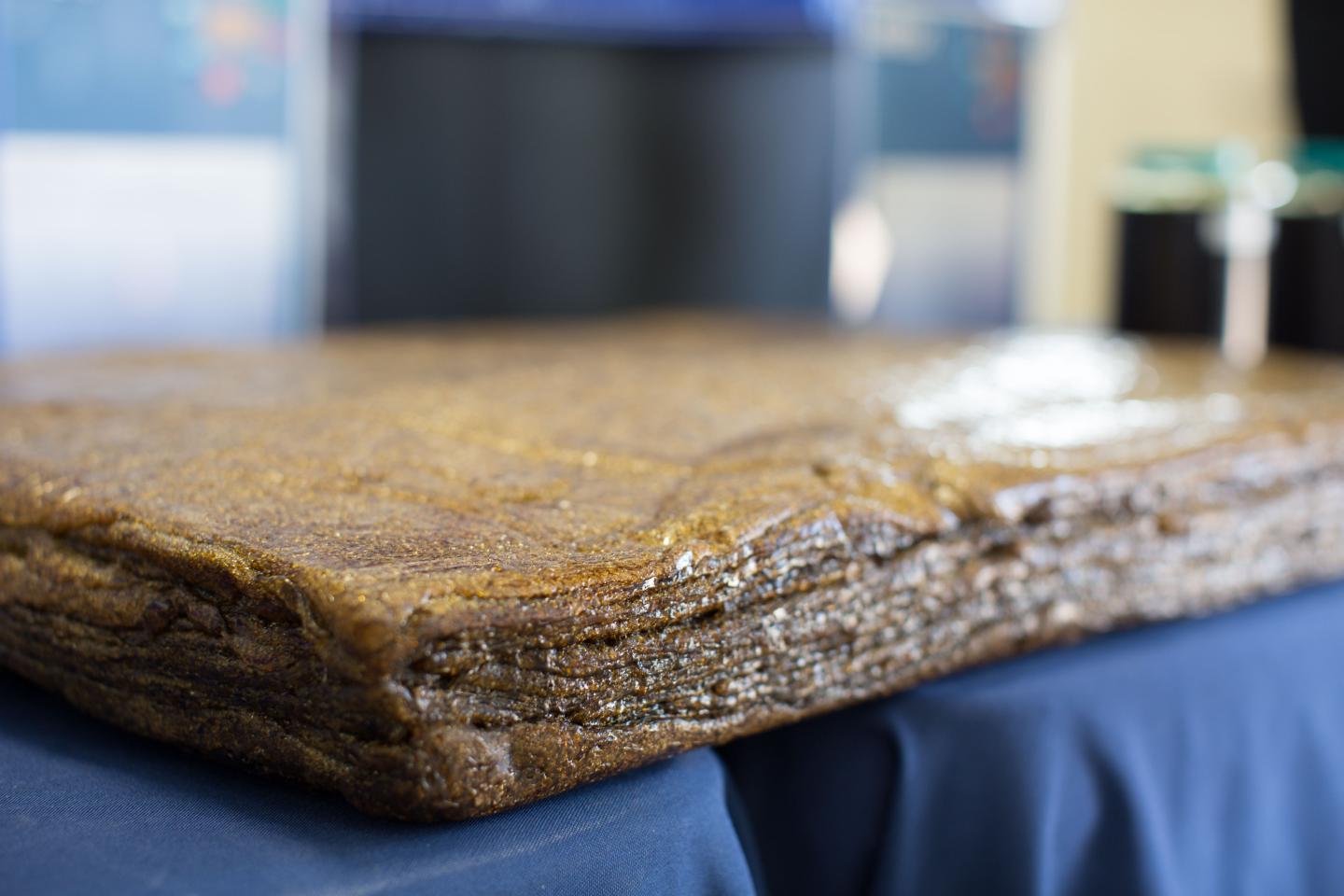
On August 18 and 19, tire maker Cooper successfully demonstrated passenger car tires made using natural rubber extracted from the wiry, tiny-leafed guayule bush. Cooper’s work, funded by a 2012 USDA grant and undertaken in cooperation with the agricultural firm PanAridus, is the latest milestone in a very long and spotty history of alternative rubber development. That development, experts say, is crucial to insulating against one of the global economy’s largest but least-understood vulnerabilities.
Natural rubber is vital to the modern world, a major component of everything from medical equipment to tanks to, most importantly, tires. No synthetic rubber can replicate its properties, and it currently comes almost entirely from one incredibly vulnerable source. More than 90% of the world’s rubber is derived from hevea brasiliensis, the rubber tree, and grown in southeast Asia, where it was transplanted from South America in the 1800s.
The limited type and range of rubber sourcing is a problem for many reasons. Production currently depends on high levels of low-cost manual labor, which may become less available as the region develops economically. The region may not be able to support rising demand from India and China. And supplies are vulnerable to geopolitical disruption, as demonstrated during World War II when Japan took control of the world’s rubber supplies.
But the main problem is that southeast Asian rubber is nearly fated to be ravaged by disease.
Rubber is not grown at commercial scale in South America because of the presence of South American leaf blight, a fungal infection that tears through any trees planted too close together. Henry Ford struggled for years to industrialize rubber production, but leaf blight struck him a rare defeat. For decades, countries like Thailand and Malaysia have tightly restricted travel and trade from South America, hoping to keep leaf blight from crossing the Pacific.
But that quarantine is becoming less effective as the world globalizes—leaf blight was recently rumored in both Thailand and India. And the prospects for fighting it are bleak. Asian rubber is planted tightly; the trees come from nearly uniform genetic stock; the disease itself is pernicious; and the majority of rubber is grown by small farmers with few resources to combat it. As Wade Davis wrote in Fortune in 1996, leaf blight’s spread would be the end of the natural rubber industry as we know it.
“It’s amazing we haven’t come to some terrible disaster already,” says Dr. Katrina Cornish of Ohio State University. “The recession we’ve just been crawling out of, it would be nothing compared to what will happen if we can’t get rubber.
“Our entire infrastructure would collapse.”
Cornish has been one of the leading researchers in alternative rubbers for nearly three decades, exploring not just guayule, but other promising sources, such as a rubbery dandelion native to areas around Uzbekistan.
Guayule has many advantages as an alternative rubber. As Cooper demonstrated, it produces rubber nearly identical to the rubber tree’s. It can be harvested mechanically, rather than by hand. Most of all, it thrives in arid environments like the American southwest, needs very little water, and essentially produces its own pesticide.
There are challenges, though. Rather than neatly dripping rubber sap like trees, guayule’s thin branches must be harvested whole, then processed using solvents and centrifuges. And its genetic stock is relatively undeveloped. All of that makes guayule rubber, at least for now, considerably more expensive than hevea rubber.
Some promising startups are betting they can change that. PanAridus, which provides the guayule for Cooper’s project, has worked to develop more efficient processing technologies and breed new strains with higher rubber content. A competing company, Yulex, has helped develop products like Patagonia’s guayule-rubber wetsuits. Yulex also developed one of the earliest widespread commercial uses of guayule rubber, in medical tools safe for those with particular latex allergies.
But experts agree that development of a competitive domestic rubber industry, and a robust global market, still needs serious investment. Government support has in the past proven fickle. After Japan’s surrender reopened global connections to southeast Asian rubber, the U.S. didn’t just stop investing in guayule research—much of the research stock was destroyed. Research was abandoned almost as abruptly after brief interest during the oil crisis of the 1970s, when synthetic rubber prices spiked.
Cornish finds this approach infuriating, blaming both government and corporate shortsightedness.
“We need to diversify it now,” she says. “Why wait for a disaster before you get yourself ready?”
Sign up for Data Sheet, Fortune’s daily newsletter about the business of technology.