• Home
  • Latest
  • Fortune 500
  • Finance
  • Tech
  • Leadership
  • Lifestyle
  • Rankings
  • Multimedia

Trendingnow

1

'The demographic dividend of the last 40 years is ending': J.P. Morgan says the world is running out of the two things that kept interest rates down

2

Jensen Huang made his $172 billion fortune on AI chips. His family's $75 million gift to Vanderbilt argues art decides what technology is for

3

The millennial generation is split in 2: an older crowd with boomer-style comfort, a younger set going 'back to the early 1900s'

1

'The demographic dividend of the last 40 years is ending': J.P. Morgan says the world is running out of the two things that kept interest rates down

2

Jensen Huang made his $172 billion fortune on AI chips. His family's $75 million gift to Vanderbilt argues art decides what technology is for

3

The millennial generation is split in 2: an older crowd with boomer-style comfort, a younger set going 'back to the early 1900s'
Tech

New 4G technology might wipe out your Wi-Fi connection

By
Kevin Fitchard
Kevin Fitchard
Down Arrow Button Icon
By
Kevin Fitchard
Kevin Fitchard
Down Arrow Button Icon
July 7, 2015, 3:06 PM ET
The Silicon Roundabout In Old Street
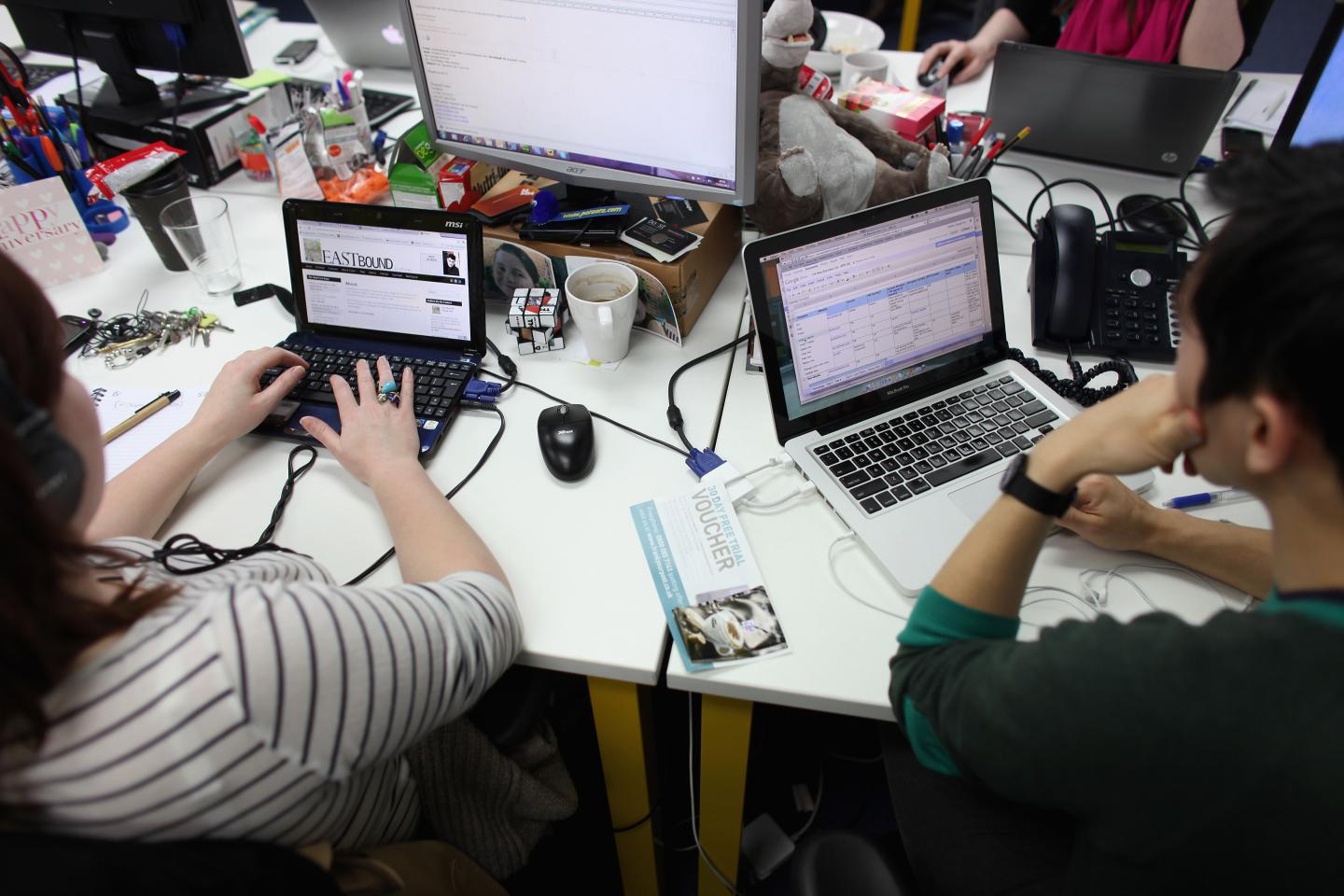
People work at computers in TechHub, an office space for technology start-up entrepreneurs, near the Old Street roundabout in Shoreditch .Photograph by Oli Scarff — Getty Images
Add Fortune on Google for similar content.

Mobile networks and Wi-Fi have long occupied their own distinct territories on the airwaves. Cellular operators stick to licensed spectrums, which they typically pay billions to use exclusively. Meanwhile, Wi-Fi takes advantage of a vast swathe of spectrum known as the unlicensed airwaves, which costs nothing. That distinction is one of the main reasons why connecting to Wi-Fi is cheap and often free, while connecting to a mobile network is not.

The line between Wi-Fi and mobile has existed for two decades, and it’s produced enormous growth and innovation in both industries, but mobile operators are now changing the game by crossing over into Wi-Fi’s turf. A new technology called LTE-Unlicensed, or LTE-U, will allow mobile carriers to dip into unlicensed frequencies for additional capacity, essentially creating 4G networks in Wi-Fi’s airwaves. This has the Wi-Fi industry worried, and has ended up pitting mobile industry giants like T-Mobile, Verizon and Qualcomm against Wi-Fi advocates like Google (GOOGL), Cisco Systems (CSCO), and other cable providers

“The worse case scenario is that LTE operates in unlicensed spectrum in a way that does not pay due regard to other users, making the Wi-Fi experience significantly degraded,” said Edgar Figueroa, president and CEO of the Wi-Fi Alliance, a global non-profit that supports Wi-Fi technologies. “In such a case, bandwidth is eliminated from use by Wi-Fi because it’s being used exclusively by LTE.”

The ins and outs of unlicensed airwaves

Before you jump all over mobile operators, keep in mind that they have every right to use these airwaves. The 2.4 GHz and 5 GHz frequency bands are called “unlicensed” for a reason. Everyone is free to use these frequencies, regardless of whether or not they’re an operator adding bandwidth to a 4G network or a just an average Joe setting up a Wi-Fi router in your home.

However, there are some rules everyone using these frequencies must follow. First, users must transmit at low power, which is why Wi-Fi’s weaker signals won’t cover much more than your apartment. Second, if there are other nearby users trying to use the same frequencies then individuals will have to share.

Wi-Fi does this sharing through a protocol called, quite simply, Listen Before Talk. A Wi-Fi network is constantly scanning its environment looking for competing signals. If it detects them, it doesn’t transmit, waiting several milliseconds before trying again. It’s the same basic principle as talking at a dinner party. Everyone waits their turn to speak rather than everyone trying to talk all at once.

This kind of frequency sharing allows multiple Wi-Fi networks to live in the same physical space, and it’s been one of the key reasons for Wi-Fi’s huge proliferation. Wi-Fi isn’t the unlicensed band’s only tenant, though. It has to share the same space with Bluetooth, cordless phones, wireless remotes and even baby monitors, but for the most part those technologies have managed to co-exist peacefully. The introduction of LTE-U, though, represents a major new incursion into unlicensed airwaves.

LTE-U basically is intended to supercharge our mobile connections in places where mobile data demand is the highest. LTE-U combines your regular connection to the 4G network with a new transmission in the unlicensed band, effectively doubling your bandwidth. For example, if you were humping along with a 10 Mbps link and suddenly entered an LTE-U coverage area, you would find your connection speed boosted to 20 Mbps or more.

Due to the low-power requirements for unlicensed bands, operators can’t use LTE-U everywhere. Mainly it’s an indoor technology, but inside of buildings is exactly where the vast majority of mobile data consumption happens today. LTE-U could add a lot of capacity to an operator’s networks, and because operators wouldn’t have to sink billions of dollars into buying airwaves, they could deliver all of that capacity at a much lower cost, which could—at least, theoretically—be passed on to consumers.

Why Wi-Fi is freaked out

Wi-Fi Alliance’s Figueroa has made it clear he doesn’t want to boot the mobile operators out of the unlicensed airwaves, which would be antithetical to the idea of shared band. What he and other Wi-Fi advocates want is to ensure that LTE plays by the same rules as the band’s other users currently do.

In fact, the Alliance and other Wi-Fi standards groups are working closely with their mobile industry counterparts to create a standardized technology similar to LTE-U called LTE-Licenses Assisted Access. LTE-LAA would employ the same Listen Before Talk protocols as Wi-Fi, which Figueroa believes will allow the two technologies to co-exist peacefully.

The problem is LTE-LAA gear and chips won’t be commercial available for several years, and mobile operators in several countries—notably the U.S., South Korea and India—don’t want to wait. Both Verizon and T-Mobile US plan to roll out LTE-U network gear and devices in 2016.

LTE-U uses a less stringent sharing protocol than Listen Before Talk, and the Wi-Fi industry fears that it will give mobile operators an unfair advantage, effectively muscling Wi-Fi users off their networks. According to comments Google filed with the Federal Communications Commission, an LTE-U transmission sharing the same frequency channel with a Wi-Fi transmission could degrade the Wi-Fi connection as much as 75%. The result, according to Google, would be a much better experience for users on the mobile network, but a much crappier experience for users on Wi-Fi.

One of LTE-U’s biggest backers, Qualcomm (QCOM), has dismissed those fears. The telecom company argues that while LTE-U uses a different sharing protocol than Wi-Fi’s Listen Before Talk, it’s perfectly adequate to ensure that Wi-Fi and LTE-U cooperate peacefully, said Prakash Sangam, Qualcomm director of technical marketing. Furthermore, Qualcomm has a vested interest in keeping Wi-Fi safe, Sangam said, since the company has its own Wi-Fi technology division, Atheros, so creating a technology that would run amuck in the unlicensed frequencies would cannibalize one of its major businesses.

“Fair co-existence with Wi-Fi has been our main concern since we started the design phase on LTE-U,” Sangam said.

He added that LTE-U actually might be a better neighbor to Wi-Fi than Wi-Fi itself. Typically Wi-Fi access points in any given location act independently, creating a constant over-the-air negotiation for signals. In contrast, LTE-U is part of an operator’s centrally managed cellular network. This type of arrangement would mean LTE-U access points would coordinate their activities in crowded airwaves, making more efficient use of the frequencies available and improving the data experience for Wi-Fi and LTE users alike.

However, the Wi-Fi industry has a different view about that kind of centrally managed network. Instead of using that central coordination to the benefit of Wi-Fi, LTE-U could use that capability to force Wi-Fi networks off the air, much like the individual cars on a racing team can cooperate to pass competing cars on a track.

Solving the impasse

The public will eventually find out if the Wi-Fi industry’s fears are warranted when T-Mobile (TMUS) and Verizon’s (VZA) LTE-U networks go live next year, although Wi-Fi advocates don’t want to wait that long. They’re asking the FCC to step in now, and put restrictions on the types of radio technologies operators can use in the unlicensed bands.

Even if the Wi-Fi and mobile camps sort out their differences and find a way to fairly share the unlicensed frequencies, there will still be some big repercussions for both industries. A lot of our smartphone traffic today already rides over Wi-Fi networks, but as LTE-U goes live you can expect some of that traffic to shift back onto mobile networks. While Wi-Fi access is largely free today, mobile operators charge for their data connections.

Also, the unlicensed band is going to get a lot more crowded. LTE-U will become a major new tenant on the unlicensed band, and regardless of how well it cooperates with Wi-Fi, space is going to get a bit tight. Anyone who’s tried and failed to connect to a Wi-Fi hotspot at a crowded coffee shop or conference center, knows there’s already a limited amount of unlicensed bandwidth to go around.

Ultimately, a move onto Wi-Fi’s turf by mobile operators demonstrates just how much interest there is for finding new uses for the unlicensed bands. Maybe, the government should take the hint and open up more airwaves not just for Wi-Fi, but for everyone.


About the Author
By Kevin Fitchard
See full bioRight Arrow Button Icon
Add Fortune on Google for similar content.

Latest in Tech

Finance
Lorem ipsum dolor sit amet, consectetur adipiscing elit, sed do eiusmod tempor incididunt ut labore et dolore magna aliqua. Ut enim ad minim veniam
By Fortune Editors
October 20, 2025
Finance
Lorem ipsum dolor sit amet, consectetur adipiscing elit, sed do eiusmod tempor incididunt ut labore et dolore magna aliqua. Ut enim ad minim veniam
By Fortune Editors
October 20, 2025
Finance
Lorem ipsum dolor sit amet, consectetur adipiscing elit, sed do eiusmod tempor incididunt ut labore et dolore magna aliqua. Ut enim ad minim veniam
By Fortune Editors
October 20, 2025
Finance
Lorem ipsum dolor sit amet, consectetur adipiscing elit, sed do eiusmod tempor incididunt ut labore et dolore magna aliqua. Ut enim ad minim veniam
By Fortune Editors
October 20, 2025
Finance
Lorem ipsum dolor sit amet, consectetur adipiscing elit, sed do eiusmod tempor incididunt ut labore et dolore magna aliqua. Ut enim ad minim veniam
By Fortune Editors
October 20, 2025
Finance
Lorem ipsum dolor sit amet, consectetur adipiscing elit, sed do eiusmod tempor incididunt ut labore et dolore magna aliqua. Ut enim ad minim veniam
By Fortune Editors
October 20, 2025

Most Popular

Finance
Lorem ipsum dolor sit amet, consectetur adipiscing elit, sed do eiusmod tempor incididunt ut labore et dolore magna aliqua. Ut enim ad minim veniam
By Fortune Editors
October 20, 2025
Finance
Lorem ipsum dolor sit amet, consectetur adipiscing elit, sed do eiusmod tempor incididunt ut labore et dolore magna aliqua. Ut enim ad minim veniam
By Fortune Editors
October 20, 2025
Finance
Lorem ipsum dolor sit amet, consectetur adipiscing elit, sed do eiusmod tempor incididunt ut labore et dolore magna aliqua. Ut enim ad minim veniam
By Fortune Editors
October 20, 2025
Finance
Lorem ipsum dolor sit amet, consectetur adipiscing elit, sed do eiusmod tempor incididunt ut labore et dolore magna aliqua. Ut enim ad minim veniam
By Fortune Editors
October 20, 2025
Finance
Lorem ipsum dolor sit amet, consectetur adipiscing elit, sed do eiusmod tempor incididunt ut labore et dolore magna aliqua. Ut enim ad minim veniam
By Fortune Editors
October 20, 2025
Finance
Lorem ipsum dolor sit amet, consectetur adipiscing elit, sed do eiusmod tempor incididunt ut labore et dolore magna aliqua. Ut enim ad minim veniam
By Fortune Editors
October 20, 2025
Fortune Secondary Logo
Rankings
  • 100 Best Companies
  • Fortune 500
  • Global 500
  • Fortune 500 Europe
  • Most Powerful Women
  • World's Most Admired Companies
  • See All Rankings
  • Lists Calendar
Sections
  • Finance
  • Fortune Crypto
  • Features
  • Leadership
  • Health
  • Commentary
  • Success
  • Retail
  • Mpw
  • Tech
  • Lifestyle
  • CEO Initiative
  • Asia
  • Politics
  • Conferences
  • Europe
  • Newsletters
  • Personal Finance
  • Environment
  • Magazine
  • Education
Customer Support
  • Frequently Asked Questions
  • Customer Service Portal
  • Privacy Policy
  • Terms Of Use
  • Single Issues For Purchase
  • International Print
Commercial Services
  • Advertising
  • Fortune Brand Studio
  • Fortune Analytics
  • Fortune Conferences
  • Business Development
  • Group Subscriptions
About Us
  • About Us
  • Press Center
  • Work At Fortune
  • Terms And Conditions
  • Site Map
  • About Us
  • Press Center
  • Work At Fortune
  • Terms And Conditions
  • Site Map
  • Facebook icon
  • Twitter icon
  • LinkedIn icon
  • Instagram icon
  • TikTok icon
  • YouTube icon

Latest in Tech

SpaceX’s Starship V3 deploys most advanced Starlink satellites then pulls off best re-entry yet with splashdown so soft it floated in the Indian Ocean
Innovationspace
SpaceX’s Starship V3 deploys most advanced Starlink satellites then pulls off best re-entry yet with splashdown so soft it floated in the Indian Ocean
By Marcia Dunn and The Associated PressJuly 25, 2026
2 hours ago
Inside On’s tech lab, where robots build running shoes in 3 minutes and can eliminate up to 300 hours of human work
C-SuiteSportswear
Inside On’s tech lab, where robots build running shoes in 3 minutes and can eliminate up to 300 hours of human work
By Ruth UmohJuly 25, 2026
3 hours ago
Can Apple’s incoming CEO bring back the product design mojo of the Steve Jobs era?
MagazineApple
Can Apple’s incoming CEO bring back the product design mojo of the Steve Jobs era?
By Sebastian HerreraJuly 25, 2026
3 hours ago
A Hims cofounder fired his entire marketing team for AI. Now his 24/7 online vet service is growing 20% a month
SuccessMarketing
A Hims cofounder fired his entire marketing team for AI. Now his 24/7 online vet service is growing 20% a month
By Sydney LakeJuly 25, 2026
4 hours ago
Schools across America are quietly admitting that screens in classrooms made students worse off and are reversing years of tech-first policies
North AmericaEducation
Schools across America are quietly admitting that screens in classrooms made students worse off and are reversing years of tech-first policies
By Marco Quiroz-GutierrezJuly 25, 2026
4 hours ago
A man stands looking out over his front porch where a sign reads, "No data centers."
EnvironmentData centers
Startups are installing tiny data centers in people’s homes to reduce strain on the beleaguered electrical grid
By Sasha RogelbergJuly 25, 2026
4 hours ago

Most Popular

'The demographic dividend of the last 40 years is ending': J.P. Morgan says the world is running out of the two things that kept interest rates down
Economy
'The demographic dividend of the last 40 years is ending': J.P. Morgan says the world is running out of the two things that kept interest rates down
By Eleanor PringleJuly 24, 2026
1 day ago
Jensen Huang made his $172 billion fortune on AI chips. His family's $75 million gift to Vanderbilt argues art decides what technology is for
Big Tech
Jensen Huang made his $172 billion fortune on AI chips. His family's $75 million gift to Vanderbilt argues art decides what technology is for
By Sydney LakeJuly 23, 2026
2 days ago
The millennial generation is split in 2: an older crowd with boomer-style comfort, a younger set going 'back to the early 1900s'
Real Estate
The millennial generation is split in 2: an older crowd with boomer-style comfort, a younger set going 'back to the early 1900s'
By Nick LichtenbergJuly 25, 2026
6 hours ago
The $39 trillion U.S. national debt isn’t as high as Japan’s and Singapore’s relative to economy size—and yet it's still worse somehow
Economy
The $39 trillion U.S. national debt isn’t as high as Japan’s and Singapore’s relative to economy size—and yet it's still worse somehow
By Sasha RogelbergJuly 23, 2026
2 days ago
Current price of oil as of July 24, 2026
Personal Finance
Current price of oil as of July 24, 2026
By Joseph HostetlerJuly 24, 2026
1 day ago
Current price of silver as of Friday, July 24, 2025
Personal Finance
Current price of silver as of Friday, July 24, 2025
By Joseph HostetlerJuly 24, 2026
1 day ago

© 2026 Fortune Media IP Limited. All Rights Reserved. Use of this site constitutes acceptance of our Terms of Use and Privacy Policy | CA Notice at Collection and Privacy Notice | Do Not Sell/Share My Personal Information
FORTUNE is a trademark of Fortune Media IP Limited, registered in the U.S. and other countries. FORTUNE may receive compensation for some links to products and services on this website. Offers may be subject to change without notice.