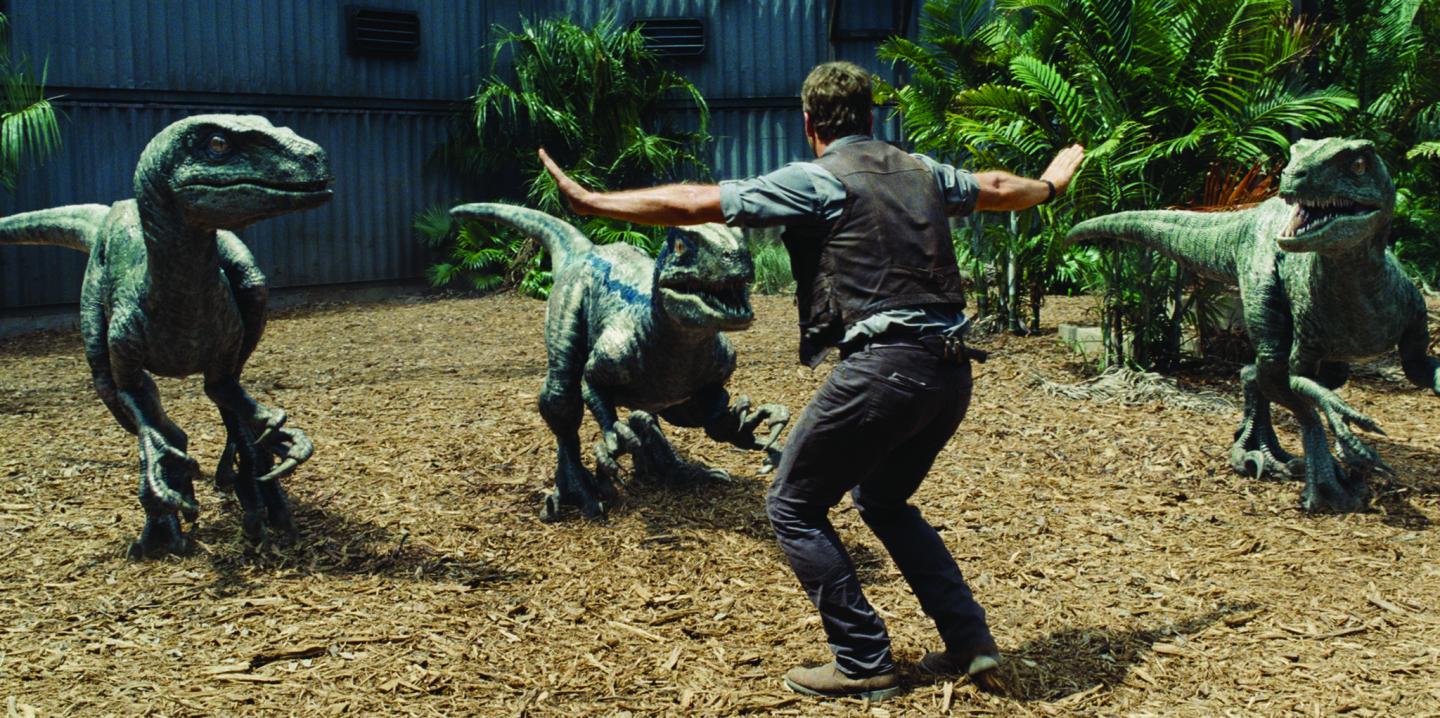
The new film Jurassic World shattered a global box office record earlier this month when it became the first movie in history to bring in over $500 million in its opening weekend. It has also become the fastest film to cross the billion-dollar mark, grossing nine figures in just 14 days according to Variety.
There’s a good reason for these amazing milestones: the film is excellent, among the most entertaining and exciting movies I’ve seen this decade. And it’s loaded with reminders for the investor class that are as universal as they are timeless. I share a few below, with some mild spoilers:
History repeats or, at the very least, rhymes
It’s 22 years later and we’re back on Isla Nubar, the site of the original Jurassic Park. The scale of the original theme park is almost quaint in the context of the current, corporatized version. It’s different this time. Ships loaded with visitors pull up to a highly organized, well staffed operation where security is cutting edge and everything is automated and augmented with technology. Jurassic World officials have learned from the mistakes of the prior generation and everything is now under control.
If that sounds familiar, it’s exactly what monetary authorities and central bankers around the world have lulled us into believing; that the lessons of the post-millennial booms and busts are being incorporated into policy. They even believe it themselves.
Sophisticated and sexier is often more dangerous for investors
Jurassic World faces a huge challenge in maintaining high attendance to please shareholders. It’s two decades after the first dinosaur resurrections and even the T-Rex is feeling a little old hat these days. So the company begins to innovate, creating new breeds of dinosaurs to make something “bigger, scarier and with more teeth” to thrill the kids.
Investment companies undergo these kinds of innovation cycles during every bull market. To grab the attention (and assets) of investors, the new funds and products become more sophisticated, with all sorts of new bells and whistles. SEC Commissioner Kara Stein spoke to the Brookings Institution this month and highlighted this risk.
Innovation has been explosive among mutual funds and ETFs during the post-crisis period. From the entire spectrum of fixed income and securitized loans to the so-called liquid alternatives and venture funds, strategies and asset classes that had never been so readily and seamlessly accessed may soon be tested like never before should capital flows reverse from in to out. Stein worries that regulators have fallen behind and that investment companies have released products into the world that will not offer the liquidity and characteristics investors have come to expect when they press the sell button en masse. Securities that cannot be quickly liquidated have been packaged in funds that can. Any rush for the exits in these products could exacerbate a sell-off. This would depress prices and market sentiment, possibly even setting a panic in motion.
Beware the law of unintended consequences
How did the Imgen laboratory cook up a scarier dinosaur? By manipulating DNA and splicing in genes from other animals, adding a la carte features that would make an ordinary T-Rex even more crowd-pleasing.
Fund companies are engaging in some gene splicing of their own to entice the masses into untested products. These include currency-hedged ETFs, triple-levered ETFs based on commodities, unconstrained bond funds with short positions betting against U.S. Treasurys, private equity funds, emerging market debt instruments, historically less-liquid bank loan funds, and all manner of actively managed strategies packaged in supposedly easy to buy and sell wrappers. “The teeth of shark, the speed of a cheetah, the venom of a cobra, the aggression of a velociraptor….”
The suppression of volatility often leads to worse outcomes
When our heroine gets word that one of these Frankenstein creations has gotten loose in the park, she immediately notifies security forces that “there is an asset out of containment.” Her next move, however, is to allow the park to operate normally without any major alarm. Visitors are kept blissfully ignorant while a 50-foot long scientifically optimized alpha predator eludes its captors. Keeping calm and maintaining business as usual is the park’s priority as it attempts to suppress the threat.
History has shown that market and economic volatility can be subdued—by central bank edict, monetary policy, or the adoption of hedges—for only so long. This willful denial of natural volatility has always led to a severe reckoning. Think of a beach ball being held underwater. At some point, the hand holding it down is going to slip. Assets get out of containment all the time.
Corporations serve multiple masters
Why are the park’s managers so intent on keeping the danger under wraps? Money! “If we evacuate now, we’ll never reopen.”
Corporations may provide products to the public and employment to their employees, but their primary master, the one they serve first and foremost, is the shareholder. All manner of disastrous decisions can be made when careerism and corporate expediency are placed above the public good. The lack of action when General Motors found out about a series of ignition problems in their vehicles is just the latest example. Upton Sinclair, the muckraking author of The Jungle, famously quipped, “It is difficult to get a man to understand something when his salary depends on his not understanding it.”
How many employees and managers of the world’s largest financial institutions were aware of the increased risks their firms were taking on in the run up to the latest crisis? Probably many, if not most. Last month, former Lehman Brothers CEO Dick Fuld made his first public remarks since the world-beating bankruptcy he presided over. He defended himself by explaining that Lehman had 27,000 risk managers (meaning his employees) on staff, and that they shared some of the responsibility for what happened. How many of those supposed “risk managers” would have kept their jobs by throwing a wrench into the works or offering resistance while the money machines were running at full tilt?
Randomness cannot be modeled, quantified, or counted on
Jurassic World has state of the art technology, an army of security specialists, and a command center overseeing every inch of the park. Every possible contingent has been planned for, every conceivable danger has been seen to. And then something unimaginable occurs that throws off the entire precautionary system. And within seconds, you’re hearing the audible crunch of human bones.
Finance professor and Bloomberg columnist Noah Smith recently wrote about a massive shift of thinking in the field of macroeconomics when it comes to modeling booms and busts. There is growing acceptance that random occurrences can so thoroughly trash a classical economic model that the exercise of modeling itself has become pointless. As the poets say, the best laid schemes of mice and men often go awry.
There’s always something bigger out there
The most satisfying scenes in Jurassic World involve the brutal interactions among the dinosaurs themselves. The battles between creatures are epic and they serve as a helpful reminder that no matter how big or wise or clever one investor may be, there is always someone bigger, wiser, and even more clever lurking out there in the wild.
A great white shark in the film learns this the hard way, when it is dangled over a lake containing a mosasaurus, a crocodile from the cretaceous period the size of a Boeing 787. We often learn this lesson the hard way ourselves, no matter how many times we’ve sat in the splash zone to witness the show.