This article is published in partnership with Time.com. The original version can be found here.
By Philip Elliott @Philip_Elliott
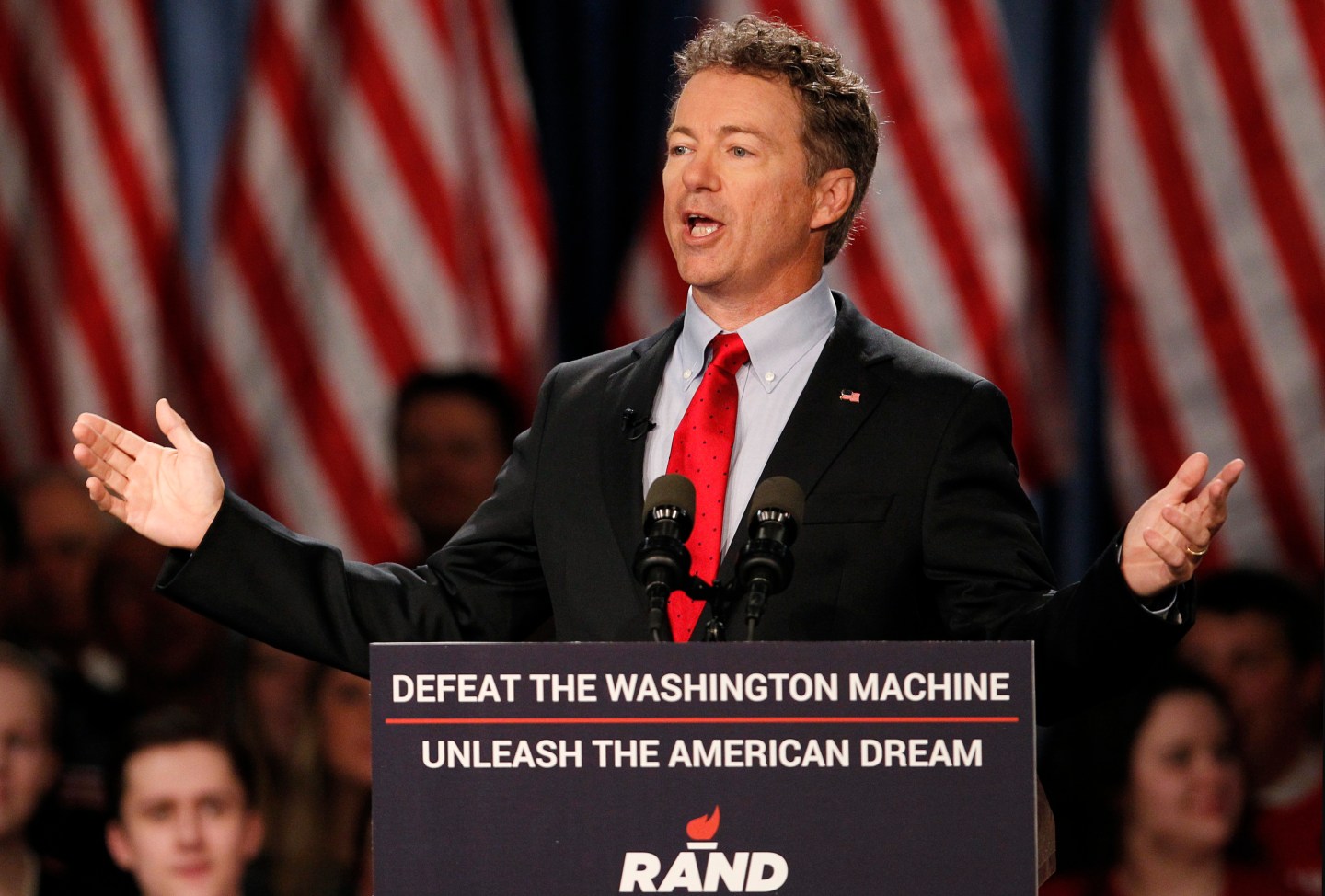
Kentucky Sen. Rand Paul’s victory over President Obama and most of his Senate colleagues Sunday was messy and almost certain to be brief. But by forcing key U.S. intelligence programs to go dark, he scored a clear win for civil libertarians and those backing his White House campaign.
The Kentucky Republican interrupted his Senate colleagues, threw up procedural roadblocks and even borrowed Democrats’ time to make his objections. He drew reprimands over Senate decorum and rules. Peers scowled at him as he smirked in his leather chair, and Republican Senate Leader Mitch McConnell called the scene inside the chamber he nominally controls “a totally unacceptable outcome.”
Yet, at the end of Sunday’s rare Senate session, Paul was able to claim victory: “I came here to defend the Bill of Rights, not to be popular,” he tweeted. The freshman single-handedly shut down intelligence agencies’ legal authority to continue collecting domestic phone records for a searchable database of who is phoning whom. The law that permitted the program, as well as several other techniques of the National Security Agency, was set to expire as the clock struck midnight Sunday, and Paul was unyielding in his effort to ensure there would be at least some temporary end to it.
For Paul, the real audience was the Republican electorate that will pick a White House nominee next year, along with potential donors who can fund his campaign. “Mark my words: The battle’s not over,” Paul said on the Senate floor, where supporters in “Stand with Rand” T-shirts watched him from the Senate visitors’ space. “The Patriot Act will expire tonight,” Paul said, before referencing his opponents. “It will only be temporary. They will ultimately get their way.”
Reluctantly, the Senate agreed to take up a House-passed bill by a 77-11 vote, and will add tweaks to it that the House will consider when it returns this week. The House bill winds down the bulk government collection of the phone records but requires phone companies to retain similar information, where it can be accessed with specific court orders.
After it was clear that the Paul would carry the day, the White House issued a statement of condemnation. “On a matter as critical as our national security, individual Senators must put aside their partisan motivations and act swiftly,” the document read. “The American people deserve nothing less.”
One Paul rival for the White House nomination, Sen. Marco Rubio of Florida, voted with him in opposing a Senate debate over the House version. Rubio did not speak on his vote. Sen. Ted Cruz of Texas voted for the House version, which would shift the collection of Americans’ phone data to phone companies and away from the NSA. Sen. Lindsey Graham of South Carolina was absent; he was back in his home state, where he is set to start his 2016 campaign on Monday.
But Paul’s conduct again renewed concerns about how he would serve as President, and the scene was certain to raise questions among national security conservatives who have a big voice in the party. “People here in town think I’m making a huge mistake. Some of them, I think, secretly want there to be an attack on the United States so they can blame it on me,” Paul said, casting himself as a victim of the political elites.
Set for a midnight expiration, the surveillance program included in the post-Sept. 11 anti-terrorism bill allowed the National Security Agency to collect information that appears on most phone bills: dates and times that calls were placed, how long they lasted and which numbers answered them. In a recent ruling, a federal appeals court said the program was too broad under current congressional authorization, but that ruling was put on hold while Congress had a chance to sort it out. The provision also lets law enforcement officers check other business records, such as hotel bills.
With the law’s expiration, the NSA and FBI will have to return to pre-Sept. 11 ways to collect this information until a replacement Patriot Act is passed by the Congress and signed by President Obama. In most cases where the targets are in the United States, that means going to a judge and asking for a search warrant to get information on specific phone numbers, not the entire database of phone transactions. If Congress renews it—and President Barack Obama restore the powers he sought to keep— the agencies could restart the data collection in a matter of days.
That remained unacceptable for Paul, who vowed to continue his fight against it. “We should be upset. We should be marching in the streets,” Paul thundered in a speech that seemed more directed at a campaign commercial than the civil and somber Senate chamber. “We cannot allow this,” Paul roared.
He even cut off a fellow Kentuckian, McConnell, who has endorsed Paul’s campaign and is the most powerful lawmaker in the chamber. McConnell seemed positively flummoxed by Paul’s one-man roadblock that prevented even a two-week extension of the current program. “That’s a totally unacceptable outcome,” McConnell said.
Even typically mild-mannered Sen. Dan Coats of Indiana was peeved with his fellow Republican for promoting “a siren song” and “a bunch of hokum.” An Indiana Republican who serves on the Intelligence Committee, Coats accused Paul of spreading irresponsible misinformation about the law. Voters, Coats said, now think government “is listening to every phone call that they make” and “knows everything about you.”
“It’s misrepresentation,” he said. “It’s time we told the truth.”
At that point, Paul interrupted Coats—a break in Senate decorum. Sen. John McCain, the Arizona Republican who was his party’s Presidential nominee in 2008, rose to Coats’ defense. “The Senator from Kentucky should learn the rules of the Senate,” McCain said dryly. The hawkish military veteran is Chairman of the Senate Armed Services Committee and sits on the Homeland Security panel.
“Obviously people don’t know the rules of the Senate. Maybe they should learn them,” McCain continued.
But Paul continued, using every trick up a Senator’s sleeve to delay debate and to confound his colleagues. He even asked the clerks to take attendance—a stalling tactic.
Eventually, his colleagues left the chamber. They had been away from Washington for more than a week, and they wanted to check in with their offices around the Capitol before heading home.
“This is a manufactured crisis,” said Sen. Patrick Leahy, the top Democrat on the Senate Judiciary Committee. “Don’t duck behind not doing anything and then pretend that’s a solution.”