• Home
  • Latest
  • Fortune 500
  • Finance
  • Tech
  • Leadership
  • Lifestyle
  • Rankings
  • Multimedia
Financemonetary policy

GMO’s James Montier: Bernanke and Yellen don’t understand how the economy works

By
Chris Matthews
Chris Matthews
Down Arrow Button Icon
By
Chris Matthews
Chris Matthews
Down Arrow Button Icon
May 22, 2015, 7:46 AM ET
Janet Yellen testifies on Capitol Hill in Washington
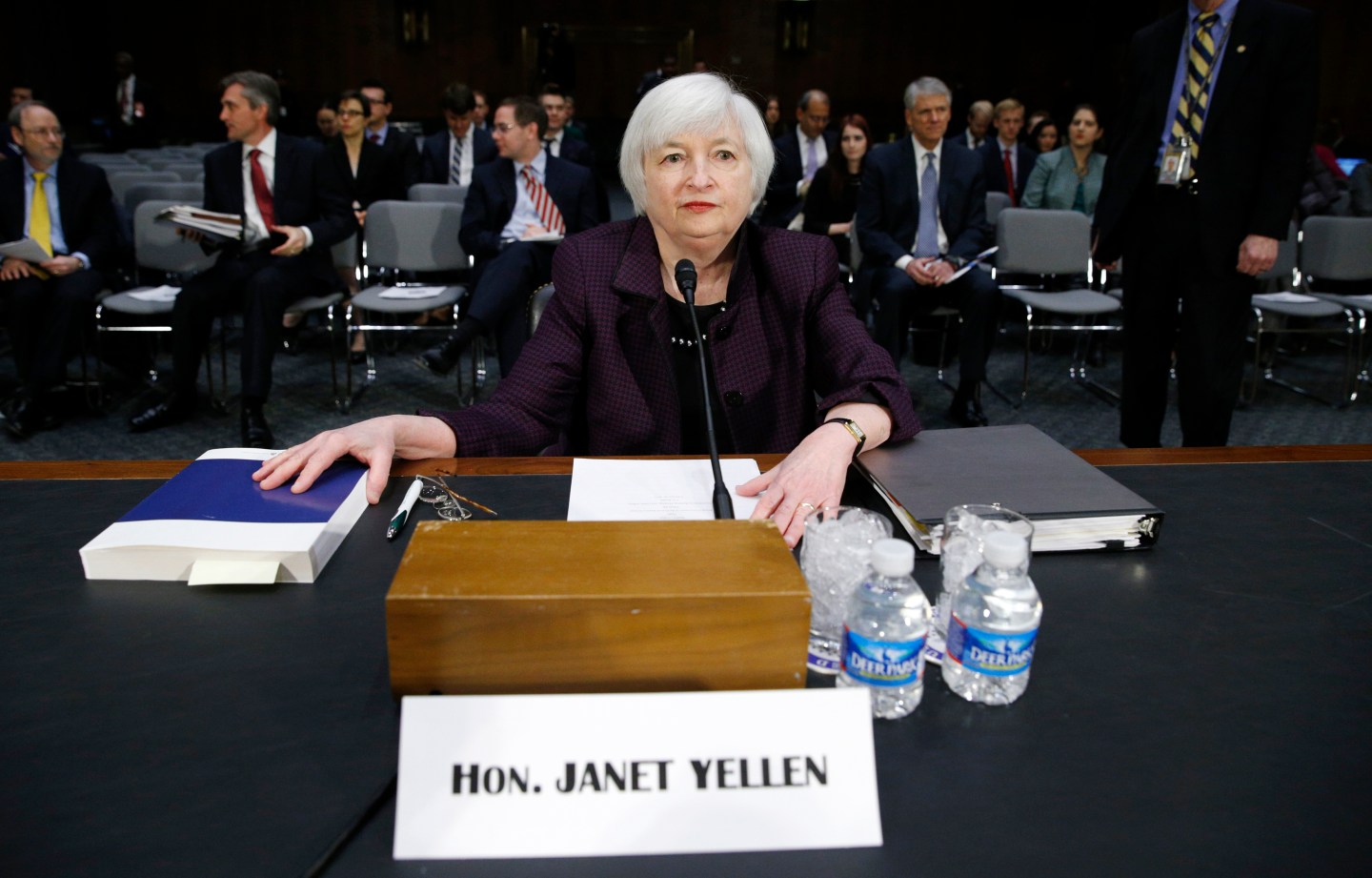
Federal Reserve Chair Janet Yellen takes her seat to testify at a Senate Banking, Housing and Urban Affairs Committee hearing on "Semiannual Monetary Policy Report to Congress" on Capitol Hill in Washington, February 24, 2015. World shares held near record highs on Tuesday after Greece produced a list of proposed economic reforms, and the dollar rose on expectations Federal Reserve chair Janet Yellen would signal the Fed was still moving towards raising interest rates. REUTERS/Kevin Lamarque (UNITED STATES - Tags: POLITICS BUSINESS) - RTR4QYSCPhotograph by Kevin Lamarque — Reuters

In this era of unprecedented, global monetary stimulus, markets hang on every word central bankers utter.

Central bankers, however, are less interested in financial markets. If you ask Janet Yellen, for instance, she’d say that the stock market is one “transmission mechanism” through which monetary policy affects the real economy. Yes, low interest rates will indirectly lead to higher stock valuations, but the central bank’s real aim is to simulate the real economy by encouraging businesses to invest and consumers to spend.

James Montier of the investment management firm GMO, however, argues that central bank policy never makes it to the real economy. In a paper published this week, Montier argues that the economics and investment communities “idolatry” of interest rates is the “greatest con ever perpetrated.” Writes Montier:

There seems to be a perception that central bankers are gods (or at the very least minor deities in some twisted economic pantheon). Coupled with this deification of central bankers is a faith that interest rates are a panacea. Whatever the problem, interest rates can solve it. Inflation too high, simply raise interest rates. Economy too weak, then lower interest rates . . . This obsession with interest rates as a cure-all rests on some dubious views about the way the world works. First, is an interest rate cut expansionary or contractionary with respect to spending? Those who believe interest rates are an effective tool clearly believe a rate cut is expansionary because it reduces the cost of financing and then stimulates demand (via investment, consumption, and/or net exports). This emphasises the obvious but oft unspoken truth that monetary policy works via the debt channel (or reducing savings, which is the same thing as increasing leverage).

Montier argues that, actually, interest rates have very little bearing on corporate and individual investment and consumption decisions. Take a look at the following charts. The first shows that corporate investment is generally financed with internal funds, rather than debt:

Screen Shot 2015-05-21 at 1.16.12 PM

Here’s another showing interest rates over time, combined with surveys showing “internal hurdle rates” for investment projects. Regardless of where interest rates are, companies generally require a 15% rate of return when embarking on a new investment:
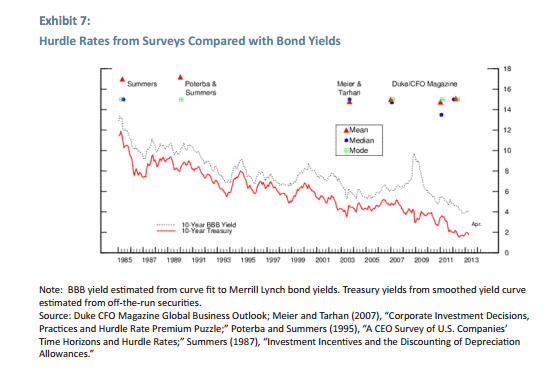
Screen Shot 2015-05-21 at 1.20.16 PM

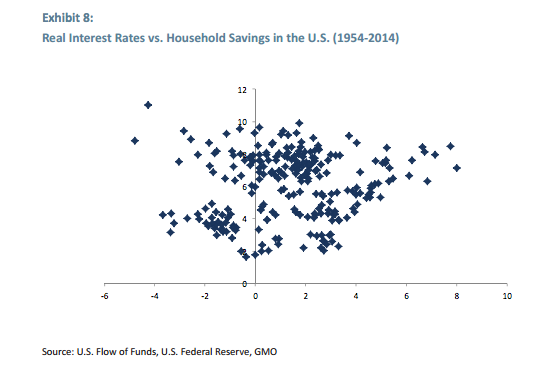
Finally, Montier argues that there isn’t a strong correlation between household savings rates and interest rates:
Screen Shot 2015-05-21 at 1.43.55 PM

“It would appear that monetary policy isn’t the most effective tool for managing the economy,” Montier writes. “I am well aware that almost everyone reading this is likely to disagree: that is the nature of the greatest con ever perpetuated.”

Montier argues that fiscal policy is the only way for the government to meaningfully manage the economy, but it is ignored for “political rather than economic” reasons. He postulates that business groups are wary of the idea that direct government spending could support employment or play too large a role in the economy, because that require the business community to relinquish power.

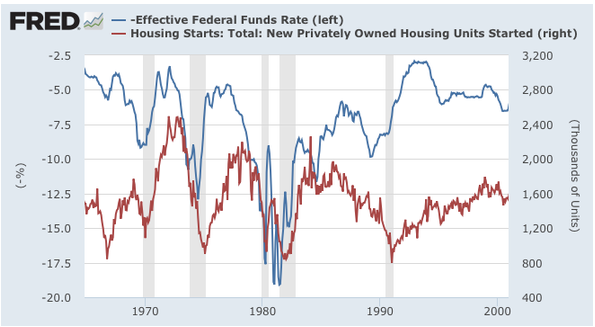
Economist and New York Times columnist Paul Krugman took umbrage with Montier’s analysis, despite the fact that these two seem to agree on Montier’s larger point that government spending should play a bigger role in propping up the economy. But Montier lumped Krugman in along with economists like Ben Bernanke and Janet Yellen who place too much faith in the power of monetary policy to manage the economy. Krugman struck back in a blog post, arguing that while interest rates may not affect business investment, they do have a major effect on housing:
Screen Shot 2015-05-21 at 4.41.22 PM


Krugman points to the strong correlation between housing construction and interest rates. Housing is a long-term investment in which the cost of money adds up to quite a lot over time. That’s a lot different than, say, a company’s decision to invest in smartphones for its employees.

So, perhaps Montier overstates his case. But it is striking to see the many ways in which monetary policy doesn’t touch the real economy. It’s been common among the economic commentariat to lament that the Fed is the only institution in Washington that has the freedom to experiment with stimulus, because of gridlock in Congress. But the Fed’s own impotence may allow it such freedom. Sure, Fed policy creates a lot of controversy. Members of Congress are known to wax apocalyptic about the effects of quantitative easing. But even the Fed itself admits that its trillions of dollars worth of bond buying has had, at best, a slightly positive effect on economic growth.

Fiscal policy on the other hand, is potent. And the American government–with its numerous checks and balances and veto points–is pretty good at preventing the wielding of power. Whether you believe more in the power of tax cuts or in infrastructure spending, changes in fiscal policy will have a powerful effect on the economy and create winners and losers. Monetary policy, on the other hand, is perhaps more like a placebo, that may help boost confidence but doesn’t come with too many unsavory side effects.


About the Author
By Chris Matthews
See full bioRight Arrow Button Icon

Latest in Finance

Finance
Lorem ipsum dolor sit amet, consectetur adipiscing elit, sed do eiusmod tempor incididunt ut labore et dolore magna aliqua. Ut enim ad minim veniam
By Fortune Editors
October 20, 2025
Finance
Lorem ipsum dolor sit amet, consectetur adipiscing elit, sed do eiusmod tempor incididunt ut labore et dolore magna aliqua. Ut enim ad minim veniam
By Fortune Editors
October 20, 2025
Finance
Lorem ipsum dolor sit amet, consectetur adipiscing elit, sed do eiusmod tempor incididunt ut labore et dolore magna aliqua. Ut enim ad minim veniam
By Fortune Editors
October 20, 2025
Finance
Lorem ipsum dolor sit amet, consectetur adipiscing elit, sed do eiusmod tempor incididunt ut labore et dolore magna aliqua. Ut enim ad minim veniam
By Fortune Editors
October 20, 2025
Finance
Lorem ipsum dolor sit amet, consectetur adipiscing elit, sed do eiusmod tempor incididunt ut labore et dolore magna aliqua. Ut enim ad minim veniam
By Fortune Editors
October 20, 2025
Finance
Lorem ipsum dolor sit amet, consectetur adipiscing elit, sed do eiusmod tempor incididunt ut labore et dolore magna aliqua. Ut enim ad minim veniam
By Fortune Editors
October 20, 2025

Most Popular

Finance
Lorem ipsum dolor sit amet, consectetur adipiscing elit, sed do eiusmod tempor incididunt ut labore et dolore magna aliqua. Ut enim ad minim veniam
By Fortune Editors
October 20, 2025
Finance
Lorem ipsum dolor sit amet, consectetur adipiscing elit, sed do eiusmod tempor incididunt ut labore et dolore magna aliqua. Ut enim ad minim veniam
By Fortune Editors
October 20, 2025
Finance
Lorem ipsum dolor sit amet, consectetur adipiscing elit, sed do eiusmod tempor incididunt ut labore et dolore magna aliqua. Ut enim ad minim veniam
By Fortune Editors
October 20, 2025
Finance
Lorem ipsum dolor sit amet, consectetur adipiscing elit, sed do eiusmod tempor incididunt ut labore et dolore magna aliqua. Ut enim ad minim veniam
By Fortune Editors
October 20, 2025
Finance
Lorem ipsum dolor sit amet, consectetur adipiscing elit, sed do eiusmod tempor incididunt ut labore et dolore magna aliqua. Ut enim ad minim veniam
By Fortune Editors
October 20, 2025
Finance
Lorem ipsum dolor sit amet, consectetur adipiscing elit, sed do eiusmod tempor incididunt ut labore et dolore magna aliqua. Ut enim ad minim veniam
By Fortune Editors
October 20, 2025
Rankings
  • 100 Best Companies
  • Fortune 500
  • Global 500
  • Fortune 500 Europe
  • Most Powerful Women
  • Future 50
  • World’s Most Admired Companies
  • See All Rankings
Sections
  • Finance
  • Leadership
  • Success
  • Tech
  • Asia
  • Europe
  • Environment
  • Fortune Crypto
  • Health
  • Retail
  • Lifestyle
  • Politics
  • Newsletters
  • Magazine
  • Features
  • Commentary
  • Mpw
  • CEO Initiative
  • Conferences
  • Personal Finance
  • Education
Customer Support
  • Frequently Asked Questions
  • Customer Service Portal
  • Privacy Policy
  • Terms Of Use
  • Single Issues For Purchase
  • International Print
Commercial Services
  • Advertising
  • Fortune Brand Studio
  • Fortune Analytics
  • Fortune Conferences
  • Business Development
About Us
  • About Us
  • Editorial Calendar
  • Press Center
  • Work At Fortune
  • Diversity And Inclusion
  • Terms And Conditions
  • Site Map
  • Facebook icon
  • Twitter icon
  • LinkedIn icon
  • Instagram icon
  • Pinterest icon

Latest in Finance

Personal FinanceCertificates of Deposit (CDs)
Best no-penalty CDs of 2026
By Joseph HostetlerFebruary 18, 2026
6 hours ago
barr
AILabor
AI doomsday where many workers are ‘essentially unemployable’ is totally possible, Fed governor says
By Nick LichtenbergFebruary 18, 2026
7 hours ago
Man in black t-shirt talking
AIIPOs
Figma investors cheer 40% growth, ties to Anthropic and OpenAI—but concerns remain about letting the ‘fox into the hen house’
By Amanda GerutFebruary 18, 2026
7 hours ago
hassett
EconomyTariffs and trade
Top Trump advisor furious about true cost of tariffs being revealed, vows to punish New York Fed for ‘worst paper’ ever in history
By Jake AngeloFebruary 18, 2026
7 hours ago
robot
AICareers
Deutsche Bank asked AI how it was planning to destroy jobs. And the robot answered
By Nick LichtenbergFebruary 18, 2026
8 hours ago
Real EstateZohran Mamdani
Why Zohran Mamdani is threatening to soak the middle class if he can’t tax the rich
By Catherina GioinoFebruary 18, 2026
8 hours ago

Most Popular

placeholder alt text
AI
Thousands of CEOs just admitted AI had no impact on employment or productivity—and it has economists resurrecting a paradox from 40 years ago
By Sasha RogelbergFebruary 17, 2026
1 day ago
placeholder alt text
Personal Finance
You need $2 million to retire and 'almost no one is close,' BlackRock CEO warns, a problem that Gen X will make 'harder and nastier'
By Sydney LakeFebruary 17, 2026
1 day ago
placeholder alt text
Economy
Trump crackdown drives 80% plunge in immigrant employment, reshaping labor market, Goldman says
By Nick LichtenbergFebruary 17, 2026
1 day ago
placeholder alt text
Personal Finance
Current price of silver as of Tuesday, February 17, 2026
By Joseph HostetlerFebruary 17, 2026
2 days ago
placeholder alt text
Economy
$56 trillion national debt leading to a spiraling crisis: Budget watchdog warns the U.S. is walking a crumbling path
By Nick LichtenbergFebruary 17, 2026
1 day ago
placeholder alt text
Economy
Top Trump advisor furious about true cost of tariffs being revealed, vows to punish New York Fed for ‘worst paper’ ever in history
By Jake AngeloFebruary 18, 2026
7 hours ago

© 2026 Fortune Media IP Limited. All Rights Reserved. Use of this site constitutes acceptance of our Terms of Use and Privacy Policy | CA Notice at Collection and Privacy Notice | Do Not Sell/Share My Personal Information
FORTUNE is a trademark of Fortune Media IP Limited, registered in the U.S. and other countries. FORTUNE may receive compensation for some links to products and services on this website. Offers may be subject to change without notice.