• Home
  • Latest
  • Fortune 500
  • Finance
  • Tech
  • Leadership
  • Lifestyle
  • Rankings
  • Multimedia
Features

Cancer drug spending hit $100 billion in 2014. Here’s why it’ll soon be much higher

By
Laura Lorenzetti
Laura Lorenzetti
Down Arrow Button Icon
By
Laura Lorenzetti
Laura Lorenzetti
Down Arrow Button Icon
May 8, 2015, 3:35 PM ET
Courtesy of IMS

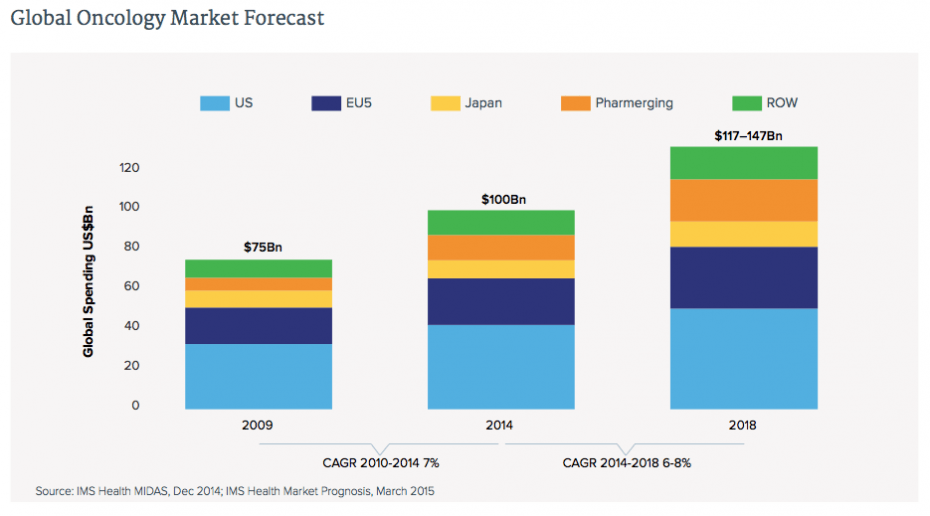
Spending on cancer drugs hit an all-time high last year, reaching the $100 billion mark worldwide for the first time, and cancer treatment outlays are expected to grow even faster in coming years given improvements in cancer care and survival rates.

The landmark figures come from a recent study by the IMS Institute for Healthcare Informatics. Growth in global spending on cancer drugs increased at a compound annual growth rate of 6.5% over the past five years (on a constant-dollar basis). Future spending on oncology medicines through 2018 is expected to grow as much as 8% annually. That spending remains concentrated largely in the U.S. and the five largest European countries, which together account for 66% of the total market for cancer drugs.

“The increased prevalence of most cancers, earlier treatment initiation, new medicines and improved outcomes are all contributing to the greater demand for oncology therapeutics around the world,” said Murray Aitken, IMS Health senior vice president and executive director of the IMS Institute for Healthcare Informatics.

Cancer medicines aren’t alone. Overall drug spending in the U.S. saw a significant boost in 2014, growing 13.1% last year after several years of declining rate increases, according to Express Scripts. Oncologic drugs’ share of total drug spending increased only slightly last year in the U.S., to 11.3% from 10.7% the year prior.

Spending on oncology drugs compared to other specialty indications is being driven higher by a confluence of factors. First off, better treatments and early diagnosis have increased the rate of cancer survivorship. Many patients with certain types of cancers, including prostate and liver cancer patients, are living longer as their cancer is treated more like a chronic illness that is controlled via ongoing therapy. Two-thirds of Americans diagnosed with cancer now live at least five years after their diagnosis, compared to just over half in 1990.

5-year-relative-survival_720

Secondly, those better drugs come with a corresponding price tag, especially given the rise of so-called precision medicine–i.e. drugs that are prescribed to target specific diseases based in part on the genetic profile of the patient or tumor. More than 1,000 of these tailored cancer treatments are in development, and we’ve already seen a handful hit the market. These drugs have the potential to vasty improve outcomes, but they often apply to only a small population and can cost $100,000 a year or more.

For instance, one of those targeted drugs, Keytruda, was approved by the Food and Drug Administration last year and has been lauded for increasing survival rates. It treats patients with genetically-linked metastatic melanoma and advanced, non-small cell lung cancer–and costs around $12,500 a month. That adds up to about $150,000 annually.

The use of these targeted therapies is growing. From 2010 to 2014, use of precision medicines grew by 14.6% worldwide, and they now represent 48% of total oncology spending, according to IMS. Spending is growing fastest in what IMS calls “pharmerging” countries–developing economies like China, Mexico and India, where spending is rising from a lower base.

Screen Shot 2015-05-08 at 2.23.30 PM
Courtesy of IMS

In the U.S., the mechanisms to control pricing on these drugs face some limitations. The Medicare Modernization Act of 2003 prohibits Medicare from negotiating drug prices directly with manufacturers, which presents a particular problem for the future of Medicare costs. As a result, many cancer drugs are much more expensive in the U.S. compared to Europe and other countries where their governments are allowed to directly negotiate with manufacturers.

That doesn’t, however, prevent private pharmacy benefits managers like Express Scripts (ESRX) or CVS/caremark (CVS) from negotiating down prices on expensive specialty drugs. That is exactly what they’re doing, which could help mute the growth in cancer treatment spending. Such negotiations, recently, wrung 40% discounts on pricey new hepatitis C therapies, though dealing with cancer drugs will be much more sensitive.

“This is going to be a much slower and much bigger effort over time,” Steve Miller, the chief medical officer for Express Scripts, said during the company’s earnings call late last month. “Cancer is different than any other disease, much more emotional.”

About the Author
By Laura Lorenzetti
See full bioRight Arrow Button Icon

Latest in Features

Finance
Lorem ipsum dolor sit amet, consectetur adipiscing elit, sed do eiusmod tempor incididunt ut labore et dolore magna aliqua. Ut enim ad minim veniam
By Fortune Editors
October 20, 2025
Finance
Lorem ipsum dolor sit amet, consectetur adipiscing elit, sed do eiusmod tempor incididunt ut labore et dolore magna aliqua. Ut enim ad minim veniam
By Fortune Editors
October 20, 2025
Finance
Lorem ipsum dolor sit amet, consectetur adipiscing elit, sed do eiusmod tempor incididunt ut labore et dolore magna aliqua. Ut enim ad minim veniam
By Fortune Editors
October 20, 2025
Finance
Lorem ipsum dolor sit amet, consectetur adipiscing elit, sed do eiusmod tempor incididunt ut labore et dolore magna aliqua. Ut enim ad minim veniam
By Fortune Editors
October 20, 2025
Finance
Lorem ipsum dolor sit amet, consectetur adipiscing elit, sed do eiusmod tempor incididunt ut labore et dolore magna aliqua. Ut enim ad minim veniam
By Fortune Editors
October 20, 2025
Finance
Lorem ipsum dolor sit amet, consectetur adipiscing elit, sed do eiusmod tempor incididunt ut labore et dolore magna aliqua. Ut enim ad minim veniam
By Fortune Editors
October 20, 2025

Most Popular

Finance
Lorem ipsum dolor sit amet, consectetur adipiscing elit, sed do eiusmod tempor incididunt ut labore et dolore magna aliqua. Ut enim ad minim veniam
By Fortune Editors
October 20, 2025
Finance
Lorem ipsum dolor sit amet, consectetur adipiscing elit, sed do eiusmod tempor incididunt ut labore et dolore magna aliqua. Ut enim ad minim veniam
By Fortune Editors
October 20, 2025
Finance
Lorem ipsum dolor sit amet, consectetur adipiscing elit, sed do eiusmod tempor incididunt ut labore et dolore magna aliqua. Ut enim ad minim veniam
By Fortune Editors
October 20, 2025
Finance
Lorem ipsum dolor sit amet, consectetur adipiscing elit, sed do eiusmod tempor incididunt ut labore et dolore magna aliqua. Ut enim ad minim veniam
By Fortune Editors
October 20, 2025
Finance
Lorem ipsum dolor sit amet, consectetur adipiscing elit, sed do eiusmod tempor incididunt ut labore et dolore magna aliqua. Ut enim ad minim veniam
By Fortune Editors
October 20, 2025
Finance
Lorem ipsum dolor sit amet, consectetur adipiscing elit, sed do eiusmod tempor incididunt ut labore et dolore magna aliqua. Ut enim ad minim veniam
By Fortune Editors
October 20, 2025
Fortune Secondary Logo
Rankings
  • 100 Best Companies
  • Fortune 500
  • Global 500
  • Fortune 500 Europe
  • Most Powerful Women
  • World's Most Admired Companies
  • See All Rankings
  • Lists Calendar
Sections
  • Finance
  • Fortune Crypto
  • Features
  • Leadership
  • Health
  • Commentary
  • Success
  • Retail
  • Mpw
  • Tech
  • Lifestyle
  • CEO Initiative
  • Asia
  • Politics
  • Conferences
  • Europe
  • Newsletters
  • Personal Finance
  • Environment
  • Magazine
  • Education
Customer Support
  • Frequently Asked Questions
  • Customer Service Portal
  • Privacy Policy
  • Terms Of Use
  • Single Issues For Purchase
  • International Print
Commercial Services
  • Advertising
  • Fortune Brand Studio
  • Fortune Analytics
  • Fortune Conferences
  • Business Development
  • Group Subscriptions
About Us
  • About Us
  • Press Center
  • Work At Fortune
  • Terms And Conditions
  • Site Map
  • About Us
  • Press Center
  • Work At Fortune
  • Terms And Conditions
  • Site Map
  • Facebook icon
  • Twitter icon
  • LinkedIn icon
  • Instagram icon
  • Pinterest icon

Latest in Features

Intel Chief Exec, Lip-Bu Tan, on stage
EuropeIntel
Intel’s share price just blew the doors off. One man thinks he knows the reason why
By Kamal AhmedApril 27, 2026
7 days ago
Who owns ideas in the AI age?
MagazinePublishing
Who owns ideas in the AI age?
By Francesca CassidyApril 8, 2026
26 days ago
The Walmart billionaires next door: Quiet backlash is brewing against the heirs who remade the retailer’s hometown
MagazineWalmart
The Walmart billionaires next door: Quiet backlash is brewing against the heirs who remade the retailer’s hometown
By Jessica MathewsApril 3, 2026
1 month ago
Have a strong brand in a world of noise—it’s like having the only red T-shirt in a stadium full of white ones
MagazineVolvo
Have a strong brand in a world of noise—it’s like having the only red T-shirt in a stadium full of white ones
By Kamal AhmedApril 2, 2026
1 month ago
Ken Griffin wants to reshape Miami—and maybe American politics
MagazineKen Griffin
Ken Griffin wants to reshape Miami—and maybe American politics
By Shawn TullyMarch 31, 2026
1 month ago
The world’s consumers are ready for robotaxis. James Peng of Pony AI wants to make sure they’re riding in his
MagazineChina
The world’s consumers are ready for robotaxis. James Peng of Pony AI wants to make sure they’re riding in his
By Nicholas GordonMarch 26, 2026
1 month ago

Most Popular

America got rich and got sad. A top economist says 2020 broke something that hasn't healed
Economy
America got rich and got sad. A top economist says 2020 broke something that hasn't healed
By Nick LichtenbergMay 3, 2026
17 hours ago
Scott Bessent on financial literacy: 'it drives me crazy' to see young men in blue-collar construction jobs playing the lottery
Personal Finance
Scott Bessent on financial literacy: 'it drives me crazy' to see young men in blue-collar construction jobs playing the lottery
By Fatima Hussein and The Associated PressMay 1, 2026
3 days ago
Gen Z is rebelling against the economy with ‘disillusionomics,’ tackling near 6-figure debt by turning life into a giant list of income streams
Economy
Gen Z is rebelling against the economy with ‘disillusionomics,’ tackling near 6-figure debt by turning life into a giant list of income streams
By Jacqueline MunisMay 2, 2026
2 days ago
Sam Altman says the quiet part out loud, confirming some companies are ‘AI washing’ by blaming unrelated layoffs on the technology
AI
Sam Altman says the quiet part out loud, confirming some companies are ‘AI washing’ by blaming unrelated layoffs on the technology
By Sasha RogelbergMay 3, 2026
16 hours ago
I spent a decade selling homes to the ultra-wealthy. What I saw explains the housing market's nepo problem
Commentary
I spent a decade selling homes to the ultra-wealthy. What I saw explains the housing market's nepo problem
By Blake O'ShaughnessyMay 3, 2026
17 hours ago
China dominates the world's lithium supply. The U.S. just found 328 years' worth in its own backyard
North America
China dominates the world's lithium supply. The U.S. just found 328 years' worth in its own backyard
By Jake AngeloApril 30, 2026
3 days ago

© 2026 Fortune Media IP Limited. All Rights Reserved. Use of this site constitutes acceptance of our Terms of Use and Privacy Policy | CA Notice at Collection and Privacy Notice | Do Not Sell/Share My Personal Information
FORTUNE is a trademark of Fortune Media IP Limited, registered in the U.S. and other countries. FORTUNE may receive compensation for some links to products and services on this website. Offers may be subject to change without notice.