• Home
  • Latest
  • Fortune 500
  • Finance
  • Tech
  • Leadership
  • Lifestyle
  • Rankings
  • Multimedia
Features

Cancer drug spending hit $100 billion in 2014. Here’s why it’ll soon be much higher

By
Laura Lorenzetti
Laura Lorenzetti
Down Arrow Button Icon
By
Laura Lorenzetti
Laura Lorenzetti
Down Arrow Button Icon
May 8, 2015, 3:35 PM ET
Courtesy of IMS

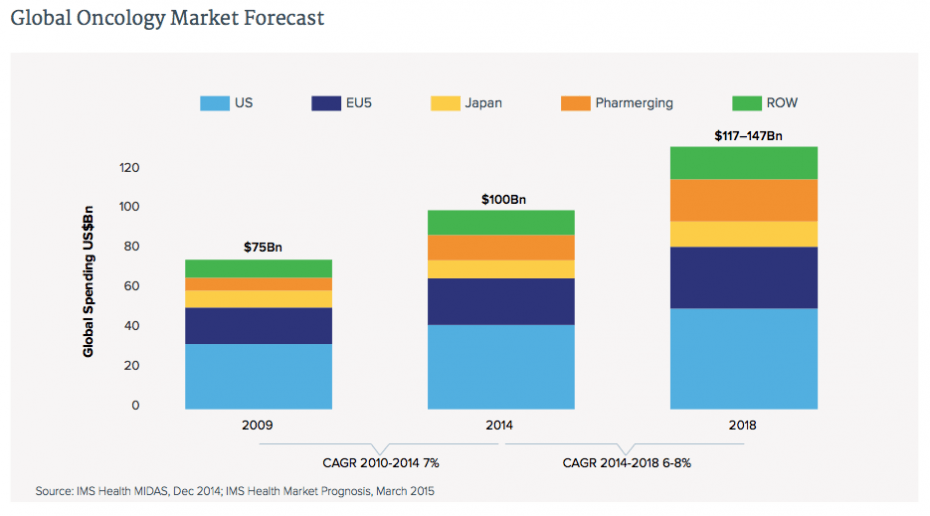
Spending on cancer drugs hit an all-time high last year, reaching the $100 billion mark worldwide for the first time, and cancer treatment outlays are expected to grow even faster in coming years given improvements in cancer care and survival rates.

The landmark figures come from a recent study by the IMS Institute for Healthcare Informatics. Growth in global spending on cancer drugs increased at a compound annual growth rate of 6.5% over the past five years (on a constant-dollar basis). Future spending on oncology medicines through 2018 is expected to grow as much as 8% annually. That spending remains concentrated largely in the U.S. and the five largest European countries, which together account for 66% of the total market for cancer drugs.

“The increased prevalence of most cancers, earlier treatment initiation, new medicines and improved outcomes are all contributing to the greater demand for oncology therapeutics around the world,” said Murray Aitken, IMS Health senior vice president and executive director of the IMS Institute for Healthcare Informatics.

Cancer medicines aren’t alone. Overall drug spending in the U.S. saw a significant boost in 2014, growing 13.1% last year after several years of declining rate increases, according to Express Scripts. Oncologic drugs’ share of total drug spending increased only slightly last year in the U.S., to 11.3% from 10.7% the year prior.

Spending on oncology drugs compared to other specialty indications is being driven higher by a confluence of factors. First off, better treatments and early diagnosis have increased the rate of cancer survivorship. Many patients with certain types of cancers, including prostate and liver cancer patients, are living longer as their cancer is treated more like a chronic illness that is controlled via ongoing therapy. Two-thirds of Americans diagnosed with cancer now live at least five years after their diagnosis, compared to just over half in 1990.

5-year-relative-survival_720

Secondly, those better drugs come with a corresponding price tag, especially given the rise of so-called precision medicine–i.e. drugs that are prescribed to target specific diseases based in part on the genetic profile of the patient or tumor. More than 1,000 of these tailored cancer treatments are in development, and we’ve already seen a handful hit the market. These drugs have the potential to vasty improve outcomes, but they often apply to only a small population and can cost $100,000 a year or more.

For instance, one of those targeted drugs, Keytruda, was approved by the Food and Drug Administration last year and has been lauded for increasing survival rates. It treats patients with genetically-linked metastatic melanoma and advanced, non-small cell lung cancer–and costs around $12,500 a month. That adds up to about $150,000 annually.

The use of these targeted therapies is growing. From 2010 to 2014, use of precision medicines grew by 14.6% worldwide, and they now represent 48% of total oncology spending, according to IMS. Spending is growing fastest in what IMS calls “pharmerging” countries–developing economies like China, Mexico and India, where spending is rising from a lower base.

Screen Shot 2015-05-08 at 2.23.30 PM
Courtesy of IMS

In the U.S., the mechanisms to control pricing on these drugs face some limitations. The Medicare Modernization Act of 2003 prohibits Medicare from negotiating drug prices directly with manufacturers, which presents a particular problem for the future of Medicare costs. As a result, many cancer drugs are much more expensive in the U.S. compared to Europe and other countries where their governments are allowed to directly negotiate with manufacturers.

That doesn’t, however, prevent private pharmacy benefits managers like Express Scripts (ESRX) or CVS/caremark (CVS) from negotiating down prices on expensive specialty drugs. That is exactly what they’re doing, which could help mute the growth in cancer treatment spending. Such negotiations, recently, wrung 40% discounts on pricey new hepatitis C therapies, though dealing with cancer drugs will be much more sensitive.

“This is going to be a much slower and much bigger effort over time,” Steve Miller, the chief medical officer for Express Scripts, said during the company’s earnings call late last month. “Cancer is different than any other disease, much more emotional.”


About the Author
By Laura Lorenzetti
See full bioRight Arrow Button Icon

Latest in Features

FeaturesThe Boring Company
Two firefighters suffered chemical burns in a Boring Co. tunnel. Then the Nevada Governor’s office got involved, and the penalties disappeared
By Jessica Mathews and Leo SchwartzNovember 12, 2025
1 month ago
CoreWeave executives pose in front of the Nasdaq building on the day of the company's IPO.
AIData centers
Data-center operator CoreWeave is a stock-market darling. Bears see its finances as emblematic of an AI infrastructure bubble
By Jeremy Kahn and Leo SchwartzNovember 8, 2025
1 month ago
Libery Energy's hydraulic fracturing, or frac, spreads are increasingly electrified with natural gas power, a technology now translating to powering data centers.
Energy
AI’s insatiable need for power is driving an unexpected boom in oil-fracking company stocks 
By Jordan BlumOctober 23, 2025
2 months ago
Politics
Huge AI data centers are turning local elections into fights over the future of energy
By Sharon GoldmanOctober 22, 2025
2 months ago
A plane carrying Donald Trump Jr. arrives in January in Nuuk, Greenland, where he is making a short private visit after his father, President Trump, suggested Washington annex the autonomous Danish territory.
EnergyGreenland
A Texas company plans to drill for oil in Greenland despite a climate change ban and Trump’s desire to annex the territory
By Jordan BlumOctober 22, 2025
2 months ago
Three of the founders of Multiverse Computing.
AIChange the World
From WhatsApp friends to a $500 million–plus valuation: These founders argue their tiny AI models are better for customers and the planet
By Vivienne WaltOctober 9, 2025
2 months ago

Most Popular

placeholder alt text
Success
Apple cofounder Ronald Wayne sold his 10% stake for $800 in 1976—today it’d be worth up to $400 billion
By Preston ForeDecember 12, 2025
2 days ago
placeholder alt text
Success
40% of Stanford undergrads receive disability accommodations—but it’s become a college-wide phenomenon as Gen Z try to succeed in the current climate
By Preston ForeDecember 12, 2025
2 days ago
placeholder alt text
Economy
Tariffs are taxes and they were used to finance the federal government until the 1913 income tax. A top economist breaks it down
By Kent JonesDecember 12, 2025
3 days ago
placeholder alt text
Uncategorized
Transforming customer support through intelligent AI operations
By Lauren ChomiukNovember 26, 2025
18 days ago
placeholder alt text
Economy
More financially distressed farmers are expected to lose their property soon as loan repayments and incomes continue to falter
By Jason MaDecember 13, 2025
1 day ago
placeholder alt text
Economy
The Fed just ‘Trump-proofed’ itself with a unanimous move to preempt a potential leadership shake-up
By Jason MaDecember 12, 2025
2 days ago
Rankings
  • 100 Best Companies
  • Fortune 500
  • Global 500
  • Fortune 500 Europe
  • Most Powerful Women
  • Future 50
  • World’s Most Admired Companies
  • See All Rankings
Sections
  • Finance
  • Leadership
  • Success
  • Tech
  • Asia
  • Europe
  • Environment
  • Fortune Crypto
  • Health
  • Retail
  • Lifestyle
  • Politics
  • Newsletters
  • Magazine
  • Features
  • Commentary
  • Mpw
  • CEO Initiative
  • Conferences
  • Personal Finance
  • Education
Customer Support
  • Frequently Asked Questions
  • Customer Service Portal
  • Privacy Policy
  • Terms Of Use
  • Single Issues For Purchase
  • International Print
Commercial Services
  • Advertising
  • Fortune Brand Studio
  • Fortune Analytics
  • Fortune Conferences
  • Business Development
About Us
  • About Us
  • Editorial Calendar
  • Press Center
  • Work At Fortune
  • Diversity And Inclusion
  • Terms And Conditions
  • Site Map

© 2025 Fortune Media IP Limited. All Rights Reserved. Use of this site constitutes acceptance of our Terms of Use and Privacy Policy | CA Notice at Collection and Privacy Notice | Do Not Sell/Share My Personal Information
FORTUNE is a trademark of Fortune Media IP Limited, registered in the U.S. and other countries. FORTUNE may receive compensation for some links to products and services on this website. Offers may be subject to change without notice.