• Home
  • Latest
  • Fortune 500
  • Finance
  • Tech
  • Leadership
  • Lifestyle
  • Rankings
  • Multimedia
Leadership

American taxpayers give an $18 billion gift to the post office every year

By
Chris Matthews
Chris Matthews
Down Arrow Button Icon
By
Chris Matthews
Chris Matthews
Down Arrow Button Icon
March 27, 2015, 12:22 PM ET
Video Poster

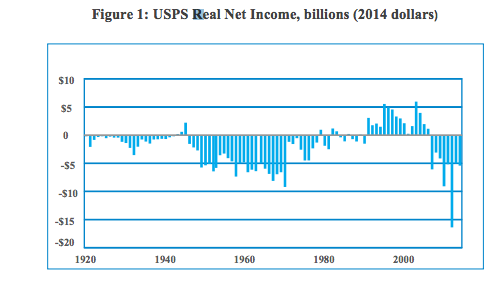
The United States Postal Service’s financial troubles have been well publicized in recent years. The worst of it came in 2012, when the USPS lost a whopping $15.9 billion dollars, followed by $4.8 billion and $5.3 billion in 2013 and 2014, respectively.

Post office officials have often attributed the losses to the decline in demand for first class mail in favor of more efficient modes of communication, and congressional mandates that the USPS do things like deliver mail on Saturdays and to unprofitable parts of the country. In fact, the USPS claims that if it weren’t for such requirements, it would more or less break even.

But as Robert Shapiro—former Treasury undersecretary and chairman of the economic consultancy Sonecon—points out in a new analysis, American taxpayers subsidize the USPS at a rate that surpasses the costs associated with any Congressional mandate. He estimates that, all told, the subsidies and legal monopolies that Congress bestows upon the post office is worth $18 billion annually. These include:

Laws that bar any other shipping service from delivering mail and packages directly to residential and business mailboxes. Shapiro estimates that this gives the Post Office a $14 billion annual boost, more than three times what the Postal Regulatory Commission estimates it to be. Shapiro argues that the PRC’s analysis doesn’t take into account the productivity gains that the Post Office would be forced to make if it really had to compete for mailbox delivery. He points out that productivity at USPS has only grown by 0.7% per year versus 2.5% for its competition.

Tax breaks. The Post Office is exempt from state and local property and real estate taxes, along with other burdens like tolls, vehicle registration fees, and parking tickets. These exemptions save the USPS $2.18 billion per year.

Cheap borrowing. The Postal Service, writes Shapiro, “can borrow from the U.S. Treasury through the Federal Financing Bank, at highly-subsidized interest rates.” It currently borrows the legal limit of $15.2 billion at a rate of 1.2%. Without this access, it would be paying somewhere between $415 million and $490 million per year more in interest.

Finally, Shapiro points out that the USPS pays its workers salaries and benefits far above the rates paid to similar workers in the private sector. Labor accounted for 78% of the organization’s costs in 2014, “with about 89% of those costs involving employees represented by collective bargaining.” These higher labor costs, plus the absence of a need to innovate due to government-granted monopolies, has freed the USPS from $20 billion in labor and productivity costs per year, Shapiro estimates. “While we do not technically count this as a subsidy,” he writes, it represents an economic burden on others arising directly from USPS’s monopoly position.” Postage, for instance, would likely be cheaper for everyone if the organization were subject to the same competitive pressures as private firms.

It’s remarkable that the United States, which has a reputation for being more free market-oriented than other rich nations, maintains this government-mandated monopoly. Over the past several decades, the process of European integration led to the deregulation and privatization of European postal monopolies, with generally good results.

Given the inability for Congress and the White House to agree on even basic legislation, it’s unlikely that any major changes to the Post Office will be coming soon. After all, the Post Office’s losses aren’t an anomaly. It has spent a large part of its history in the red, as this chart from Shapiro shows:
Screen Shot 2015-03-27 at 9.49.58 AM

Meanwhile, the $18 billion in subsidies given to the USPS are spread imperceptibly over the entire country, while the costs of privatization would be borne heavily by a few. Folks in rural areas might have to pay much more to lure private businesses to deliver mail.

The Post Office employs 618,000 people—more than any civilian employer besides Wal Mart. Given the pay disparities between the Post Office and private employers, these people would be highly motivated to block any significant change to the current system.

That said, the benefits the rest of us bestow on the USPS are enormous. None of this will help you calm down the next time you are waiting on a line that just won’t move at your local post office.


About the Author
By Chris Matthews
See full bioRight Arrow Button Icon

Latest in Leadership

Finance
Lorem ipsum dolor sit amet, consectetur adipiscing elit, sed do eiusmod tempor incididunt ut labore et dolore magna aliqua. Ut enim ad minim veniam
By Fortune Editors
October 20, 2025
Finance
Lorem ipsum dolor sit amet, consectetur adipiscing elit, sed do eiusmod tempor incididunt ut labore et dolore magna aliqua. Ut enim ad minim veniam
By Fortune Editors
October 20, 2025
Finance
Lorem ipsum dolor sit amet, consectetur adipiscing elit, sed do eiusmod tempor incididunt ut labore et dolore magna aliqua. Ut enim ad minim veniam
By Fortune Editors
October 20, 2025
Finance
Lorem ipsum dolor sit amet, consectetur adipiscing elit, sed do eiusmod tempor incididunt ut labore et dolore magna aliqua. Ut enim ad minim veniam
By Fortune Editors
October 20, 2025
Finance
Lorem ipsum dolor sit amet, consectetur adipiscing elit, sed do eiusmod tempor incididunt ut labore et dolore magna aliqua. Ut enim ad minim veniam
By Fortune Editors
October 20, 2025
Finance
Lorem ipsum dolor sit amet, consectetur adipiscing elit, sed do eiusmod tempor incididunt ut labore et dolore magna aliqua. Ut enim ad minim veniam
By Fortune Editors
October 20, 2025

Most Popular

Finance
Lorem ipsum dolor sit amet, consectetur adipiscing elit, sed do eiusmod tempor incididunt ut labore et dolore magna aliqua. Ut enim ad minim veniam
By Fortune Editors
October 20, 2025
Finance
Lorem ipsum dolor sit amet, consectetur adipiscing elit, sed do eiusmod tempor incididunt ut labore et dolore magna aliqua. Ut enim ad minim veniam
By Fortune Editors
October 20, 2025
Finance
Lorem ipsum dolor sit amet, consectetur adipiscing elit, sed do eiusmod tempor incididunt ut labore et dolore magna aliqua. Ut enim ad minim veniam
By Fortune Editors
October 20, 2025
Finance
Lorem ipsum dolor sit amet, consectetur adipiscing elit, sed do eiusmod tempor incididunt ut labore et dolore magna aliqua. Ut enim ad minim veniam
By Fortune Editors
October 20, 2025
Finance
Lorem ipsum dolor sit amet, consectetur adipiscing elit, sed do eiusmod tempor incididunt ut labore et dolore magna aliqua. Ut enim ad minim veniam
By Fortune Editors
October 20, 2025
Finance
Lorem ipsum dolor sit amet, consectetur adipiscing elit, sed do eiusmod tempor incididunt ut labore et dolore magna aliqua. Ut enim ad minim veniam
By Fortune Editors
October 20, 2025
Fortune Secondary Logo
Rankings
  • 100 Best Companies
  • Fortune 500
  • Global 500
  • Fortune 500 Europe
  • Most Powerful Women
  • World's Most Admired Companies
  • See All Rankings
  • Lists Calendar
Sections
  • Finance
  • Fortune Crypto
  • Features
  • Leadership
  • Health
  • Commentary
  • Success
  • Retail
  • Mpw
  • Tech
  • Lifestyle
  • CEO Initiative
  • Asia
  • Politics
  • Conferences
  • Europe
  • Newsletters
  • Personal Finance
  • Environment
  • Magazine
  • Education
Customer Support
  • Frequently Asked Questions
  • Customer Service Portal
  • Privacy Policy
  • Terms Of Use
  • Single Issues For Purchase
  • International Print
Commercial Services
  • Advertising
  • Fortune Brand Studio
  • Fortune Analytics
  • Fortune Conferences
  • Business Development
  • Group Subscriptions
About Us
  • About Us
  • Press Center
  • Work At Fortune
  • Terms And Conditions
  • Site Map
  • About Us
  • Press Center
  • Work At Fortune
  • Terms And Conditions
  • Site Map
  • Facebook icon
  • Twitter icon
  • LinkedIn icon
  • Instagram icon
  • Pinterest icon

Latest in Leadership

Andrew McAfee
SuccessCareers
MIT AI expert warns automating Gen Z entry-level jobs could backfire—and cost companies their future workforce
By Preston ForeMay 1, 2026
5 minutes ago
francis
CommentaryFlorida
Former Miami Mayor Francis Suarez: Why I’m joining Stephen Ross and Ken Griffin in betting big on ambitious business leaders
By Francis SuarezMay 1, 2026
53 minutes ago
elon
LawOpenAI
Elon Musk gets testy on the stand: ‘I thought I had started a nonprofit with OpenAI but they stole it’
By Barbara Ortutay and The Associated PressMay 1, 2026
2 hours ago
valerie
CommentaryLayoffs
Tesla’s former HR chief: the AI layoff panic Is built on a false premise—here’s what most workers need to know
By Valerie Capers WorkmanMay 1, 2026
2 hours ago
AI
AIdisruption
Meet the Americans dismissing AI hype and using it with ingenuity: ‘The efficiencies gained out of it have been tremendous’
By Cathy Bussewitz and The Associated PressMay 1, 2026
2 hours ago
bessent
Personal FinanceFinancial Literacy
Scott Bessent on financial literacy: ‘it drives me crazy’ to see young men in blue-collar construction jobs playing the lottery
By Fatima Hussein and The Associated PressMay 1, 2026
2 hours ago

Most Popular

China dominates the world's lithium supply. The U.S. just found 328 years' worth in its own backyard
North America
China dominates the world's lithium supply. The U.S. just found 328 years' worth in its own backyard
By Jake AngeloApril 30, 2026
21 hours ago
Accenture's Julie Sweet blew up 50 years of company history. She says the hardest part is still ahead
Conferences
Accenture's Julie Sweet blew up 50 years of company history. She says the hardest part is still ahead
By Nick LichtenbergApril 29, 2026
2 days ago
Apple cofounder Ronald Wayne—whose stake would be worth up to $400 billion had he not sold it in 1976—says that at 91, he has no regrets
Success
Apple cofounder Ronald Wayne—whose stake would be worth up to $400 billion had he not sold it in 1976—says that at 91, he has no regrets
By Preston ForeApril 27, 2026
4 days ago
America shot its arsenal empty in 2 wars. Now it needs Beijing's permission to reload
Commentary
America shot its arsenal empty in 2 wars. Now it needs Beijing's permission to reload
By Steve H. Hanke and Jeffrey WengApril 30, 2026
22 hours ago
Exclusive: America's largest Black-owned bank launches podcast with mission to unlock hidden shame holding back generational wealth
Banking
Exclusive: America's largest Black-owned bank launches podcast with mission to unlock hidden shame holding back generational wealth
By Nick LichtenbergApril 29, 2026
2 days ago
The U.S. economy is booming — just not where 50 million Americans live
Commentary
The U.S. economy is booming — just not where 50 million Americans live
By Derek KilmerMay 1, 2026
7 hours ago

© 2026 Fortune Media IP Limited. All Rights Reserved. Use of this site constitutes acceptance of our Terms of Use and Privacy Policy | CA Notice at Collection and Privacy Notice | Do Not Sell/Share My Personal Information
FORTUNE is a trademark of Fortune Media IP Limited, registered in the U.S. and other countries. FORTUNE may receive compensation for some links to products and services on this website. Offers may be subject to change without notice.