• Home
  • Latest
  • Fortune 500
  • Finance
  • Tech
  • Leadership
  • Lifestyle
  • Rankings
  • Multimedia
Commentary

Self-driving cars: the first potentially deadly robots?

By
Jonathan Handel
Jonathan Handel
and
Grady Johnson
Grady Johnson
Down Arrow Button Icon
By
Jonathan Handel
Jonathan Handel
and
Grady Johnson
Grady Johnson
Down Arrow Button Icon
February 25, 2015, 11:00 AM ET
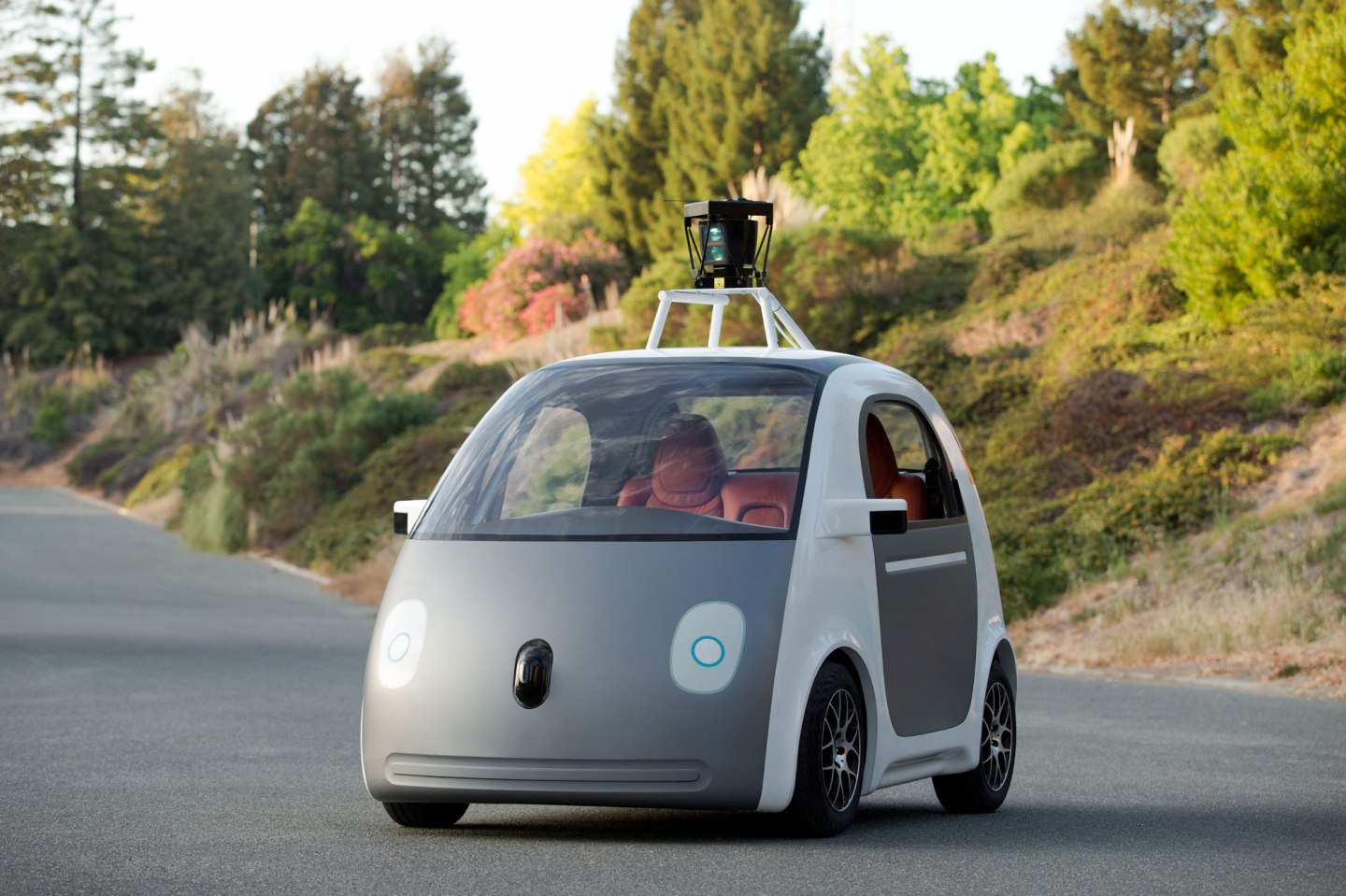
One of Google's self-driving cars.
One of Google's self-driving cars.Courtesy: Google

Ever since Google introduced its self-driving Prius in 2010, there’s been a lot of excitement over driverless cars. Automakers from Ford to Audi to Mercedes are developing their own autonomous vehicles. But while there seems to be a lot of promise here, we need more than the manufacturers’ word before we start deploying 3,000-pound robots on public streets.

Anyone who’s ever written more than a dozen lines of code knows that you can’t test software just by using it. As the U.S. Food and Drug Administration has said of life-critical systems such as pacemakers, “testing alone cannot fully verify that software is complete and correct. … Except for the simplest of programs, software cannot be exhaustively tested.” You have to read and analyze the code. Even seemingly simple software can be deceptively complex, and buried deep in all the if-then-else statements and self-referential subroutines may be dormant errors: division by zero, stack overflows, corrupted variables and other programming nightmares that can produce catastrophic failures.

And a self-driving car is more than a dozen lines of code; it’s more like tens of millions. Those cars live at the intersection of two wildly complex types of software. On the one hand, they’re “expert systems” or “artificial intelligence” – software and hardware that includes human-like capabilities and judgment. But they’re also “hard real-time systems” – software that interacts with the physical world in real time and where delay can result in injury or death. Yet Google (GOOG) and the auto manufacturers want to write regulators out of the picture. The ethical dimensions are also complex. Despite the incredible feat of engineering that driverless cars represent, teaching them to do the best thing when there are no good choices – when an accident is unavoidable – may prove to be especially challenging.

For humans, the rules are pretty basic: be attentive, stay sober, stay awake, don’t speed, don’t text, and don’t leave the scene of an accident. But we can and should expect more from a computer, which can react faster than a person.

We might ask, for instance, if a child darts in front of a driverless car on a one-lane road, with the car boxed in by opposing traffic on its left, should the car swerve to its right onto an apparently clear sidewalk to avoid the child? That’s not legal, presumably, but maybe it ought to be. “Stay in your lane and hit the brakes” isn’t necessarily the best answer if the car knows that death will be the result. And unlike humans, who are forced to react on instinct, a driverless car can assess the situation quickly enough that it actually gets to make a choice.

Indeed, the car will have to make a choice. In fact, the decision will have been programmed well in advance by its engineers. Each driverless car that pulls off the lot will have already made Sophie’s choice, or a multitude of them. And as cars get better at knowing their environment, the hard decisions will multiply.

But who is making those choices, and how?

Today, the answer is unclear. It could be a lone programmer on a tight deadline, working late to complete an overdue piece of code. Or it could be a lawyer seeking to limit company liability. Yet there’s a public interest here that should be represented. These are social, societal decisions. They’re public roadways. And there’s already evidence that individuals don’t want companies unilaterally making these decisions.

Driverless cars are code with consequences, and the public interest needs to be represented. We believe there should be Institutional Review Boards (IRBs) set up as adjuncts to the companies. Analogous to such boards in medicine, self-driving car IRBs should be legally required to adhere to standards in both their composition and their operation, to encompass the relevant expertise and major stakeholders including the companies, public, lawyers, government and ethicists. That would allow applying a range of nuance and expertise.

When it comes to safety, privacy, ethics and a host of issues, what we do today matters – and not just for cars. Self-driving cars are the first potentially deadly robots the public will meet, but they won’t be the last. Indeed, Google itself recently bought a half-dozen robotics companies – including a 6-foot tall humanoid that looks like the Terminator and Nest, a company that wants to put sensors in your home. At some point, we may need a broader solution, like a federal robotics commission.

Jonathan Handel is an entertainment and technology attorney in Los Angeles and former computer scientist. Grady Johnson is an Associate Technologist at New America’s Open Technology Institute.

About the Authors
By Jonathan Handel
See full bioRight Arrow Button Icon
By Grady Johnson
See full bioRight Arrow Button Icon

Latest in Commentary

Finance
Lorem ipsum dolor sit amet, consectetur adipiscing elit, sed do eiusmod tempor incididunt ut labore et dolore magna aliqua. Ut enim ad minim veniam
By Fortune Editors
October 20, 2025
Finance
Lorem ipsum dolor sit amet, consectetur adipiscing elit, sed do eiusmod tempor incididunt ut labore et dolore magna aliqua. Ut enim ad minim veniam
By Fortune Editors
October 20, 2025
Finance
Lorem ipsum dolor sit amet, consectetur adipiscing elit, sed do eiusmod tempor incididunt ut labore et dolore magna aliqua. Ut enim ad minim veniam
By Fortune Editors
October 20, 2025
Finance
Lorem ipsum dolor sit amet, consectetur adipiscing elit, sed do eiusmod tempor incididunt ut labore et dolore magna aliqua. Ut enim ad minim veniam
By Fortune Editors
October 20, 2025
Finance
Lorem ipsum dolor sit amet, consectetur adipiscing elit, sed do eiusmod tempor incididunt ut labore et dolore magna aliqua. Ut enim ad minim veniam
By Fortune Editors
October 20, 2025
Finance
Lorem ipsum dolor sit amet, consectetur adipiscing elit, sed do eiusmod tempor incididunt ut labore et dolore magna aliqua. Ut enim ad minim veniam
By Fortune Editors
October 20, 2025

Most Popular

Finance
Lorem ipsum dolor sit amet, consectetur adipiscing elit, sed do eiusmod tempor incididunt ut labore et dolore magna aliqua. Ut enim ad minim veniam
By Fortune Editors
October 20, 2025
Finance
Lorem ipsum dolor sit amet, consectetur adipiscing elit, sed do eiusmod tempor incididunt ut labore et dolore magna aliqua. Ut enim ad minim veniam
By Fortune Editors
October 20, 2025
Finance
Lorem ipsum dolor sit amet, consectetur adipiscing elit, sed do eiusmod tempor incididunt ut labore et dolore magna aliqua. Ut enim ad minim veniam
By Fortune Editors
October 20, 2025
Finance
Lorem ipsum dolor sit amet, consectetur adipiscing elit, sed do eiusmod tempor incididunt ut labore et dolore magna aliqua. Ut enim ad minim veniam
By Fortune Editors
October 20, 2025
Finance
Lorem ipsum dolor sit amet, consectetur adipiscing elit, sed do eiusmod tempor incididunt ut labore et dolore magna aliqua. Ut enim ad minim veniam
By Fortune Editors
October 20, 2025
Finance
Lorem ipsum dolor sit amet, consectetur adipiscing elit, sed do eiusmod tempor incididunt ut labore et dolore magna aliqua. Ut enim ad minim veniam
By Fortune Editors
October 20, 2025
Rankings
  • 100 Best Companies
  • Fortune 500
  • Global 500
  • Fortune 500 Europe
  • Most Powerful Women
  • Future 50
  • World’s Most Admired Companies
  • See All Rankings
Sections
  • Finance
  • Leadership
  • Success
  • Tech
  • Asia
  • Europe
  • Environment
  • Fortune Crypto
  • Health
  • Retail
  • Lifestyle
  • Politics
  • Newsletters
  • Magazine
  • Features
  • Commentary
  • Mpw
  • CEO Initiative
  • Conferences
  • Personal Finance
  • Education
Customer Support
  • Frequently Asked Questions
  • Customer Service Portal
  • Privacy Policy
  • Terms Of Use
  • Single Issues For Purchase
  • International Print
Commercial Services
  • Advertising
  • Fortune Brand Studio
  • Fortune Analytics
  • Fortune Conferences
  • Business Development
About Us
  • About Us
  • Editorial Calendar
  • Press Center
  • Work At Fortune
  • Diversity And Inclusion
  • Terms And Conditions
  • Site Map
  • Facebook icon
  • Twitter icon
  • LinkedIn icon
  • Instagram icon
  • Pinterest icon

© 2026 Fortune Media IP Limited. All Rights Reserved. Use of this site constitutes acceptance of our Terms of Use and Privacy Policy | CA Notice at Collection and Privacy Notice | Do Not Sell/Share My Personal Information
FORTUNE is a trademark of Fortune Media IP Limited, registered in the U.S. and other countries. FORTUNE may receive compensation for some links to products and services on this website. Offers may be subject to change without notice.


Most Popular

placeholder alt text
North America
'I meant what I said in Davos': Carney says he really is planning a Canada split with the U.S. along with 12 new trade deals
By Rob Gillies and The Associated PressJanuary 28, 2026
10 hours ago
placeholder alt text
Commentary
Yes, you're getting a bigger tax refund. Your kids won't thank you for the $3 trillion it's adding to the deficit
By Daniel BunnJanuary 26, 2026
2 days ago
placeholder alt text
Personal Finance
Current price of silver as of Tuesday, January 27, 2026
By Joseph HostetlerJanuary 27, 2026
1 day ago
placeholder alt text
C-Suite
Fortune 500 CEOs are no longer giving employees an A for effort. Now they want proof of impact
By Claire ZillmanJanuary 28, 2026
17 hours ago
placeholder alt text
Real Estate
Ryan Serhant thinks the American Dream was just a 'slogan created by banks,' but it was really about FDR, the Great Depression, and an economic crisis
By Sydney Lake and Nick LichtenbergJanuary 26, 2026
2 days ago
placeholder alt text
Success
As AI wipes out desk jobs, Citigroup CEO Jane Fraser says the company is training 175,000 employees to ‘reinvent themselves’ before their roles change forever
By Emma BurleighJanuary 27, 2026
1 day ago

Latest in Commentary

belichick
CommentarySports
Football snubs Bill Belichick, one of its greatest ever coaches—showing how his unapologetic leadership style came with a cost
By Nick LichtenbergJanuary 28, 2026
5 hours ago
hanrahan
CommentarySocial Media
How social media upended the 75-year-old playbook of big CPG
By Oisín HanrahanJanuary 28, 2026
10 hours ago
trump
CommentaryHousing
Banning investors won’t fix America’s housing shortage
By Edward Peter StringhamJanuary 28, 2026
11 hours ago
reem
Commentaryhunger
How to fight child hunger in a time of foreign aid cuts
By Reem Alabali Radovan, Rajiv J. Shah and Mads Krogsgaard ThomsenJanuary 28, 2026
15 hours ago
kids
CommentaryGen Z
Coming soon: a lost generation of employee talent?
By Patrick E. HopkinsJanuary 27, 2026
1 day ago
Man at his laptop working on taxes
CommentaryTaxes
Yes, you’re getting a bigger tax refund. Your kids won’t thank you for the $3 trillion it’s adding to the deficit
By Daniel BunnJanuary 26, 2026
2 days ago