• Home
  • Latest
  • Fortune 500
  • Finance
  • Tech
  • Leadership
  • Lifestyle
  • Rankings
  • Multimedia
Commentary

The hype over driverless cars: is it overdone?

By
Nicholas Carr
Nicholas Carr
Down Arrow Button Icon
By
Nicholas Carr
Nicholas Carr
Down Arrow Button Icon
February 18, 2015, 7:00 AM ET
Inside The 2015 Consumer Electronics Show
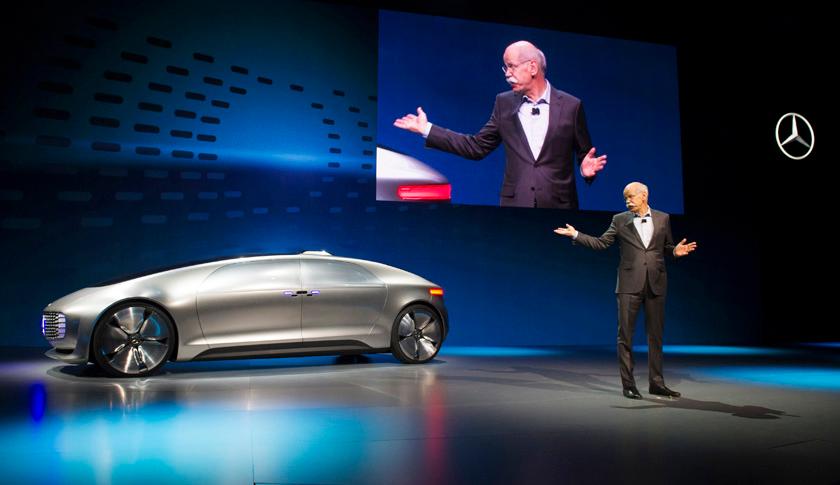
Dieter Zetsche, chief executive officer of Daimler AG, gestures as he speaks about the Mercedes-Benz F015 concept vehicle at a news conference during the 2015 Consumer Electronics Show (CES) in Las Vegas, Nevada, U.S., on Monday, Jan. 5, 2015. Mercedes-Benz aims to transform the car into a rolling luxury lounge that chauffeurs passengers autonomously. Photographer: David Paul Morris/Bloomberg via Getty ImagesPhotograph by David Paul Morris — Bloomberg via Getty Images

Visitors to last month’s Consumer Electronics Show in Las Vegas might have thought that they’d stumbled into the Detroit Auto Show by mistake. Carmakers were everywhere at CES, with automotive exhibits occupying some four acres of floor space.

On display were whizzy driving apps and expansive dashboard monitors. But what generated the most buzz were prototypes of autonomous, or “self-driving,” vehicles. Mercedes unveiled its F015 “Luxury in Motion” concept car, which features touchpad door panels along with robotic steering and speed-control systems. Audi pitched its A7 Prologue sedan, a test version of which drove itself to Las Vegas from Silicon Valley, with only occasional human assistance. And BMW showed off a car that can snoop out an open spot in a parking garage and slip into it — without anyone at the wheel.

The excitement about autonomous cars has been building ever since Google(GOOG) introduced its self-driving Prius in 2010. But the hype, and the sense of inevitability it provokes, is misleading. Ford CEO Mark Fields, one of several top car executives speaking at CES, made headlines when he predicted that “fully autonomous vehicles” would likely be on sale by the end of the decade. What went unreported was a more detailed explanation offered by Raj Nair, Ford’s top engineer. Nair explained that “full automation” would be possible only in limited circumstances, particularly “where high definition mapping is available along with favorable environmental conditions for the vehicle’s sensors.” In other situations, human drivers would remain firmly “in the loop.”

As Nair’s remarks made clear, we’re still a long way from having robotic chauffeurs that can reliably drive cars through any traffic scenario without the aid and oversight of a capable human being. While it may be relatively straightforward to design a car that can drive itself down a limited-access highway in good weather, programming it to navigate chaotic city or suburban streets or to make its way through a snowstorm or a downpour poses much harder challenges. Many engineers and automation experts believe it will take decades of further development to build a completely autonomous car, and some warn that it may never happen, at least not without a massive and very expensive overhaul of our road system.

At a car conference last September, Steven Shladover, a research engineer at the University of California at Berkeley, explained that automotive automation presents far more daunting challenges than aircraft automation. Cars travel much closer together than planes do; they have less room to maneuver in emergencies, and drivers have to deal with a welter of earthly obstacles, from jaywalkers to work crews to potholes. Developing a driverless car, Shladover said, will be orders of magnitude harder than developing a pilotless airliner. It’s going to be a long time, he cautioned, before we’ll be able to curl up in the back seat while a robot drives us to work.

Even if perfect automation remains beyond our reach, progress in automotive robotics will sprint forward. Top-end luxury cars are already highly automated, able to center themselves in a lane and adjust their speed to fit traffic conditions, and computers are set to take over many more driving tasks in the years ahead. As always, though, the road to the future will have many twists and forks. The choices that companies and designers make in automating cars will influence not only how we drive but how we live. As we learned in the last century, advances in personal-transportation technologies can have profound consequences for everything from housing to urban planning to energy policy.

Consider safety. It’s often assumed that automation will reduce traffic accidents, if not eliminate them entirely. But that’s not necessarily the case. Research into human-computer interaction reveals that partial automation can actually make complex tasks like driving more dangerous. People relying on automation quickly become complacent, trusting the computer to perform flawlessly, and that raises the odds that they’ll make mistakes when they have to reengage with the work, particularly in an emergency. A study of drivers by U.K. scholars Neville Stanton and Mark Young found that while shifting routine driving chores to computers can reduce workload and stress, it also “lulls drivers into a false sense of security.” They lose “situational awareness,” which can have tragic consequences when split-second reactions are required to avoid an accident.

The risks will likely be magnified during the long transitional period when automobiles with varying degrees of automation share the road. Given that the average American passenger vehicle is more than 11 years old, there will be “at least a several-decade-long period during which conventional and self-driving vehicles would need to interact,” report Michael Sivak and Brandon Schoettle of the University of Michigan’s Transportation Research Institute. That becomes problematic when you take into account driving’s complex psychology. When we change lanes, enter traffic, or execute other tricky maneuvers, we tend to make quick, intuitive decisions based on our experience of how other drivers act. But all those deeply learned assumptions may no longer apply when the other driver is a robot. Just the loss of eye contact between human drivers, Sivak and Schoettle warn, could introduce new and unexpected risks, particularly for drivers of older, less automated cars.

Beyond the knotty technical questions are equally complicated social ones. Peter Norton, a transportation expert at the University of Virginia, points out that the way autonomous vehicles are designed will have a profound influence on people’s driving habits. If automation makes driving and parking easier, and in particular if it allows commuters to do other things while in their cars, it could end up encouraging people to drive more often or to commute over longer distances. Cities and suburbs would become even more congested, highway infrastructure would come under more stress, and investments in public transport might wither further. “If we rebuild the landscape for autonomous vehicles,” Norton cautions, “we may make it unsuitable for anything else — including walking.”

On the other hand, if we design autonomous vehicles as part of a thoughtful overhaul of the nation’s transit systems, the new cars could play a part in reducing traffic, curtailing air pollution, and engendering more livable cities. It’s a mistake, Norton argues, to view autonomous cars in isolation, and it’s an even bigger mistake to assume that automotive automation will be a panacea for complex problems like traffic and safety. “Before we make autonomous cars the solution,” he writes, “we must formulate the problem correctly.”

In 1893, the great U.S. historian Henry Adams visited the World’s Fair in Chicago. He found himself entranced by the many exhibits dedicated to the nascent technology of electrification. The soaring towers of light bulbs and the massively powerful dynamos amazed him. But the new technology also worried him. He wondered, as he would later write in his autobiography, “whether the American people knew where they were driving.” That same question, though with a more literal edge, confronts us again today as computerized cars throng our streets and highways.

Nicholas Carr is the author of the new book The Glass Cage: Automation and Us.

About the Author
By Nicholas Carr
See full bioRight Arrow Button Icon

Latest in Commentary

Finance
Lorem ipsum dolor sit amet, consectetur adipiscing elit, sed do eiusmod tempor incididunt ut labore et dolore magna aliqua. Ut enim ad minim veniam
By Fortune Editors
October 20, 2025
Finance
Lorem ipsum dolor sit amet, consectetur adipiscing elit, sed do eiusmod tempor incididunt ut labore et dolore magna aliqua. Ut enim ad minim veniam
By Fortune Editors
October 20, 2025
Finance
Lorem ipsum dolor sit amet, consectetur adipiscing elit, sed do eiusmod tempor incididunt ut labore et dolore magna aliqua. Ut enim ad minim veniam
By Fortune Editors
October 20, 2025
Finance
Lorem ipsum dolor sit amet, consectetur adipiscing elit, sed do eiusmod tempor incididunt ut labore et dolore magna aliqua. Ut enim ad minim veniam
By Fortune Editors
October 20, 2025
Finance
Lorem ipsum dolor sit amet, consectetur adipiscing elit, sed do eiusmod tempor incididunt ut labore et dolore magna aliqua. Ut enim ad minim veniam
By Fortune Editors
October 20, 2025
Finance
Lorem ipsum dolor sit amet, consectetur adipiscing elit, sed do eiusmod tempor incididunt ut labore et dolore magna aliqua. Ut enim ad minim veniam
By Fortune Editors
October 20, 2025

Most Popular

Finance
Lorem ipsum dolor sit amet, consectetur adipiscing elit, sed do eiusmod tempor incididunt ut labore et dolore magna aliqua. Ut enim ad minim veniam
By Fortune Editors
October 20, 2025
Finance
Lorem ipsum dolor sit amet, consectetur adipiscing elit, sed do eiusmod tempor incididunt ut labore et dolore magna aliqua. Ut enim ad minim veniam
By Fortune Editors
October 20, 2025
Finance
Lorem ipsum dolor sit amet, consectetur adipiscing elit, sed do eiusmod tempor incididunt ut labore et dolore magna aliqua. Ut enim ad minim veniam
By Fortune Editors
October 20, 2025
Finance
Lorem ipsum dolor sit amet, consectetur adipiscing elit, sed do eiusmod tempor incididunt ut labore et dolore magna aliqua. Ut enim ad minim veniam
By Fortune Editors
October 20, 2025
Finance
Lorem ipsum dolor sit amet, consectetur adipiscing elit, sed do eiusmod tempor incididunt ut labore et dolore magna aliqua. Ut enim ad minim veniam
By Fortune Editors
October 20, 2025
Finance
Lorem ipsum dolor sit amet, consectetur adipiscing elit, sed do eiusmod tempor incididunt ut labore et dolore magna aliqua. Ut enim ad minim veniam
By Fortune Editors
October 20, 2025
Fortune Secondary Logo
Rankings
  • 100 Best Companies
  • Fortune 500
  • Global 500
  • Fortune 500 Europe
  • Most Powerful Women
  • Future 50
  • World’s Most Admired Companies
  • See All Rankings
Sections
  • Finance
  • Fortune Crypto
  • Features
  • Leadership
  • Health
  • Commentary
  • Success
  • Retail
  • Mpw
  • Tech
  • Lifestyle
  • CEO Initiative
  • Asia
  • Politics
  • Conferences
  • Europe
  • Newsletters
  • Personal Finance
  • Environment
  • Magazine
  • Education
Customer Support
  • Frequently Asked Questions
  • Customer Service Portal
  • Privacy Policy
  • Terms Of Use
  • Single Issues For Purchase
  • International Print
Commercial Services
  • Advertising
  • Fortune Brand Studio
  • Fortune Analytics
  • Fortune Conferences
  • Business Development
  • Group Subscriptions
About Us
  • About Us
  • Editorial Calendar
  • Press Center
  • Work At Fortune
  • Diversity And Inclusion
  • Terms And Conditions
  • Site Map
  • About Us
  • Editorial Calendar
  • Press Center
  • Work At Fortune
  • Diversity And Inclusion
  • Terms And Conditions
  • Site Map
  • Facebook icon
  • Twitter icon
  • LinkedIn icon
  • Instagram icon
  • Pinterest icon

Latest in Commentary

Anita Beveridge-Raffo is Head of Retail and Consumer Goods at Palantir Technologies
CommentaryAI agents
Palantir exec: the biggest mistake retailers are making with AI? Trying to do it all with one agent
By Anita Beveridge-RaffoApril 16, 2026
16 hours ago
wyle
CommentaryHealth
‘The Pitt’ reveals why healthcare desperately needs a new front door
By Jeremy MorganApril 16, 2026
16 hours ago
health
CommentaryHealth Care Service
Two physicians on ending the waiting-room era: bring care home
By Benjamin Kornitzer and Bill FristApril 16, 2026
18 hours ago
venezuela
Commentaryhappiness
The world’s most — and least — miserable economies in 2025, ranked
By Steve H. HankeApril 16, 2026
18 hours ago
fauber
Commentarytrust
Moody’s CEO: AI has a trust problem – better models won’t fix it
By Rob FauberApril 16, 2026
18 hours ago
bostrom
CommentaryMedical
Top New York surgeon: Americans have better data for choosing restaurants than surgeons. That has to change
By Mathias P. BostromApril 16, 2026
20 hours ago

Most Popular

Jeff Bezos pledged $10 billion for climate change. With the 2030 clock ticking, his wife, Lauren Sánchez Bezos, is leading the charge to spend it
Environment
Jeff Bezos pledged $10 billion for climate change. With the 2030 clock ticking, his wife, Lauren Sánchez Bezos, is leading the charge to spend it
By Sydney LakeApril 15, 2026
2 days ago
A world going broke: IMF says America's $39 trillion national debt is actually a global problem—and AI may be the only rescue
Economy
A world going broke: IMF says America's $39 trillion national debt is actually a global problem—and AI may be the only rescue
By Nick LichtenbergApril 16, 2026
9 hours ago
Germany already told its workers to ditch four-day weeks and work-life balance. Now the government wants to cut their pay for calling in sick, too
Success
Germany already told its workers to ditch four-day weeks and work-life balance. Now the government wants to cut their pay for calling in sick, too
By Orianna Rosa RoyleApril 16, 2026
22 hours ago
MacKenzie Scott is bypassing the Ivy League and rewriting the $79 billion higher ed playbook by giving to HBCUs and community colleges
Politics
MacKenzie Scott is bypassing the Ivy League and rewriting the $79 billion higher ed playbook by giving to HBCUs and community colleges
By Sydney LakeApril 16, 2026
14 hours ago
Billionaire philanthropist MacKenzie Scott has donated again—a week after gifting millions to a college, she's just given $70 million to Meals on Wheels America
Success
Billionaire philanthropist MacKenzie Scott has donated again—a week after gifting millions to a college, she's just given $70 million to Meals on Wheels America
By Emma BurleighApril 13, 2026
4 days ago
Current price of oil as of April 16, 2026
Personal Finance
Current price of oil as of April 16, 2026
By Joseph HostetlerApril 16, 2026
17 hours ago

© 2026 Fortune Media IP Limited. All Rights Reserved. Use of this site constitutes acceptance of our Terms of Use and Privacy Policy | CA Notice at Collection and Privacy Notice | Do Not Sell/Share My Personal Information
FORTUNE is a trademark of Fortune Media IP Limited, registered in the U.S. and other countries. FORTUNE may receive compensation for some links to products and services on this website. Offers may be subject to change without notice.