• Home
  • Latest
  • Fortune 500
  • Finance
  • Tech
  • Leadership
  • Lifestyle
  • Rankings
  • Multimedia
Finance

The cost of winter storms: Should we believe economists?

By
Chris Matthews
Chris Matthews
Down Arrow Button Icon
By
Chris Matthews
Chris Matthews
Down Arrow Button Icon
February 12, 2015, 1:59 PM ET
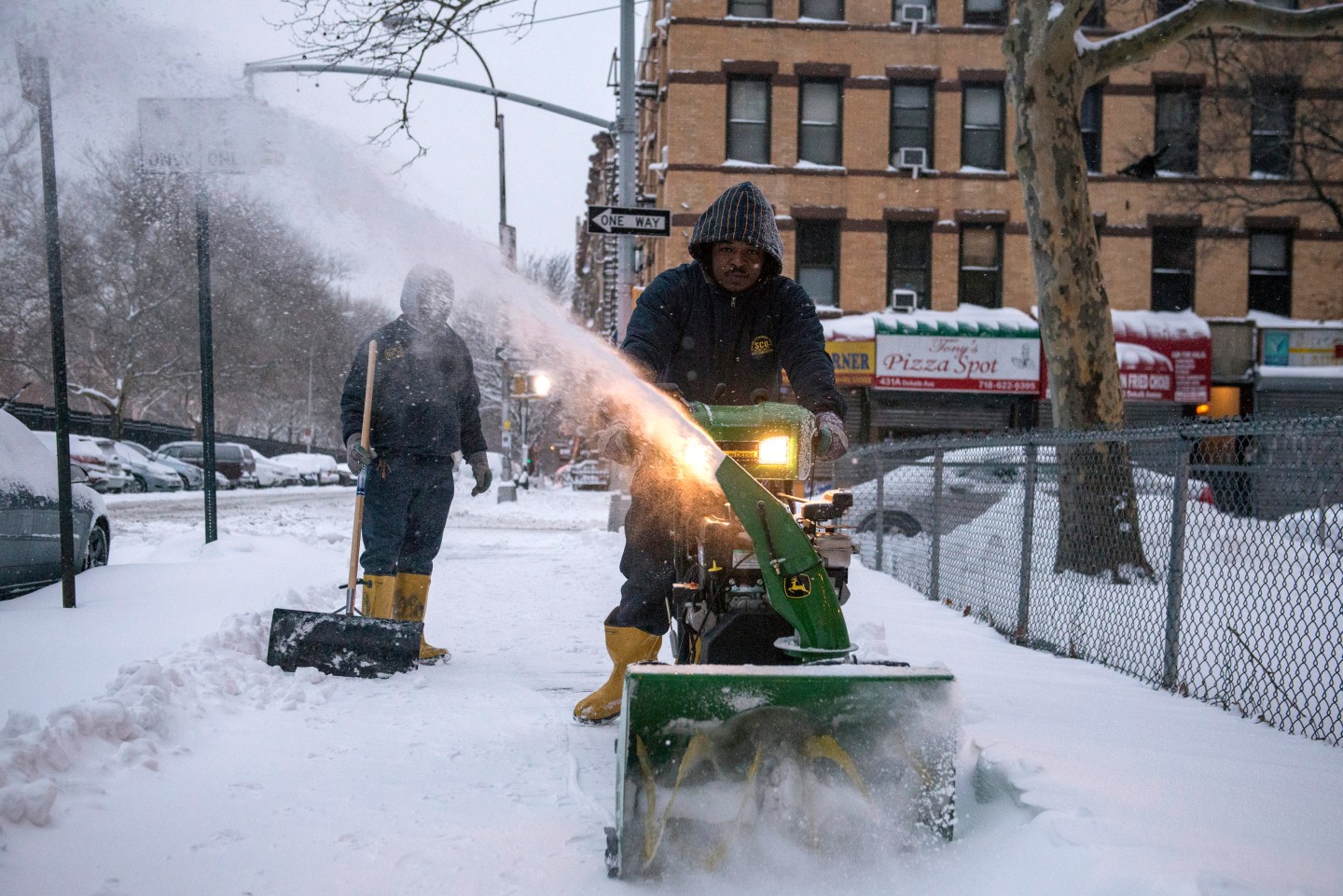
A man plows a sidewalk after a snow storm in the Brooklyn borough of New York
A man plows a sidewalk after a snow storm in the Brooklyn borough of New York January 27, 2015. A blizzard swept across the northeastern United States on Tuesday, dropping as much as 2 feet (60 cm) of snow across Massachusetts and Connecticut even as its impact on New York City fell short of dire predictions. The governors of New York and New Jersey lifted travel bans they had imposed a day earlier and New York City's subway system restarted after being closed for 10 hours, though officials urged people to stay off snow-covered roadways. REUTERS/Stephanie Keith (UNITED STATES - Tags: ENVIRONMENT) - RTR4N70EPhotograph by Stephanie Keith — Reuters

We hear it every winter: pronouncements that a blizzard cost the U.S. economy hundreds of millions of dollars.

But in an era when so much business can be done over the phone and online, these estimates leave some scratching their heads. Could a simple snowstorm really cost the U.S. upwards of $1 billion, as some economists predicted of January’s blizzard that shut down New York City?

The short answer: yes, it can.

But it’s not that simple. First of all, the media knows that by pointing out that something “costs” $1 billion, it will get people’s attention. After all, if a reader could somehow get ahold of that money, he and his family could avoid working for generations to come. It’s a lot of money.

But for the $17 trillion U.S. economy, it’s chump change. It’s .005% of the country’s annual output. On a per-capita basis, it’s $3.17. On a conceptual level, it would probably be more honest to write that the next storm could cost you $3.17. (In fact, for the median Joe it would be much less, since income is unevenly distributed). That at least communicates the magnitude of the effect on the economy in a way that the average person can understand. Of course, if news reporters did really put these figures into such context, the public would realize that a story about the economic impact of an average blizzard wouldn’t be worth reading at all.

That said, where do these hundreds of millions of lost dollars actually come from? According to Doug Handler, an economist at IHS Global Economics, one of the biggest hits the economy takes is in the form of lost wages for hourly employees. While salaried office workers get paid even if they can’t make it to work and can likely even work from home, hourly employees aren’t so fortunate. And it’s not as if all these workers can simply make up the money on another day.

The economy also takes a hit from lost sales at places like restaurants or retailers. Some of that consumer spending gets made up at a later date. If you are, for instance, planning to buy a car, a snowstorm will merely delay your purchase. But if you had planned to eat out the night of the storm, it’s not certain that you will still buy that meal another time. Another big contributor to lost economic activity is cancelled plane flights. It’s costly to cancel and reschedule flights, and in many cases, some routes will not be rescheduled at all.

There is a certain point at which a snowstorm can go from being a small economic obstacle to something a bit more pernicious. That’s what happened in the winter of 2013-2014, when a series of severe snowstorms across America helped the economy shrink by 2.1% in the first quarter of 2014. In that instance, the bad weather was persistent enough to mess with supply chains. Trucks and air freight couldn’t get to their destinations, mucking up inventory management. That led not only to fewer consumer purchases, but also to companies buying less than they otherwise would.

But even in the case of sustained periods of very bad weather like what we saw in the Northeast and Midwest last winter, estimating the economic effects involves a lot of guesswork. Economists know that output fell in the first quarter of last year in a way that isn’t consistent with broader economic conditions, and they also know that snowfall levels were much higher and temperatures were much lower than usual in some of the most productive areas of the country.

weather1_7_25_14

Economists also make use of qualitative and quantitative survey data from the Federal Reserve and private groups to connect the dots. But in the end. it’s impossible to know for sure how big a role weather plays in the economy. As Handler says, “it’s more an art than a science.”


About the Author
By Chris Matthews
See full bioRight Arrow Button Icon

Latest in Finance

EconomyFederal Reserve
The Fed just ‘Trump-proofed’ itself with a unanimous move to preempt a potential leadership shakeup
By Jason MaDecember 12, 2025
59 minutes ago
robots
InnovationRobots
‘The question is really just how long it will take’: Over 2,000 gather at Humanoids Summit to meet the robots who may take their jobs someday
By Matt O'Brien and The Associated PressDecember 12, 2025
2 hours ago
Man about to go into police vehicle
CryptoCryptocurrency
Judge tells notorious crypto scammer ‘you have been bitten by the crypto bug’ in handing down 15 year sentence 
By Carlos GarciaDecember 12, 2025
3 hours ago
Donald Trump, sitting in the Roosevelt Room, looks forward and frowns.
EconomyTariffs and trade
For the first time since Trump’s tariff rollout, import tax revenue has fallen, threatening his lofty plans to slash the $38 trillion national debt
By Sasha RogelbergDecember 12, 2025
3 hours ago
Personal Financemortgages
7 best HELOC lenders in 2025: How to choose the best home equity line of credit for your situation
By Joseph HostetlerDecember 12, 2025
3 hours ago
Personal FinanceCertificates of Deposit (CDs)
Truist CD rates 2025: Probably not your best option (but here’s how to decide)
By Joseph HostetlerDecember 12, 2025
4 hours ago

Most Popular

placeholder alt text
Economy
Tariffs are taxes and they were used to finance the federal government until the 1913 income tax. A top economist breaks it down
By Kent JonesDecember 12, 2025
12 hours ago
placeholder alt text
Success
At 18, doctors gave him three hours to live. He played video games from his hospital bed—and now, he’s built a $10 million-a-year video game studio
By Preston ForeDecember 10, 2025
3 days ago
placeholder alt text
Success
Palantir cofounder calls elite college undergrads a ‘loser generation’ as data reveals rise in students seeking support for disabilities, like ADHD
By Preston ForeDecember 11, 2025
1 day ago
placeholder alt text
Investing
Baby boomers have now 'gobbled up' nearly one-third of America's wealth share, and they're leaving Gen Z and millennials behind
By Sasha RogelbergDecember 8, 2025
4 days ago
placeholder alt text
Arts & Entertainment
'We're not just going to want to be fed AI slop for 16 hours a day': Analyst sees Disney/OpenAI deal as a dividing line in entertainment history
By Nick LichtenbergDecember 11, 2025
24 hours ago
placeholder alt text
Uncategorized
Transforming customer support through intelligent AI operations
By Lauren ChomiukNovember 26, 2025
16 days ago
Rankings
  • 100 Best Companies
  • Fortune 500
  • Global 500
  • Fortune 500 Europe
  • Most Powerful Women
  • Future 50
  • World’s Most Admired Companies
  • See All Rankings
Sections
  • Finance
  • Leadership
  • Success
  • Tech
  • Asia
  • Europe
  • Environment
  • Fortune Crypto
  • Health
  • Retail
  • Lifestyle
  • Politics
  • Newsletters
  • Magazine
  • Features
  • Commentary
  • Mpw
  • CEO Initiative
  • Conferences
  • Personal Finance
  • Education
Customer Support
  • Frequently Asked Questions
  • Customer Service Portal
  • Privacy Policy
  • Terms Of Use
  • Single Issues For Purchase
  • International Print
Commercial Services
  • Advertising
  • Fortune Brand Studio
  • Fortune Analytics
  • Fortune Conferences
  • Business Development
About Us
  • About Us
  • Editorial Calendar
  • Press Center
  • Work At Fortune
  • Diversity And Inclusion
  • Terms And Conditions
  • Site Map

© 2025 Fortune Media IP Limited. All Rights Reserved. Use of this site constitutes acceptance of our Terms of Use and Privacy Policy | CA Notice at Collection and Privacy Notice | Do Not Sell/Share My Personal Information
FORTUNE is a trademark of Fortune Media IP Limited, registered in the U.S. and other countries. FORTUNE may receive compensation for some links to products and services on this website. Offers may be subject to change without notice.