• Home
  • Latest
  • Fortune 500
  • Finance
  • Tech
  • Leadership
  • Lifestyle
  • Rankings
  • Multimedia
TechShipping

Slow progress at America’s biggest (and most dysfunctional) port

By
David Z. Morris
David Z. Morris
Down Arrow Button Icon
By
David Z. Morris
David Z. Morris
Down Arrow Button Icon
February 6, 2015, 10:54 AM ET
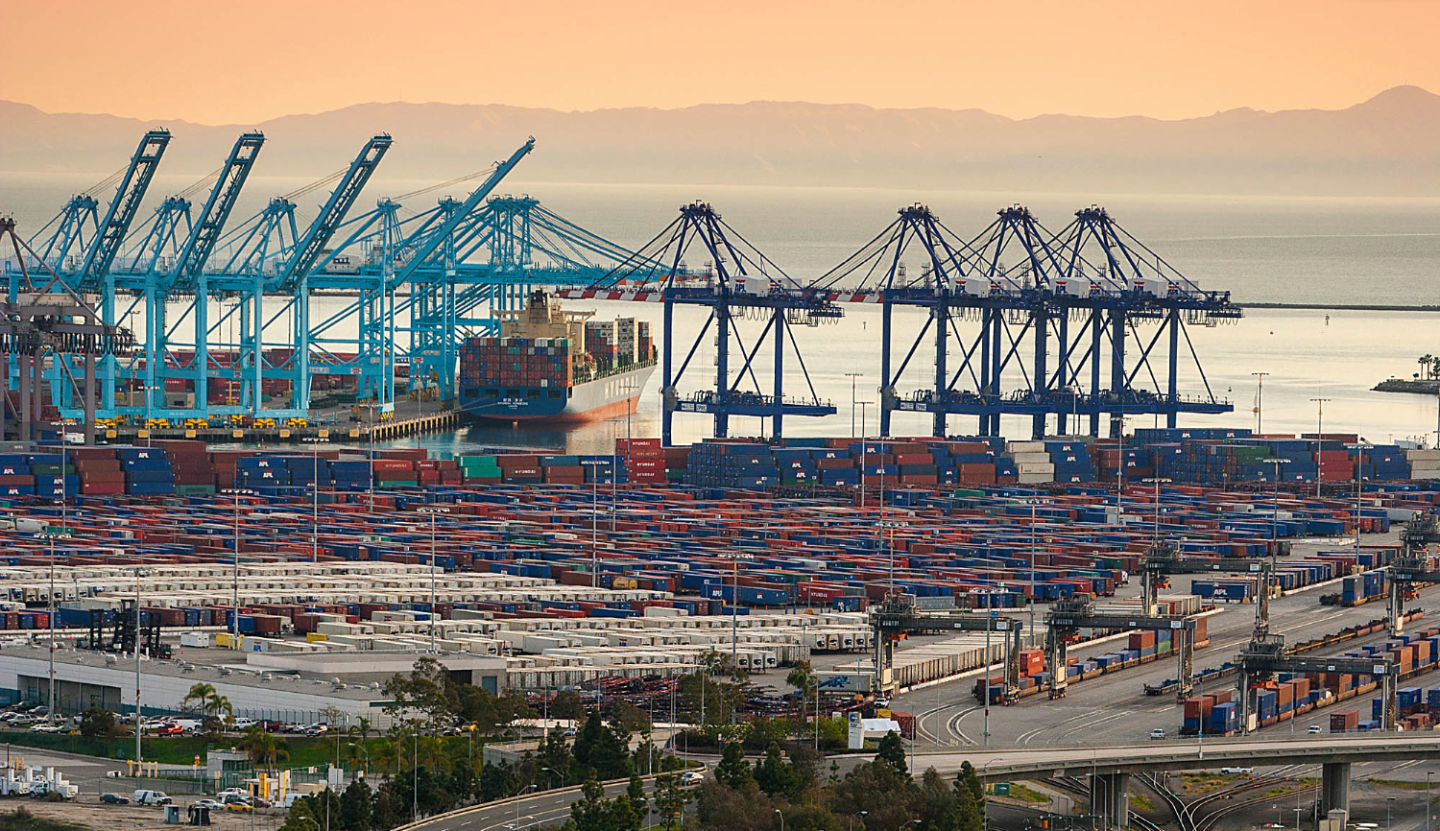
CROPPED: Aerial Views Of The $2.4 Billion Alameda Corridor Rail Cargo Expressway Project
The Port of Los Angeles in Feb. 2013.Photograph by Tim Rue — Bloomberg/Getty Images

The adjacent ports of Los Angeles and Long Beach in California are the beating heart of United States international trade. They handle two-thirds of all ocean cargo volume on the West Coast, and more than one-third of all volume in the U.S. Their steel ventricles sprawl over more than 11 square miles of land—one-third the size of Manhattan. Tugboats weighing tons look like bathtub toys next to container ships the size of city blocks. Squadrons of semi trucks and mile-long trains disappear into the horizon, pumping goods from across Asia eastward to American manufacturers, businesses, and consumers.

Since last summer, though, changes in shipping technology and practices at L.A.-Long Beach have slowed the flow of trade through the port. Starting in October 2014, a labor slowdown by longshoremen worsened problems and spread them to other ports along the West Coast. Cargo unloading times have more than doubled to the slowest rate in a decade. Twenty-five-ton containers are now stacked five deep, frustrated truckers spend hours waiting for their loads, and full ships wait at anchor for an open terminal.

Retailers avoided a disastrous disruption of the prime Christmas shipping season—late summer and early fall—only through canny planning and some expensive short-term solutions. “Leading into the [labor] negotiations, retailers were looking at contingency planning options, knowing how negotiations typically go,” says Jonathan Gold, vice president of supply chain and customs policy at the National Retail Federation. “[They’ve been] bringing cargo in early, and shifting to non-West Coast ports like Canada, Mexico, East Coast, Gulf Coast. And the last option is air cargo.”

Those workarounds kept store shelves stocked for the 2014 winter holidays, but the costs of compensating for port congestion have been substantial. Ocean carriers have begun to levy congestion surcharges against cargo owners, despite some initial hesitation. And while the Targets (TGT) and Wal-Marts (WMT) of the world were able to adjust their surface shipping plans, many small and mid-size retailers were forced to rely on air cargo to get Christmas shipments on time. Gold says that additional costs of air cargo for individual retailers have run into the millions of dollars.

The single biggest factor in the costly chaos at L.A.-Long Beach is amazingly mundane: a change in the handling of the long, wheeled chassis that allow semi trucks to pull shipping containers from the ports to their destinations inland.

For many years, these chassis were owned by the same ocean cargo companies that own container ships. But many shipping lines, in part to heal balance sheets wounded by the global recession, have recently spun off or sold their chassis to equipment leasing companies including Flexi-Van, TRAC, and Direct ChassisLink (a former Maersk subsidiary). The transition has been extremely rocky.

“The chassis availability is scrambled, because there are all these companies that were supposed to have taken over, but didn’t have things entirely together,” says Val Naronha, president of the port research firm Digital Geographic. “If I [as a trucker entering a terminal] haven’t made my own arrangements for a chassis, I turn around. I’ve achieved nothing at the terminal having waited all that time.”

The chassis logjam may begin to clear up this month as an agreement among chassis providers establishes a common pool of chassis, making them easier to manage. But other factors contributing to congestion have no clear resolution timeline. Poor pay and conditions for truckers have caused driver shortages and discontent, while overall U.S. rail shipping capacity is under pressure from rising oil and gas loads from Midwest fracking operations. It’s simply getting harder to get loads out of port, even as overall volume increases.

The ongoing automation of L.A.-Long Beach has also, ironically, added to congestion, as longshoremen have demanded work-stopping safety reviews at the automated terminal run by TraPac. Other problems include bottlenecks caused by ever-larger ships and extra congestion caused by the timing of port workers’ lunch breaks.

For ports and labor unions, who are now in the ninth month of negotiations to renew a contract that expired in July, the sclerosis at L.A.-Long Beach has become ammunition in a war of position: the ports argue that longshoremen are engaged in an illegal slowdown, but workers blame the ports and carriers.

“The true origins of the crisis involve other industry problems and bad decisions,” says Craig Merrilees, spokesperson for the International Longshore and Warehouse Union, which represents West Coast dockworkers. “The resulting mess has left customers angry, public port officials frazzled, and workers frustrated because the congestion makes their jobs more dangerous.”

But there has been rising congestion even at West Coast ports with fewer operational issues than L.A.-Long Beach, which some say proves that a labor slowdown is a major factor. “The ports at Seattle and Tacoma had been running at about 25 to 35 [container] moves per hour,” says Wade Gates, a representative of the Pacific Maritime Association, which negotiates with the longshoremen on behalf of port operators. “And at one point in time [in late 2014] that actually moved to as low as 10 to 14.”

“At L.A. and Long Beach,” continues Gates, “We’re seeing the unions . . . make a difficult situation even worse.”

One of the situation’s few bright spots is that a complete labor stoppage is unlikely. “They will not shut down the ports,” says Bill Mongelluzzo of the shipping trade publication The Journal of Commerce. “The ILWU doesn’t want to attract federal mediation.”

Even once the chassis gridlock clears and the labor slowdown ends, though, the multiple chronic issues facing West Coast ports have observers wondering whether the future will be much smoother.

“We know trade is going to continue to grow,” says the NRF’s Gold. “Looking at how our ports work today, we’re not ready.”


About the Author
By David Z. Morris
See full bioRight Arrow Button Icon

Latest in Tech

Finance
Lorem ipsum dolor sit amet, consectetur adipiscing elit, sed do eiusmod tempor incididunt ut labore et dolore magna aliqua. Ut enim ad minim veniam
By Fortune Editors
October 20, 2025
Finance
Lorem ipsum dolor sit amet, consectetur adipiscing elit, sed do eiusmod tempor incididunt ut labore et dolore magna aliqua. Ut enim ad minim veniam
By Fortune Editors
October 20, 2025
Finance
Lorem ipsum dolor sit amet, consectetur adipiscing elit, sed do eiusmod tempor incididunt ut labore et dolore magna aliqua. Ut enim ad minim veniam
By Fortune Editors
October 20, 2025
Finance
Lorem ipsum dolor sit amet, consectetur adipiscing elit, sed do eiusmod tempor incididunt ut labore et dolore magna aliqua. Ut enim ad minim veniam
By Fortune Editors
October 20, 2025
Finance
Lorem ipsum dolor sit amet, consectetur adipiscing elit, sed do eiusmod tempor incididunt ut labore et dolore magna aliqua. Ut enim ad minim veniam
By Fortune Editors
October 20, 2025
Finance
Lorem ipsum dolor sit amet, consectetur adipiscing elit, sed do eiusmod tempor incididunt ut labore et dolore magna aliqua. Ut enim ad minim veniam
By Fortune Editors
October 20, 2025

Most Popular

Finance
Lorem ipsum dolor sit amet, consectetur adipiscing elit, sed do eiusmod tempor incididunt ut labore et dolore magna aliqua. Ut enim ad minim veniam
By Fortune Editors
October 20, 2025
Finance
Lorem ipsum dolor sit amet, consectetur adipiscing elit, sed do eiusmod tempor incididunt ut labore et dolore magna aliqua. Ut enim ad minim veniam
By Fortune Editors
October 20, 2025
Finance
Lorem ipsum dolor sit amet, consectetur adipiscing elit, sed do eiusmod tempor incididunt ut labore et dolore magna aliqua. Ut enim ad minim veniam
By Fortune Editors
October 20, 2025
Finance
Lorem ipsum dolor sit amet, consectetur adipiscing elit, sed do eiusmod tempor incididunt ut labore et dolore magna aliqua. Ut enim ad minim veniam
By Fortune Editors
October 20, 2025
Finance
Lorem ipsum dolor sit amet, consectetur adipiscing elit, sed do eiusmod tempor incididunt ut labore et dolore magna aliqua. Ut enim ad minim veniam
By Fortune Editors
October 20, 2025
Finance
Lorem ipsum dolor sit amet, consectetur adipiscing elit, sed do eiusmod tempor incididunt ut labore et dolore magna aliqua. Ut enim ad minim veniam
By Fortune Editors
October 20, 2025
Fortune Secondary Logo
Rankings
  • 100 Best Companies
  • Fortune 500
  • Global 500
  • Fortune 500 Europe
  • Most Powerful Women
  • Future 50
  • World’s Most Admired Companies
  • See All Rankings
Sections
  • Finance
  • Fortune Crypto
  • Features
  • Leadership
  • Health
  • Commentary
  • Success
  • Retail
  • Mpw
  • Tech
  • Lifestyle
  • CEO Initiative
  • Asia
  • Politics
  • Conferences
  • Europe
  • Newsletters
  • Personal Finance
  • Environment
  • Magazine
  • Education
Customer Support
  • Frequently Asked Questions
  • Customer Service Portal
  • Privacy Policy
  • Terms Of Use
  • Single Issues For Purchase
  • International Print
Commercial Services
  • Advertising
  • Fortune Brand Studio
  • Fortune Analytics
  • Fortune Conferences
  • Business Development
About Us
  • About Us
  • Editorial Calendar
  • Press Center
  • Work At Fortune
  • Diversity And Inclusion
  • Terms And Conditions
  • Site Map
Fortune Secondary Logo
  • About Us
  • Editorial Calendar
  • Press Center
  • Work At Fortune
  • Diversity And Inclusion
  • Terms And Conditions
  • Site Map
  • Facebook icon
  • Twitter icon
  • LinkedIn icon
  • Instagram icon
  • Pinterest icon

Latest in Tech

sam altman
AIOpenAI
Sam Altman tells staff at an all-hands that OpenAI is negotiating a deal with the Pentagon, after Trump orders the end of Anthropic contracts
By Sharon GoldmanFebruary 27, 2026
46 minutes ago
Future of Workthe future of work
Have good taste? It may just get you a job during the AI jobs apocalypse, says Sam Altman
By Marco Quiroz-GutierrezFebruary 27, 2026
49 minutes ago
CybersecurityMeta
Trump’s FTC backs off social media regulation despite finding that nearly 20% of America’s children are online for 4 hours or more
By Catherina GioinoFebruary 27, 2026
1 hour ago
Emil Michael smirks
AIAnthropic
Emil Michael, the Silicon Valley exec turned Trump official leading the war against Anthropic, has deep ties to the tech world
By Lily Mae LazarusFebruary 27, 2026
2 hours ago
AIMilitary
Trump orders U.S. government to stop using Anthropic but gives Pentagon six months to phase it out while Hegseth adds supply-chain risk designation
By Jason MaFebruary 27, 2026
2 hours ago
Arts & EntertainmentHollywood
The battle over WBD left three big winners on Wall Street—while the thousands who lost out will remain behind the scenes
By Geoff ColvinFebruary 27, 2026
2 hours ago

Most Popular

placeholder alt text
Innovation
An MIT roboticist who cofounded bankrupt robot vacuum maker iRobot says Elon Musk’s vision of humanoid robot assistants is ‘pure fantasy thinking’
By Marco Quiroz-GutierrezFebruary 25, 2026
2 days ago
placeholder alt text
Success
Jeff Bezos says being lazy, not working hard, is the root of anxiety: ‘The stress goes away the second I take that first step’
By Sydney LakeFebruary 25, 2026
2 days ago
placeholder alt text
Economy
Trump claims America is ‘winning so much.’ The IMF agrees, adding that Trump’s trade policies are the only thing holding it back from even more
By Tristan BoveFebruary 26, 2026
1 day ago
placeholder alt text
Commentary
'The Pitt': a masterclass display of DEI in action 
By Robert RabenFebruary 26, 2026
1 day ago
placeholder alt text
Economy
It’s more than George Clooney moving to France: America is becoming the ‘uncool’ country that people want to move away from
By Nick LichtenbergFebruary 27, 2026
15 hours ago
placeholder alt text
Success
Gen Z Olympic champion Eileen Gu says she rewires her brain daily to be more successful—and multimillionaire founder Arianna Huffington says it really does work
By Orianna Rosa RoyleFebruary 25, 2026
2 days ago

© 2026 Fortune Media IP Limited. All Rights Reserved. Use of this site constitutes acceptance of our Terms of Use and Privacy Policy | CA Notice at Collection and Privacy Notice | Do Not Sell/Share My Personal Information
FORTUNE is a trademark of Fortune Media IP Limited, registered in the U.S. and other countries. FORTUNE may receive compensation for some links to products and services on this website. Offers may be subject to change without notice.