• Home
  • Latest
  • Fortune 500
  • Finance
  • Tech
  • Leadership
  • Lifestyle
  • Rankings
  • Multimedia

Trendingnow

1

'Dr. Doom' Nouriel Roubini says we're headed for universal basic income or 'some form of socialism' as AI revolutionizes work—He calls that optimistic

2

Power companies are using eminent domain to seize land for data centers as 70% of Americans say not in my backyard

3

‘I want to die broke’: Billionaire philanthropist Denny Sanford dies after giving away $4 billion

1

'Dr. Doom' Nouriel Roubini says we're headed for universal basic income or 'some form of socialism' as AI revolutionizes work—He calls that optimistic

2

Power companies are using eminent domain to seize land for data centers as 70% of Americans say not in my backyard

3

‘I want to die broke’: Billionaire philanthropist Denny Sanford dies after giving away $4 billion
CommentaryCommentary

15 years later, lessons from the failed AOL-Time Warner merger

By
Rita Gunther McGrath
Down Arrow Button Icon
By
Rita Gunther McGrath
Down Arrow Button Icon
January 10, 2015, 12:00 PM ET
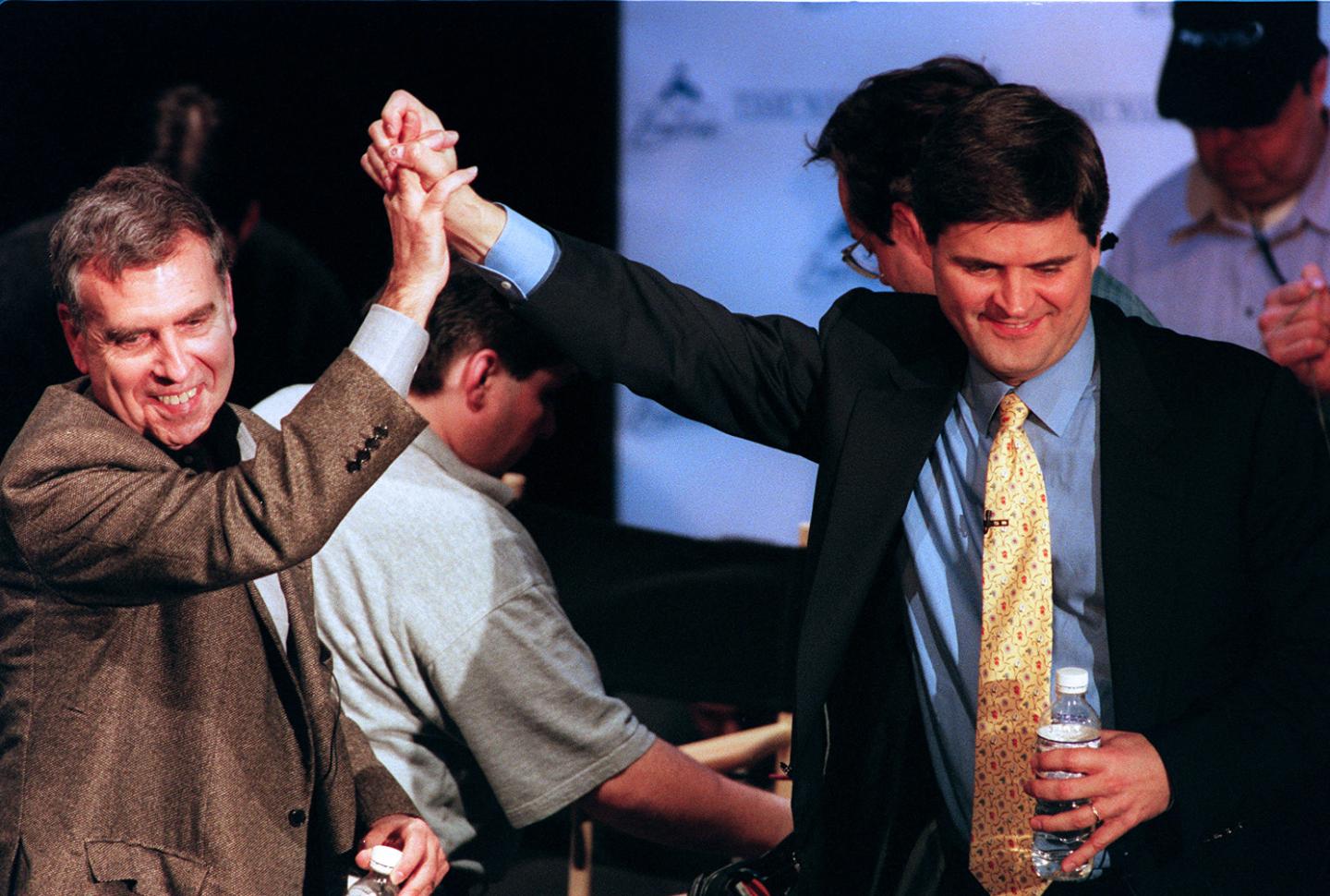
Gerald Levin of Time Warner, left, with Stephen Case of America Online, announcing A.O.L.'s $165 billion deal to acquire Time Warner in January 2000.
FILE -- Gerald Levin of Time Warner, left, with Stephen Case of America Online, announcing A.O.L.'s $165 billion deal to acquire Time Warner in January 2000. Time Warner said on Thursday, May 28, 2009, that it would file for divorce in one of the most ill-fated marriages in the history of the media and technology business, its 2001 merger with AOL. The companies hope the separation is complete at the end of the year. (Ruby Washington/The New York Times)Photograph by Ruby Washington — The New York Times/REDUX
Add Fortune on Google for similar content.

The landscape of mergers and acquisitions is littered with business flops, some catastrophic, highly visible disasters that were often hugely hyped before their eventual doom. Today marks the 15th anniversary of one such calamity when media giants AOL and Time Warner combined their businesses in what is usually described as the worst merger of all time. But what happened then will happen again, and ironically for the exact same reasons.

A lot of people thought that the merger was a brilliant move and worried that their own companies would be left behind. At the time, the dot-coms could do no wrong, and AOL (AOL) was at the head of the pack as the ‘dominant’ player. Its sky-high stock market valuation, bid up by investors looking for a windfall, made the young company more valuable in market cap terms than many blue chips. Then CEO Steve Case was already shopping around before the Time Warner opportunity came up.

On the other side, Time Warner anxiously tried, and failed, to establish an online presence before the merger. And here, in one fell swoop, was a solution. The strategy sounded compelling. Time Warner (TWC), via AOL, would now have a footprint of tens of millions of new subscribers. AOL, in turn, would benefit from access to Time Warner’s cable network as well as to the content, adding its layer of so-called ‘user friendly’ interfaces on top of the pipes. The whole thing was “transformative” (a word that gets really old really fast when reading about this period). Had these initial assumptions been borne out, we might be talking today about what a visionary deal it was.

Merging the cultures of the combined companies was problematic from the get go. Certainly the lawyers and professionals involved with the merger did the conventional due diligence on the numbers. What also needed to happen, and evidently didn’t, was due diligence on the culture. The aggressive and, many said, arrogant AOL people “horrified” the more staid and corporate Time Warner side. Cooperation and promised synergies failed to materialize as mutual disrespect came to color their relationships.

A few scant months after the deal closed, the dot com bubble burst and the economy went into recession. Advertising dollars evaporated, and AOL was forced to take a goodwill write-off of nearly $99 billion in 2002, an astonishing sum that shook even the business-hardened writers of the Wall Street Journal. AOL was also losing subscribers and subscription revenue. The total value of AOL stock subsequently went from $226 billion to about $20 billion.

The business was up against a phenomenon I refer to as transient advantage; namely when a combination of capabilities that at one point made a firm a leader, erodes and is replaced by the next form of competitive advantage. AOL was indeed the king of the dial-up Internet world, but that world was rapidly being supplanted by always-on, much faster broadband. At the time of the merger, half the country had Internet access, yes, but only 3% had broadband. AOL’s business model – originally based on payment for usage and subsequently for a monthly subscription – was about to implode. The eventual divorce of the two businesses was inevitable.

This leads me to a cautionary note about today’s crop of digital darlings, many valued in the billions. According to the Wall Street Journal, there are at least 48 venture-capital backed companies with an implied value of over $1 billion, while the number of such companies peaked at 10 during the height of the 2000 dot-com boom. Moreover, these firms – not yet profitable, not yet stable and not yet assessed by normal market metrics – are burning through vast amounts of cash each month.

As Berkeley University’s Steven David Solomon observed, even old ideas (think grocery delivery!) are being recycled in what he describes as a “frenzy” of investors pursuing startups seemingly at any price. Uber, for instance, has a valuation of $41 billion, even though total taxi revenue in the United States is about $11 billion a year.

Billion dollar acquisitions of these young firms and the desperation of venture capitalists to be part of the next Whatsapp acquisition or Facebook or Twitter IPO have created exactly the kind of pressures that can cause them to redouble their investments, hoping that the beneficiaries will be “the” category leader and shut everyone else out. One or two of the new crop of hot startups may well accomplish this, but the reality is that most of them won’t.

So if you’re an investor excited about the prospect of potential new business combinations, take a few minutes to check out this all-too common recipe for failure:

  • Untested assumptions are taken as facts.
  • Few opportunities exist for inexpensive, low-commitment testing.
  • Leaders are convinced they have the answer and not willing to change course.
  • Huge up-front investment, rather than a staged or sequenced flow of resources.
  • Massive uncertainty and a sense of time pressure.

Put these ingredients together and the result is often toxic. My advice: It’s much better to take a look at the assumptions behind that “transformative” startup before diving in head first with your checkbook.

Rita Gunther McGrath is a professor of business strategy at Columbia Business School and author of The End of Competitive Advantage: How to Keep Your Strategy Moving as Fast as Your Business.

About the Author
By Rita Gunther McGrath
See full bioRight Arrow Button Icon
Add Fortune on Google for similar content.

Latest in Commentary

Finance
Lorem ipsum dolor sit amet, consectetur adipiscing elit, sed do eiusmod tempor incididunt ut labore et dolore magna aliqua. Ut enim ad minim veniam
By Fortune Editors
October 20, 2025
Finance
Lorem ipsum dolor sit amet, consectetur adipiscing elit, sed do eiusmod tempor incididunt ut labore et dolore magna aliqua. Ut enim ad minim veniam
By Fortune Editors
October 20, 2025
Finance
Lorem ipsum dolor sit amet, consectetur adipiscing elit, sed do eiusmod tempor incididunt ut labore et dolore magna aliqua. Ut enim ad minim veniam
By Fortune Editors
October 20, 2025
Finance
Lorem ipsum dolor sit amet, consectetur adipiscing elit, sed do eiusmod tempor incididunt ut labore et dolore magna aliqua. Ut enim ad minim veniam
By Fortune Editors
October 20, 2025
Finance
Lorem ipsum dolor sit amet, consectetur adipiscing elit, sed do eiusmod tempor incididunt ut labore et dolore magna aliqua. Ut enim ad minim veniam
By Fortune Editors
October 20, 2025
Finance
Lorem ipsum dolor sit amet, consectetur adipiscing elit, sed do eiusmod tempor incididunt ut labore et dolore magna aliqua. Ut enim ad minim veniam
By Fortune Editors
October 20, 2025

Most Popular

Finance
Lorem ipsum dolor sit amet, consectetur adipiscing elit, sed do eiusmod tempor incididunt ut labore et dolore magna aliqua. Ut enim ad minim veniam
By Fortune Editors
October 20, 2025
Finance
Lorem ipsum dolor sit amet, consectetur adipiscing elit, sed do eiusmod tempor incididunt ut labore et dolore magna aliqua. Ut enim ad minim veniam
By Fortune Editors
October 20, 2025
Finance
Lorem ipsum dolor sit amet, consectetur adipiscing elit, sed do eiusmod tempor incididunt ut labore et dolore magna aliqua. Ut enim ad minim veniam
By Fortune Editors
October 20, 2025
Finance
Lorem ipsum dolor sit amet, consectetur adipiscing elit, sed do eiusmod tempor incididunt ut labore et dolore magna aliqua. Ut enim ad minim veniam
By Fortune Editors
October 20, 2025
Finance
Lorem ipsum dolor sit amet, consectetur adipiscing elit, sed do eiusmod tempor incididunt ut labore et dolore magna aliqua. Ut enim ad minim veniam
By Fortune Editors
October 20, 2025
Finance
Lorem ipsum dolor sit amet, consectetur adipiscing elit, sed do eiusmod tempor incididunt ut labore et dolore magna aliqua. Ut enim ad minim veniam
By Fortune Editors
October 20, 2025
Fortune Secondary Logo
Rankings
  • 100 Best Companies
  • Fortune 500
  • Global 500
  • Fortune 500 Europe
  • Most Powerful Women
  • World's Most Admired Companies
  • See All Rankings
  • Lists Calendar
Sections
  • Finance
  • Fortune Crypto
  • Features
  • Leadership
  • Health
  • Commentary
  • Success
  • Retail
  • Mpw
  • Tech
  • Lifestyle
  • CEO Initiative
  • Asia
  • Politics
  • Conferences
  • Europe
  • Newsletters
  • Personal Finance
  • Environment
  • Magazine
  • Education
Customer Support
  • Frequently Asked Questions
  • Customer Service Portal
  • Privacy Policy
  • Terms Of Use
  • Single Issues For Purchase
  • International Print
Commercial Services
  • Advertising
  • Fortune Brand Studio
  • Fortune Analytics
  • Fortune Conferences
  • Business Development
  • Group Subscriptions
About Us
  • About Us
  • Press Center
  • Work At Fortune
  • Terms And Conditions
  • Site Map
  • About Us
  • Press Center
  • Work At Fortune
  • Terms And Conditions
  • Site Map
  • Facebook icon
  • Twitter icon
  • LinkedIn icon
  • Instagram icon
  • Pinterest icon

Latest in Commentary

Sumeet Agrawal is VP of Product Management (Data, AI Governance & Context Engineering for Agentic Systems) at Salesforce.
CommentaryAI agents
Salesforce VP on the leaky AI pipeline: why cheaper tokens won’t fix enterprise AI
By Sumeet AgrawalJuly 20, 2026
6 hours ago
japan
CommentaryJapan
Japan’s monetary conundrum — why the yen hit a 40-year low as interest rates hit a 31-year high
By Steve H. Hanke and John GreenwoodJuly 20, 2026
7 hours ago
ryan
CommentaryLeadership
I’ve interviewed 700 leaders. The ones outsourcing their thinking to AI lose their best people first
By Ryan HawkJuly 20, 2026
8 hours ago
ranch
CommentaryWorld Cup
Ranch dressing is quietly doing America’s diplomacy for it
By David BohigianJuly 19, 2026
1 day ago
jt
CommentaryRetirement
Gen X built their whole identity on never needing help. Retirement is the one door they can’t unlock alone
By Jeanne ThompsonJuly 19, 2026
1 day ago
biden
CommentaryLeadership
Ginsburg and Biden’s blind spot: when leaders don’t know when to leave
By Michael SonnenfeldtJuly 19, 2026
1 day ago

Most Popular

'Dr. Doom' Nouriel Roubini says we're headed for universal basic income or 'some form of socialism' as AI revolutionizes work—He calls that optimistic
AI
'Dr. Doom' Nouriel Roubini says we're headed for universal basic income or 'some form of socialism' as AI revolutionizes work—He calls that optimistic
By Jason MaJuly 18, 2026
2 days ago
Power companies are using eminent domain to seize land for data centers as 70% of Americans say not in my backyard
AI
Power companies are using eminent domain to seize land for data centers as 70% of Americans say not in my backyard
By Aaron Walayat and The ConversationJuly 19, 2026
1 day ago
‘I want to die broke’: Billionaire philanthropist Denny Sanford dies after giving away $4 billion
Success
‘I want to die broke’: Billionaire philanthropist Denny Sanford dies after giving away $4 billion
By Sydney LakeJuly 20, 2026
6 hours ago
Red Lobster’s 37-year-old CEO waited tables before joining the C-suite—he says it was a crash course in managing ‘difficult people and situations’
Success
Red Lobster’s 37-year-old CEO waited tables before joining the C-suite—he says it was a crash course in managing ‘difficult people and situations’
By Preston ForeJuly 19, 2026
2 days ago
Warren Buffett says his $147 billion investing career was an accident: ‘I may be one of the 10 luckiest in the world’
Future of Work
Warren Buffett says his $147 billion investing career was an accident: ‘I may be one of the 10 luckiest in the world’
By Sarah GlodekJuly 20, 2026
13 hours ago
It’s not just Taco Bell lettuce and possible glass in Pillsbury rolls: Food and drink recall events reached a 6-year year-over-year high
Retail
It’s not just Taco Bell lettuce and possible glass in Pillsbury rolls: Food and drink recall events reached a 6-year year-over-year high
By Sasha RogelbergJuly 20, 2026
10 hours ago

© 2026 Fortune Media IP Limited. All Rights Reserved. Use of this site constitutes acceptance of our Terms of Use and Privacy Policy | CA Notice at Collection and Privacy Notice | Do Not Sell/Share My Personal Information
FORTUNE is a trademark of Fortune Media IP Limited, registered in the U.S. and other countries. FORTUNE may receive compensation for some links to products and services on this website. Offers may be subject to change without notice.