• Home
  • News
  • Fortune 500
  • Tech
  • Finance
  • Leadership
  • Lifestyle
  • Rankings
  • Multimedia
China

China’s foreign trade rebounds in September but growth fears remain

By
Geoffrey Smith
Geoffrey Smith
Down Arrow Button Icon
By
Geoffrey Smith
Geoffrey Smith
Down Arrow Button Icon
October 13, 2014, 5:31 AM ET
CHINA-ECONOMY-TRADE
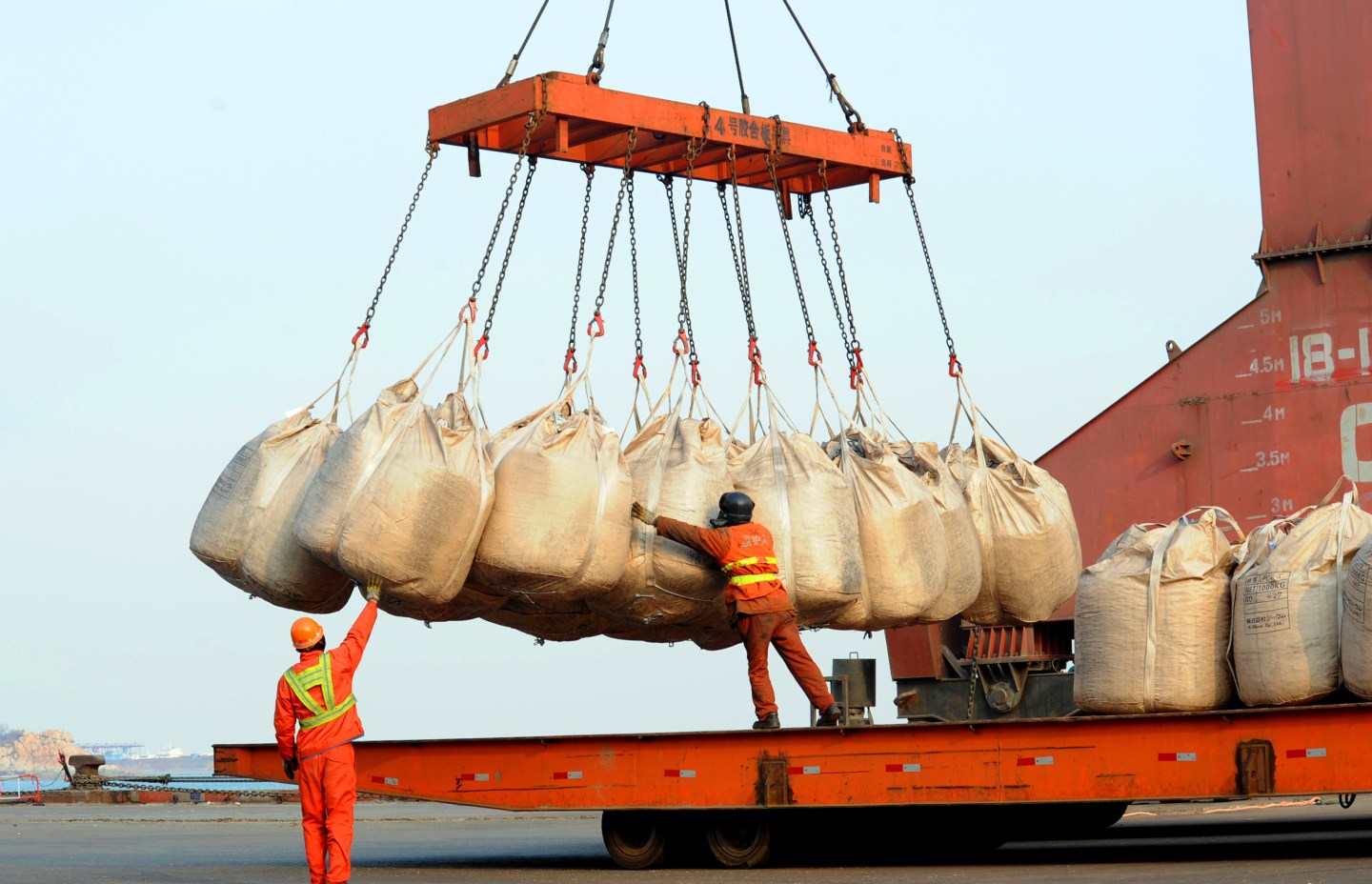
Workers unload goods from a ship at the port in Lianyungang, east China's Jiangsu province on February 12, 2014. China's trade surplus rose 14.0 percent year-on-year in January to 31.86 billion USD, official figures showed as exports increased 10.6 percent to 207.13 billion USD, while imports were up 10.0 percent to 175.27 billion USD, the General Administration of Customs said. CHINA OUT AFP PHOTO (Photo credit should read STR/AFP/Getty Images)STR AFP/Getty Images

You know things in the markets are bad when they don’t even react well to what appears to be good news.

Fears that the world economy was slowing down too fast threw global stock markets into a funk last week, so it might have been expected that better-than-forecast trade data from China, the world’s second-largest economy, would have injected a bit of optimism into everyone’s Monday morning.

China’s exports rose 15.3% on the year in September, accelerating from a rate of 9.4% in August and comfortably above the 12% expected. Shipments to the U.S. and E.U. both grew by around 15%, a particularly decent clip in the case of Europe, where Germany, France and Italy have all but ground to a halt.

But Asian stock markets continued to sell off Monday, partly because of fears–not for the first time–that there may be something fishy about the numbers. The benchmark Shanghai index fell 0.4%, and the Japanese Nikkei fell 1.2%.

Specifically, exports to Hong Kong leaped 34% on the year in September, having been down 2.1% in August. That suggested to some that much of the improvement in the data might not be down to real exports as such, but rather to disguised bets on the foreign exchange market.

China’s capital account is tightly controlled and only allows foreign exchange to be bought or sold when needed for real underlying trade. As a result, mainland businesses often fake invoices to subsidiaries in Hong Kong to generate phantom exports or imports when they want to take on, or reduce, exposure to swings in currency markets. Analysts at ANZ noted that the rise in exports to Hong Kong were “coincident with the renewed renminbi appreciation in the last few months.”

But there were more encouraging signs from the other side of the trade data. Imports rose 7% on the year, having fallen 2.4% in the year to August, but perhaps not for the reasons either Beijing or western economists would want. Much of the increase was due to more purchases of iron ore (for steel) and crude oil–hardly clear evidence of the kind of rebalancing towards domestic consumption that the authorities are aiming for.

China’s government is trying to sustain a growth rate of around 7.5% this year. The International Monetary Fund, whose gloomy predictions last week were one of the triggers for the market sell-offs, left its forecast for this year and 2015 unchanged at 7.4% and 7.1%, respectively, even while it downgraded it forecasts for most of the rest of the world. Many analysts are concerned that the collapse of a real estate bubble may lead to a sharper slowdown.


About the Author
By Geoffrey Smith
See full bioRight Arrow Button Icon
0

Most Popular

placeholder alt text
Economy
Two months into the new fiscal year and the U.S. government is already spending more than $10 billion a week servicing national debt
By Eleanor PringleDecember 4, 2025
2 days ago
placeholder alt text
Success
‘Godfather of AI’ says Bill Gates and Elon Musk are right about the future of work—but he predicts mass unemployment is on its way
By Preston ForeDecember 4, 2025
2 days ago
placeholder alt text
Success
Nvidia CEO Jensen Huang admits he works 7 days a week, including holidays, in a constant 'state of anxiety' out of fear of going bankrupt
By Jessica CoacciDecember 4, 2025
2 days ago
placeholder alt text
Success
Nearly 4 million new manufacturing jobs are coming to America as boomers retire—but it's the one trade job Gen Z doesn't want
By Emma BurleighDecember 4, 2025
2 days ago
placeholder alt text
Big Tech
Mark Zuckerberg rebranded Facebook for the metaverse. Four years and $70 billion in losses later, he’s moving on
By Eva RoytburgDecember 5, 2025
22 hours ago
placeholder alt text
Real Estate
‘There is no Mamdani effect’: Manhattan luxury home sales surge after mayoral election, undercutting predictions of doom and escape to Florida
By Sasha RogelbergDecember 4, 2025
2 days ago
Rankings
  • 100 Best Companies
  • Fortune 500
  • Global 500
  • Fortune 500 Europe
  • Most Powerful Women
  • Future 50
  • World’s Most Admired Companies
  • See All Rankings
Sections
  • Finance
  • Leadership
  • Success
  • Tech
  • Asia
  • Europe
  • Environment
  • Fortune Crypto
  • Health
  • Retail
  • Lifestyle
  • Politics
  • Newsletters
  • Magazine
  • Features
  • Commentary
  • Mpw
  • CEO Initiative
  • Conferences
  • Personal Finance
  • Education
Customer Support
  • Frequently Asked Questions
  • Customer Service Portal
  • Privacy Policy
  • Terms Of Use
  • Single Issues For Purchase
  • International Print
Commercial Services
  • Advertising
  • Fortune Brand Studio
  • Fortune Analytics
  • Fortune Conferences
  • Business Development
About Us
  • About Us
  • Editorial Calendar
  • Press Center
  • Work At Fortune
  • Diversity And Inclusion
  • Terms And Conditions
  • Site Map

© 2025 Fortune Media IP Limited. All Rights Reserved. Use of this site constitutes acceptance of our Terms of Use and Privacy Policy | CA Notice at Collection and Privacy Notice | Do Not Sell/Share My Personal Information
FORTUNE is a trademark of Fortune Media IP Limited, registered in the U.S. and other countries. FORTUNE may receive compensation for some links to products and services on this website. Offers may be subject to change without notice.