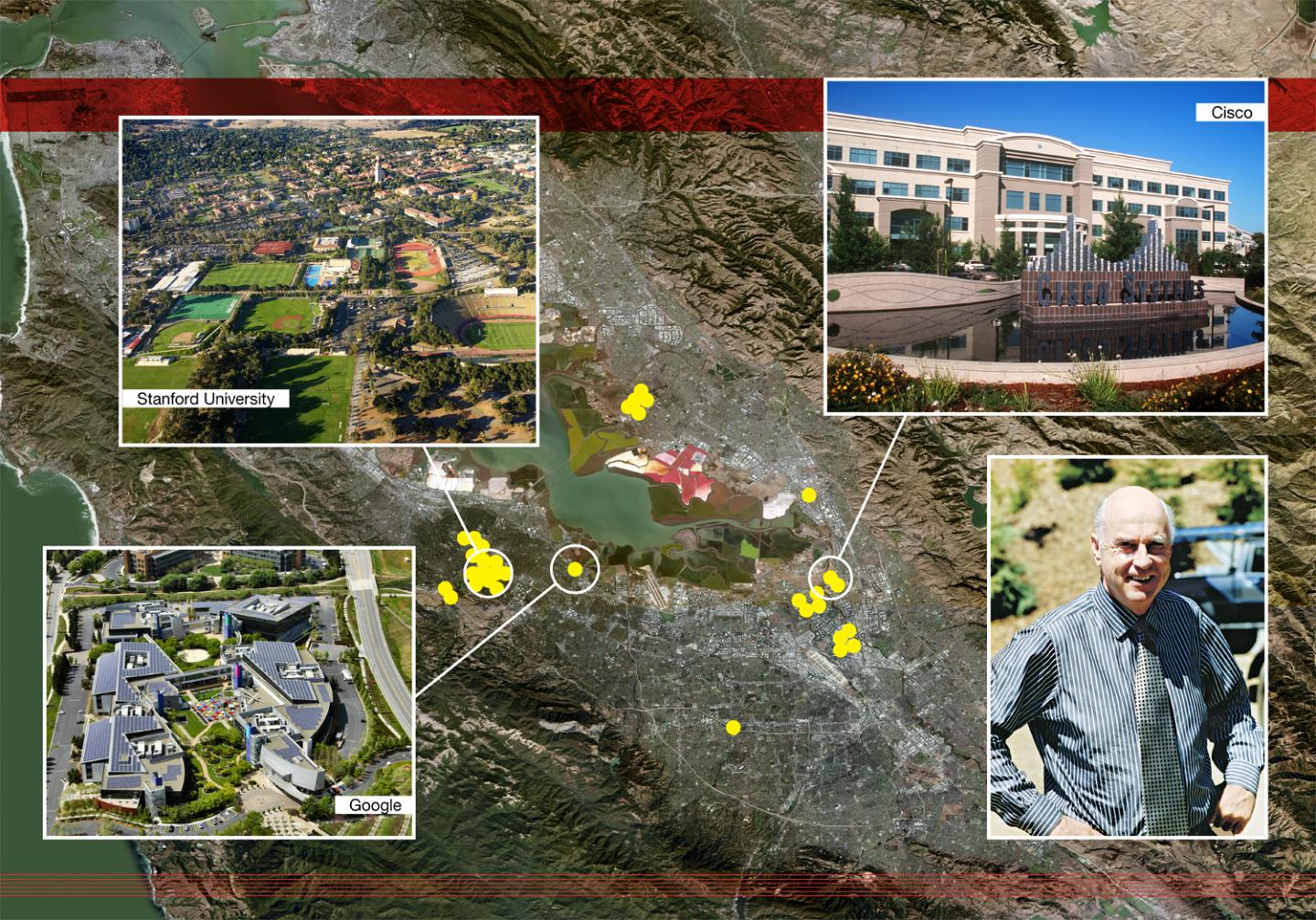
For months it has been a popular parlor game among the tech cognoscenti: speculating on the identity of Company X, the mysterious tenant slated to move into the 2-million-square-foot office park planned near Mineta San Jose International Airport. Some insist that it’s Apple, spreading its cash-laden wings beyond Cupertino and Sunnyvale. Did we mention the scale: 10 seven-story buildings, 7,000-plus parking spaces, a complex twice the size of Facebook’s current quarters in Menlo Park? Others say Samsung–or Google. Note the Googley underground pool, the skyways, the soccer field sketched out in the blueprint. Still others claim Company X is Qualcomm, decamping at last from the outback of San Diego–or EMC, or SAP. Hey, San Jose’s mayor slipped that it’s a Fortune 100 company … Then Microsoft? Or Cisco, maybe?
Of all the names connected to the development, though, there is one that says more about the project–about the mystery surrounding it, about the history of Silicon Valley and perhaps even its future–than any other. And that, remarkably, is one that most people outside the Valley have never heard of: John Arrillaga Sr., the 77-year-old co-founding partner of the site’s developer, Peery Arrillaga. Sure, the modern tech industry was created by visionaries like Gordon Moore and Robert Noyce, the semiconductor entrepreneurs who put the “silicon” in the Santa Clara Valley; by the likes of Bill Hewlett and Dave Packard, the computer whizzes who burnished the romance of starting a company in a one-car garage; by Steve Jobs, who, well, was Steve Jobs. But Arrillaga–who also happens to be the father-in-law of one of the Valley’s famed venture capitalists, Marc Andreessen–is the guy who built the tech corridor where it all happened.
He and business partner Richard Peery are the real estate developers who had the foresight in the 1960s to buy up the Valley’s fruit orchards and turn the farmland into thousands of acres of low-slung office parks and campuses that have come to house Intel (INTC), HP (HPQ), Apple (AAPL), Google (GOOG), and more. All told, the duo have erected more than 12 million square feet of office space and sold or leased tens of billions of dollars in property–an effort that has made Arrillaga, worth more than $2.5 billion, perhaps the richest man in Silicon Valley who didn’t make his money by starting a tech company. (Peery is also a billionaire.)

Seemingly in lockstep with these development projects, Arrillaga has remade, brick by brick, his alma mater, Stanford University–contributing hundreds of millions of dollars to the school and donating an additional 160 buildings, including Stanford Stadium, which he demolished and rebuilt in 2005 and 2006. There are even those who credit Stanford’s unprecedented run of championship NCAA teams–in June the school collected its 20th consecutive Learfield Sports Directors’ Cup, awarded to the nation’s best college athletic program overall–in large part to Arrillaga’s dutiful, hands-on patronage. (The claim is hardly outlandish.)
But if all this weren’t unusual enough, there is one aspect to the man that runs counter to the tech industry’s star-centered ethos, the look-what-I-did mantra of founder-folk like Jobs, Jeff Bezos, and Larry Ellison: John Arrillaga doesn’t want to be known. Famously private, the developer detests awards, won’t do ribbon-cuttings, and never talks to the press. (Keeping to that practice, he refused to be interviewed for this story.) Though his family name graces several buildings at Stanford, Arrillaga reportedly does the vast majority of his giving anonymously. Interviews with dozens of associates, relatives, and business partners–many of whom requested anonymity as well–paint a portrait of a man who is so modest that he looks downright pained when receiving a compliment. He will listen with a kind of gentle frustration, say two longtime friends who were classmates of Arrillaga’s at Morningside High School in Inglewood, Calif. “He just has no place in his life to put admiration,” says one.
John Arrillaga grew up one of five children in a lower-middle-class home in Inglewood, Calif., a small city southwest of Los Angeles. His father, Gabriel, who traced his roots to the Basque region that straddles Spain and France, operated a small wholesale produce store; his mother, Frieda, stayed home, bringing up the kids and washing neighbors’ laundry. Money was always scarce. Frieda kept the kids full with pieces of bread stuffed with lettuce. When Saturday “steak night” rolled around, the seven of them shared one flank.

For John’s high school senior-class photo, the broad-shouldered, 165-pound, 6-foot 4-inch teen couldn’t afford a jacket, dress shirt, and tie, so he borrowed them from his chemistry teacher. The sleeves were six inches too short. Graduating from Morningside High in 1955, Arrillaga attended Stanford on a basketball scholarship, juggling several jobs, from delivering campus mail to the odd gardening gig, to cover expenses.
On the basketball court Arrillaga proved to be as good as the scholarship, serving as captain and making third team All-American his senior year while averaging a squad-leading 14.2 points a game. The years at Stanford were formative ones, by all accounts. “I think he looks back to his simple beginnings, his coming to play basketball at Stanford, then really catching the wave of success after, and he’s never forgotten the fortune of it all,” says Larry Sonsini, a friend and chairman of the law firm Wilson Sonsini Goodrich & Rosati.
Arrillaga spent more than a year playing professional basketball–first in Spain, then for the San Francisco Warriors, the precursor to the Golden State team. He quit the Warriors after just six weeks–not because he couldn’t cut it on the court, but because he couldn’t countenance the way some of his married teammates behaved, frivolously sleeping with groupies. (“Other people were compromising values that he held so dearly,” says his daughter, Laura, who is married to Andreessen and who in 2011 published a bestselling book on philanthropy, Giving 2.0.) Arrillaga then worked as a broker for the commercial real estate firm Renault & Handley, at the time in Palo Alto, where he was often so determined to make his properties stand out that he landscaped them himself.
In the early 1960s, Arrillaga met Richard Peery through Peery’s uncle, a Wells Fargo executive who suggested they might have a lot in common. The ambitious Peery hailed from Palo Alto and displayed an entrepreneurial streak early on. By middle school he already owned every gumball machine on Stanford’s campus, and during his teens he opened his own miniature golf course.

The two men saw colossal potential in the undeveloped acres of prune, almond, and cherry orchards occupying much of what was then called Santa Clara Valley. The semiconductor industry had already begun to take off. Newer businesses like Intel were rapidly expanding, and Stanford Industrial Park, a 700-acre office park that housed Hewlett-Packard (and still does), seemed too small to handle all that tech growth.
With about $2,000 of their own cash–and some financing assistance from others–the two scooped up thousands of acres of orchards and began development before they had tenants. Their speculative approach was essentially unheard-of locally, but the two believed that if they built the office space, tenants would come. Peery Arrillaga, as they soon called their business, focused initially on low, concrete buildings, called tilt-ups, in areas like Sunnyvale, San Jose, and Mountain View. They were cost-effective and quick to build. The young entrepreneurs, meanwhile, relied largely on their own capital to fund their ventures. The idea of borrowing was anathema to Arrillaga. “That antidebt attitude is one of the things that makes him unique,” says Andreessen.
Arrillaga and Peery each brought a different skill. From years of working in real estate, Peery had developed a good sense of what land to buy, and he knew how to get rapid approval for construction as well. Arrillaga handled negotiations with suppliers and tenants. “John is the psychological genius. He understands people at a very sophisticated level,” says Ben Horowitz, Andreessen’s partner in the Valley venture capital firm that bears their names. “I’ve known situations where he has negotiated the other side to an economic loss,” says Sonsini. “Then he’ll pause and say, ‘Look, you really shouldn’t give me that much. Let’s compromise at this level so you can make a profit.’ ”
Meanwhile, the young developer was starting a family of his own. In 1968 he married Frances Marion Cook, a sixth-grade public school teacher. She eventually took up director or trustee roles for institutions such as the Palo Alto Medical Foundation and the Peninsula Center for the Blind and Visually Impaired. When their first child, John Jr., was born, Frances left the classroom for good; Laura arrived 11 months later. Now a professor at Stanford, Laura inherited her parents’ passion for philanthropy, directing a nonprofit organization focused on education issues, the Laura Arrillaga-Andreessen Foundation. In 1995, Frances succumbed to lung cancer after a 20-month battle. (Stanford’s alumni center is now named after her.) Some years later Arrillaga married Gioia Fasi, a former attorney from Honolulu, with whom he now lives in a secluded, 200-plus-acre compound in Portola Valley, where he spends over six hours a week mowing 40 of those grassy acres himself.

From the start, he and Peery approached their land deals with an acute sense of price and value–and a challenging short horizon. Boyd Smith Sr., co-founder of WSJ Properties, a real estate development company and longtime Peery Arrillaga partner, recalls Peery telling him: “You make your money when you buy [not when you sell]. You buy something you know is going to be worth more a month from now, and you buy it at a very advantageous price.”
There was no guarantee, certainly, that the farmland the duo were buying would be worth more a month hence, but by the mid-1980s, the signposts were at least pointing that way. The Santa Clara Valley was establishing itself as America’s tech hub. Engineers and entrepreneurs from around the world were flocking to the area as innovations in personal computing, software, and semiconductors flourished. Oracle (ORCL), Cisco (CSCO), and others were bursting from their original workspaces and moving into new facilities as fast as Peery Arrillaga could develop them. It wasn’t long before the firm became the go-to landlords and developers in the Valley. The men built and sold new buildings to LinkedIn (LNKD), Google, and Apple, and they developed commercial office space on spec that they then leased to multiple small tenants.
What made the partners stand out wasn’t just the locations they were cornering but also their attention to detail. Here, numerous people say, Arrillaga’s focus has long bordered on the obsessive. His $100 million rebuild of Stanford Stadium took just 10 months, as he and three shifts of crews worked around the clock. Arrillaga not only chose the crews but also picked out the concession food, the seat material–even the palm trees framing the scoreboard. (He had the trees dug up and removed from another property.)
These days Arrillaga spends at least half his week driving through Stanford’s campus in his own golf cart, zipping around at least 11 concurrent projects he’s overseeing to expand and gussy up “the Farm” even farther. One of them is a volleyball stadium, scheduled to open this summer, with grassy slopes, palm trees, and four sand-filled courts–complete with finely ground sand from Monterey, which Arrillaga is particularly fond of. As with Stanford Stadium before it, he is overseeing every morsel of development, even designing the surrounding fence, which is made of a steel alloy that weathers elegantly in the elements.
Notwithstanding his care for details, he reportedly refuses to put them on paper. In a world obsessed with term sheets and employment agreements, associates say, Arrillaga has never signed a formal contract with any of his construction crews.
His way of doing business seems wonderfully, refreshingly anachronistic–and to hear legions of other Valley notables tell it, it is the reason Arrillaga, who bats away offers to take cushy director seats on startup boards, has become a role model to a new generation of entrepreneurs and executives, many of whom initially seek his development expertise but keep coming back for his wisdom. It’s no surprise, perhaps, that Andreessen looks to his father-in-law regularly for advice; Horowitz, though, says he’s just as solicitous of Arrillaga’s ear. The developer advises him on everything from real estate matters–“Always buy from a leveraged, distressed seller,” he says–to why it’s not worth cheating on your wife (somewhat self-explanatory). Says Horowitz: “He is the guy everyone wants to do business with.”
For all of Arrillaga’s involvement in the minutiae of bathroom tile and landscaping, his projects are not quite things of beauty. His buildings, like much–or even most–of the office space in Silicon Valley, are simply utilitarian. But as an economic indicator of sorts, the team’s developments are a thing of beauty and clarity. The company’s website suggests where it thinks the action is, listing dozens of properties available in the south part of the Valley, in Milpitas and South San Jose. And in North San Jose, by the airport, where Company X (its name still a secret at presstime) is getting ready to reside (or move or expand), there is likely to be a flutter of new tech activity.
Given the Valley’s ever-escalating prices, how much more potential upside is there? Arrillaga, those close to him say, believes the climb has much further to go. The demand is now coming overwhelmingly from businesses like Google, Apple, and LinkedIn–huge tech companies that are expanding their businesses and increasing employee headcounts, pushing the companies into a continual hunt for space. They are making gigantic bets on expansion in a way the developer (again, to hear colleagues tell it) has never witnessed, even during the 1990s dotcom boom.
“John just sees that as a very powerful thing,” says Andreessen. “He has a deep and abiding faith in the Silicon Valley phenomenon.” Andreessen recalls a recent conversation in which he asked his father-in-law, if he could invest again, with the same startup enthusiasm–anywhere in the U.S.–where would it be?
Arrillaga didn’t pause a moment: “Oh, the Bay Area, for sure.”
This story is from the July 21, 2014 issue of Fortune.