• Home
  • Latest
  • Fortune 500
  • Finance
  • Tech
  • Leadership
  • Lifestyle
  • Rankings
  • Multimedia
LeadershipLabor

Supreme Court delivers blow to public unions

Claire Zillman
By
Claire Zillman
Claire Zillman
Editor, Leadership
Down Arrow Button Icon
Claire Zillman
By
Claire Zillman
Claire Zillman
Editor, Leadership
Down Arrow Button Icon
June 30, 2014, 11:54 AM ET
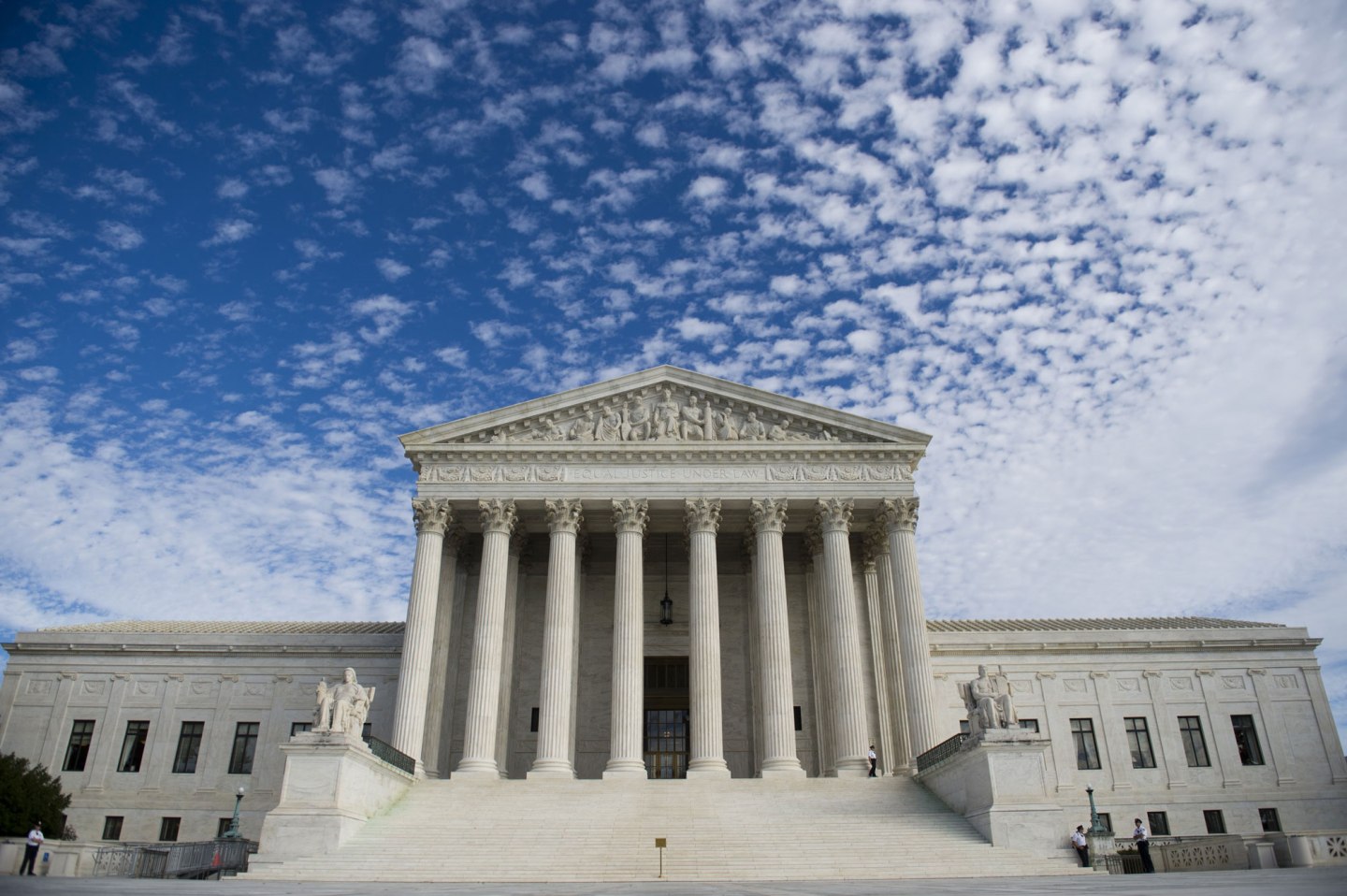
Saul Loeb/AFP—Getty Images

Public unions dodged what could have been a lethal bullet on Monday in what’s been touted as the most important labor case the Supreme Court has considered in decades.

The Justices decided in a 5-4 ruling on Monday to not overturn a 37-year precedent that allows public unions to collect dues from non-members. But the nation’s top court did recognize a category of “partial public employees” that cannot be forced to contribute union fees, which will limit unions’ ability to represent a fast-growing pool of potential members: home care aides.

The decision had the potential to be a death knell for unions, which are already struggling to maintain membership rolls. Union membership in the U.S. stands at 11.3%, down from 20.1% in 1983, according to the Bureau of Labor Statistics. The one relatively healthy sector for unions—the public sphere, where 35.3% of the workforce is unionized—was put at serious risk in the case decided Monday.

The case grew out of a law passed in Illinois in 2003 that recognized some home care providers as public employees and selected a Midwest branch of the SEIU to exclusively represent these workers.

The law held that no home care workers would be compelled to join the SEIU but that all workers would be required to contribute “fair share” dues to the union since the law directed the SEIU to collectively bargain on behalf of all the workers covered by the law regardless of whether the workers wanted the representation.

The Illinois law relied a 1977 decision by the Supreme Court in Abood v. Detroit Board of Education that said that states could require employees to pay partial union dues to cover the cost of unions bargaining on their behalf.

The lead plaintiff in the case, Pamela Harris, worked as a home care aid and was represented by the conservative National Right to Work Legal Defense Foundation, which aimed to upset the Illinois law and the Abood decision with a class action suit. Harris claimed that Illinois was infringing on her first amendment rights since the money that the SEIU automatically subtracted from her paycheck constituted compelled speech in support of the union.

Unions, meanwhile, argued that the required dues prevents freeloaders—those who enjoy the benefits of union representation without having to pay for it.

“This case represents a very, very aggressive attempt by the National Right to Work Foundation to try to make America a right-to-work country in which public unions can never compel dues from people,” Lee Adler of Cornell’s Industrial and Labor Relations School told Fortune. And history has shown that many workers choose to avoid paying union dues if they are given the option, meaning that a decision overturning Abood could have crippled public unions.

But those fears weren’t wholly realized on Monday. In writing for the majority and siding with the home care aides, Justice Samuel Alito, a conservative, kept Abood in place while ruling that personal home-care employees couldn’t be forced to pay union dues because they are not technically full-time state employees. “Abood involved full-fledged public employees, but in this case, the status of personal assistants is much different,” Justice Alito said in his opinion.

While the decision didn’t mark as big a blow to unions as it could have, it has hit labor where it hurts. Personal care aides help elderly or disabled clients with everyday tasks and are paid through Medicaid. It’s a low paid profession—about $20,000 annually—that’s expected to grow by 580,000 workers by 2022 as the nation’s population ages, according to the BLS. The field is ripe for unionization and labor has tried—and succeeded—to organize workers in several states.

“Other states have decided like Illinois to share the control over the workers, so this decision has the potential to impact those other programs,” says Cathy Ruckelshaus, general counsel for the National Employment Law Project. A decision against the unionization of these workers will trickle through the elderly and disabled care system, which already has a shortage for workers since working conditions are so poor. “It’s a blow not just to the individual workers,” she said, “but also to the care and service provided to the recipients.”
About the Author
Claire Zillman
By Claire ZillmanEditor, Leadership
LinkedIn iconTwitter icon

Claire Zillman is a senior editor at Fortune, overseeing leadership stories. 

See full bioRight Arrow Button Icon

Latest in Leadership

Asiathe future of work
The CEO of one of Asia’s largest co-working space providers says his business has more in common with hotels
By Angelica AngDecember 12, 2025
2 hours ago
Donald Trump
HealthHealth Insurance
‘Tragedy in the making’: Top healthcare exec on why insurance will spike to subsidize a tax cut to millionaires and billionaires
By Nick LichtenbergDecember 12, 2025
9 hours ago
three men in suits, one gesturing
AIBrainstorm AI
The fastest athletes in the world can botch a baton pass if trust isn’t there—and the same is true of AI, Blackbaud exec says
By Amanda GerutDecember 12, 2025
10 hours ago
Brainstorm AI panel
AIBrainstorm AI
Creative workers won’t be replaced by AI—but their roles will change to become ‘directors’ managing AI agents, executives say
By Beatrice NolanDecember 12, 2025
10 hours ago
Ryan Serhant lifts his arms at the premiere of Owning Manhattan, his Netflix show
Successrelationships
Ryan Serhant, a real estate mogul who’s met over 100 billionaires, reveals his best networking advice: ‘Every room I go into, I use the two C’s‘
By Dave SmithDecember 12, 2025
12 hours ago
Fei-Fei Li, the "Godmother of AI," says she values AI skills more than college degrees when hiring software engineers for her tech startup.
AITech
‘Godmother of AI’ says degrees are less important in hiring than how quickly you can ‘superpower yourself’ with new tools
By Nino PaoliDecember 12, 2025
13 hours ago

Most Popular

placeholder alt text
Economy
Tariffs are taxes and they were used to finance the federal government until the 1913 income tax. A top economist breaks it down
By Kent JonesDecember 12, 2025
18 hours ago
placeholder alt text
Success
At 18, doctors gave him three hours to live. He played video games from his hospital bed—and now, he’s built a $10 million-a-year video game studio
By Preston ForeDecember 10, 2025
3 days ago
placeholder alt text
Success
Apple cofounder Ronald Wayne sold his 10% stake for $800 in 1976—today it’d be worth up to $400 billion
By Preston ForeDecember 12, 2025
14 hours ago
placeholder alt text
Success
Palantir cofounder calls elite college undergrads a ‘loser generation’ as data reveals rise in students seeking support for disabilities, like ADHD
By Preston ForeDecember 11, 2025
2 days ago
placeholder alt text
Success
40% of Stanford undergrads receive disability accommodations—but it’s become a college-wide phenomenon as Gen Z try to succeed in the current climate
By Preston ForeDecember 12, 2025
14 hours ago
placeholder alt text
Arts & Entertainment
'We're not just going to want to be fed AI slop for 16 hours a day': Analyst sees Disney/OpenAI deal as a dividing line in entertainment history
By Nick LichtenbergDecember 11, 2025
1 day ago
Rankings
  • 100 Best Companies
  • Fortune 500
  • Global 500
  • Fortune 500 Europe
  • Most Powerful Women
  • Future 50
  • World’s Most Admired Companies
  • See All Rankings
Sections
  • Finance
  • Leadership
  • Success
  • Tech
  • Asia
  • Europe
  • Environment
  • Fortune Crypto
  • Health
  • Retail
  • Lifestyle
  • Politics
  • Newsletters
  • Magazine
  • Features
  • Commentary
  • Mpw
  • CEO Initiative
  • Conferences
  • Personal Finance
  • Education
Customer Support
  • Frequently Asked Questions
  • Customer Service Portal
  • Privacy Policy
  • Terms Of Use
  • Single Issues For Purchase
  • International Print
Commercial Services
  • Advertising
  • Fortune Brand Studio
  • Fortune Analytics
  • Fortune Conferences
  • Business Development
About Us
  • About Us
  • Editorial Calendar
  • Press Center
  • Work At Fortune
  • Diversity And Inclusion
  • Terms And Conditions
  • Site Map

© 2025 Fortune Media IP Limited. All Rights Reserved. Use of this site constitutes acceptance of our Terms of Use and Privacy Policy | CA Notice at Collection and Privacy Notice | Do Not Sell/Share My Personal Information
FORTUNE is a trademark of Fortune Media IP Limited, registered in the U.S. and other countries. FORTUNE may receive compensation for some links to products and services on this website. Offers may be subject to change without notice.