
• Home
  • Latest
  • Fortune 500
  • Finance
  • Tech
  • Leadership
  • Lifestyle
  • Rankings
  • Multimedia

Trendingnow

1

Jeff Bezos wants the bottom half of earners to pay zero income tax—he says nurses making just $75K should save $12K a year

2

Despite a $500 million net worth, Shaq just finished his fourth degree. He warns graduates: 'Your character will take you further than your resume'

3

Bolt CEO says he let go of his entire HR team for creating problems that didn’t exist: ‘Those problems disappeared when I let them go’ 

1

Jeff Bezos wants the bottom half of earners to pay zero income tax—he says nurses making just $75K should save $12K a year

2

Despite a $500 million net worth, Shaq just finished his fourth degree. He warns graduates: 'Your character will take you further than your resume'

3

Bolt CEO says he let go of his entire HR team for creating problems that didn’t exist: ‘Those problems disappeared when I let them go’ 
Cybersecurity

Need to lock your mobile device? Just doodle

Robert Hackett
By
Robert Hackett
Robert Hackett
Down Arrow Button Icon
Robert Hackett
By
Robert Hackett
Robert Hackett
Down Arrow Button Icon
June 23, 2014, 1:13 PM ET
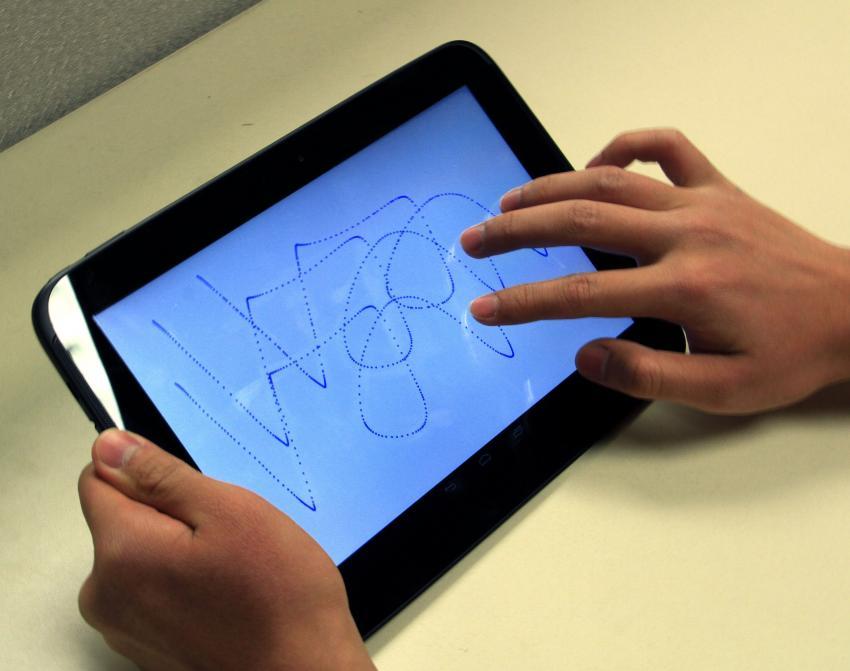
A hand-drawn scribble may be more effective than a PIN or pattern, according to a new study.
A hand-drawn scribble may be more effective than a PIN or pattern, according to a new study.Photo courtesy Rutgers University/Max-Planck Institute for Informatics/University of Helsinki.

That locking mechanism on your tablet computer or smartphone? It’s mostly a relic from the days of the keyboard. With the advent of touchscreens, the three-by-three grids and four-digit passcodes popular on today’s mobile devices are anachronistic. Yet they persist, despite “shoulder surfers” and the telltale oils left by swiping fingers.

A new study from Rutgers University suggests that squiggling—yes, squiggling—on the screen of your tablet or smartphone may provide a better authentication mechanism than the standard pattern locks favored by Google’s (GOOG) Android operating system and the Personal Identification Numbers (PINs) preferred by Apple’s (AAPL) iOS.

“The current locking and authentication mechanisms available for mobile systems commercially do not work so well,” said Janne Lindqvist, an assistant professor of electrical and computer engineering at Rutgers University and an author of the study. “Instead of having old methods or cued methods, we let people just generate gestures without any kind of visual cue or other kind of instructions.”

The studies’ researchers, which included collaborators from the Max-Planck Institute for Informatics and the University of Helsinki, asked 63 participants to scrawl “continuous free-form multitouch gestures,” essentially finger-painting on the blank touchscreen canvas of a Google Nexus 10 tablet. No grid, no template: the subjects improvised a pass-doodle, rather than a password.

The researchers then asked users to recall and redraw their scribbles after a short break and a bit of distracting mental math (counting down from 20 to 0 and rotating a shape in their minds). Next, the researchers retested the users’ memory after a minimum of 10 days. (Six subjects didn’t return for the second test.)

The trick—as with any good password—was to concoct a gesture complex enough to dupe spies yet simple enough to remember.

“You never need to be perfect,” Lindqvist said on reproducing a gesture swipe-for-swipe. “You can make a bit of errors, but not too much. It depends a lot on the security policy you want to implement.”

For instance, authentication for a mobile device might accept a higher error rate than one protecting a bank vault.

To verify matches, the team used a “recognizer” algorithm, which compared each gesture to a set of stored templates. The algorithm then calculated an average score for each attempt at unlocking. Gestures whose scores rose above a certain threshold value were authorized entry.

“You never can, in any case—with any kind of meaningfully complex gesture—repeat it exactly the same way,” Lindqvist said, noting that it takes at least three repetitions, or templates, for a gesture to become stable. (For improved accuracy, the study used 10 templates per participant.)

The researchers also used a flexible algorithm. Participants were able to draw anywhere on the device’s screen at whatever size and angle they wished, as long as the shape of the gesture was correct. Such flexibility may allow single gestures to adapt across platforms: for instance, on the larger screen of a tablet versus the smaller screen of a smartphone.

To measure each gesture’s level of security, the researchers imported a concept from Information Theory called “differential entropy.” This metric quantified the “information content,” or “surprisingness,” of a gesture. Generally, the most secure gestures were the most complex. Some of these looked like brambles, tumbleweeds or multi-faceted jewels.

On average the most memorable gestures were shorter and simpler than those best for security. Some of the most memorable ones included simple angular shapes, like triangles, and signatures.

The least-secure gestures consisted of gentle, looping circles.

Another measure of security involved a “shoulder surfing” test. Six student volunteers independently watched videos of another student performing three representative gestures. These “attackers” were then asked to replicate each gesture.

The preliminary results were promising. “None of the attackers came even close to the gesture,” Lindqvist said.

In fact, one attacker did nearly replicate one of the gestures—a backwards “N”—but did not come close enough for a “recognizer” to authenticate.

“Typing in a password seems to be an artifact of the past,” said Nasir Memon, professor of computer science and engineering at New York University, who was not involved in the study. “There is definitely a need to explore the alternatives.”

Still, even with the aid of muscle memory, one must question how confusing a world of security gestures might become.

“If you have three different gestures for three different accounts, how do you deal with that?” Memon asked.

In future studies, Lindqvist said he plans to instruct participants in best practices for generating secure and memorable gestures. He also hopes to expand the shoulder-surfing test. “I think that this robust alternative and a better alternative than the current method, and looking forward to working on this more,” Lindqvist said.

If the new tactic’s promise holds, the future of password security may look less like a keyboard and more like finger-skating. For now, though, the billions of people around the world using mobile devices must stick with their PINs and patterns.

“It holds potential,” Memon said. “But we’re still a long way from it being seriously adopted.”

About the Author
Robert Hackett
By Robert Hackett
Instagram iconLinkedIn iconTwitter icon
See full bioRight Arrow Button Icon

Latest in

Finance
Lorem ipsum dolor sit amet, consectetur adipiscing elit, sed do eiusmod tempor incididunt ut labore et dolore magna aliqua. Ut enim ad minim veniam
By Fortune Editors
October 20, 2025
Finance
Lorem ipsum dolor sit amet, consectetur adipiscing elit, sed do eiusmod tempor incididunt ut labore et dolore magna aliqua. Ut enim ad minim veniam
By Fortune Editors
October 20, 2025
Finance
Lorem ipsum dolor sit amet, consectetur adipiscing elit, sed do eiusmod tempor incididunt ut labore et dolore magna aliqua. Ut enim ad minim veniam
By Fortune Editors
October 20, 2025
Finance
Lorem ipsum dolor sit amet, consectetur adipiscing elit, sed do eiusmod tempor incididunt ut labore et dolore magna aliqua. Ut enim ad minim veniam
By Fortune Editors
October 20, 2025
Finance
Lorem ipsum dolor sit amet, consectetur adipiscing elit, sed do eiusmod tempor incididunt ut labore et dolore magna aliqua. Ut enim ad minim veniam
By Fortune Editors
October 20, 2025
Finance
Lorem ipsum dolor sit amet, consectetur adipiscing elit, sed do eiusmod tempor incididunt ut labore et dolore magna aliqua. Ut enim ad minim veniam
By Fortune Editors
October 20, 2025

Most Popular

Finance
Lorem ipsum dolor sit amet, consectetur adipiscing elit, sed do eiusmod tempor incididunt ut labore et dolore magna aliqua. Ut enim ad minim veniam
By Fortune Editors
October 20, 2025
Finance
Lorem ipsum dolor sit amet, consectetur adipiscing elit, sed do eiusmod tempor incididunt ut labore et dolore magna aliqua. Ut enim ad minim veniam
By Fortune Editors
October 20, 2025
Finance
Lorem ipsum dolor sit amet, consectetur adipiscing elit, sed do eiusmod tempor incididunt ut labore et dolore magna aliqua. Ut enim ad minim veniam
By Fortune Editors
October 20, 2025
Finance
Lorem ipsum dolor sit amet, consectetur adipiscing elit, sed do eiusmod tempor incididunt ut labore et dolore magna aliqua. Ut enim ad minim veniam
By Fortune Editors
October 20, 2025
Finance
Lorem ipsum dolor sit amet, consectetur adipiscing elit, sed do eiusmod tempor incididunt ut labore et dolore magna aliqua. Ut enim ad minim veniam
By Fortune Editors
October 20, 2025
Finance
Lorem ipsum dolor sit amet, consectetur adipiscing elit, sed do eiusmod tempor incididunt ut labore et dolore magna aliqua. Ut enim ad minim veniam
By Fortune Editors
October 20, 2025
Fortune Secondary Logo
Rankings
  • 100 Best Companies
  • Fortune 500
  • Global 500
  • Fortune 500 Europe
  • Most Powerful Women
  • World's Most Admired Companies
  • See All Rankings
  • Lists Calendar
Sections
  • Finance
  • Fortune Crypto
  • Features
  • Leadership
  • Health
  • Commentary
  • Success
  • Retail
  • Mpw
  • Tech
  • Lifestyle
  • CEO Initiative
  • Asia
  • Politics
  • Conferences
  • Europe
  • Newsletters
  • Personal Finance
  • Environment
  • Magazine
  • Education
Customer Support
  • Frequently Asked Questions
  • Customer Service Portal
  • Privacy Policy
  • Terms Of Use
  • Single Issues For Purchase
  • International Print
Commercial Services
  • Advertising
  • Fortune Brand Studio
  • Fortune Analytics
  • Fortune Conferences
  • Business Development
  • Group Subscriptions
About Us
  • About Us
  • Press Center
  • Work At Fortune
  • Terms And Conditions
  • Site Map
  • About Us
  • Press Center
  • Work At Fortune
  • Terms And Conditions
  • Site Map
  • Facebook icon
  • Twitter icon
  • LinkedIn icon
  • Instagram icon
  • Pinterest icon

Latest in

How Grab’s CTO sees the superapp’s push into physical AI and automated driving—and why he uses his competitors’ robots in the office
AITransportation
How Grab’s CTO sees the superapp’s push into physical AI and automated driving—and why he uses his competitors’ robots in the office
By Angelica AngMay 22, 2026
8 hours ago
Trump AI and crpto czar David Sacks sits next to Meta CEO Mark Zuckerberg at a dinner table in the White House as Zuckerberg turns to Sacks and says something.
AIAmerican Politics
Tech billionaires convinced Trump to back off an AI executive order. But much of MAGA favors AI regulation
By Jeremy KahnMay 22, 2026
9 hours ago
James Daunt sits in a booksop, gesturing with both hands and smiling.
AIbooks
Barnes & Noble CEO clarifies the bookseller’s stance on AI-written books after refusing to ban them: ‘This is a straightforward rejection of AI books’
By Sasha RogelbergMay 22, 2026
10 hours ago
A photo taken during the Maroon Bells bicycle ride during Fortune Brainstorm Tech 2019 in Aspen, Colorado. (Photo: Fortune)
InnovationBrainstorm Tech
Fortune Brainstorm Tech 2026 will be brilliant
By Andrew NuscaMay 22, 2026
11 hours ago
Beyond the diploma: Skills that actually get graduates hired
Future of WorkWorkplace Innovation Summit
Beyond the diploma: Skills that actually get graduates hired
By Ashley LutzMay 22, 2026
12 hours ago
satya nadella
AITech
Microsoft reports are exposing AI’s real cost problem: Using the tech is more expensive than paying human employees
By Jake AngeloMay 22, 2026
12 hours ago

Most Popular

Jeff Bezos wants the bottom half of earners to pay zero income tax—he says nurses making just $75K should save $12K a year
Success
Jeff Bezos wants the bottom half of earners to pay zero income tax—he says nurses making just $75K should save $12K a year
By Preston ForeMay 21, 2026
2 days ago
Despite a $500 million net worth, Shaq just finished his fourth degree. He warns graduates: 'Your character will take you further than your resume'
Success
Despite a $500 million net worth, Shaq just finished his fourth degree. He warns graduates: 'Your character will take you further than your resume'
By Preston ForeMay 20, 2026
3 days ago
Bolt CEO says he let go of his entire HR team for creating problems that didn’t exist: ‘Those problems disappeared when I let them go’ 
Workplace Culture
Bolt CEO says he let go of his entire HR team for creating problems that didn’t exist: ‘Those problems disappeared when I let them go’ 
By Preston ForeMay 19, 2026
3 days ago
Indeed chief economist says we’re entering an era of ‘great mismatch’ thanks to a generational imbalance of workers
Success
Indeed chief economist says we’re entering an era of ‘great mismatch’ thanks to a generational imbalance of workers
By Emma BurleighMay 22, 2026
14 hours ago
Pay transparency is exposing a bigger problem: Most companies can't explain why they pay what they pay
Workplace Culture
Pay transparency is exposing a bigger problem: Most companies can't explain why they pay what they pay
By Sydney LakeMay 20, 2026
2 days ago
Microsoft reports are exposing AI's real cost problem: Using the tech is more expensive than paying human employees
AI
Microsoft reports are exposing AI's real cost problem: Using the tech is more expensive than paying human employees
By Jake AngeloMay 22, 2026
12 hours ago

© 2026 Fortune Media IP Limited. All Rights Reserved. Use of this site constitutes acceptance of our Terms of Use and Privacy Policy | CA Notice at Collection and Privacy Notice | Do Not Sell/Share My Personal Information
FORTUNE is a trademark of Fortune Media IP Limited, registered in the U.S. and other countries. FORTUNE may receive compensation for some links to products and services on this website. Offers may be subject to change without notice.