Editors note: This article was originally published in the August 8, 2005 issue of Fortune.
At the beginning of December 2003, the U.S. Military’s search for Saddam Hussein appeared to be going nowhere. Eight months after the deposed dictator escaped from Baghdad, the trail, at least to the outside world, seemed to have gone cold. But a small group of unidentified investors suspected that Saddam was about to be trapped–and made money on their hunch.
How? They were members of Intrade, a fledgling web-based market where you can buy or sell a contract on everything from the likelihood that Hillary Clinton will be the next Democratic presidential nominee, to whether the Nasdaq 100 will close higher today than yesterday, to how much the new summer blockbuster will gross on its opening weekend.
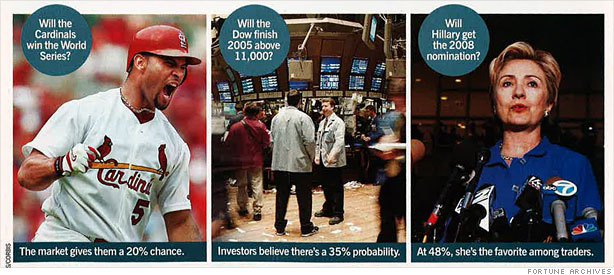
The traders in this case invested in a contract saying that Saddam Hussein would be “captured or neutralized” by the end of December 2003. That contract had bobbed along at a price of 9 (more later on how pricing works) for weeks. But on Thursday, Dec. 11, volume suddenly spiked, and the value of the contract leaped to 30, on no (public) news. Then, on Saturday night, Dec. 13, Hussein was captured in his spider hole near Tikrit. The announcement was made the following day–and the contract settled at 100. A piece of inside info about the progress of U.S. forces (or a bit of inspired guesswork) made those investors a bundle.
At FORTUNE we often write about the latest hot company, but it’s rare that we get a chance to introduce you to an entirely new market. And yet that’s what Intrade appears to be. Just a few years old, Intrade is beginning to attract a good deal of attention from market prognosticators, political strategists, statisticians, professional traders, and increasingly, ordinary investors. Some heavy-hitter backers have bought stakes in the company, and it recently began negotiations to become a regulated exchange in the U.S.
There are a handful of other quirky exchanges that take bets on future events. The Iowa Electronic Markets, for instance, has been run by the University of Iowa since 1988 as a forum for predicting economic and political outcomes, with an emphasis on elections. And HedgeStreet, which opened for business in 2004, is a private exchange that allows investors to use options it calls Event Derivatives to hedge against various economic outcomes. But Intrade is the only efficient market system around for investing in, well, almost anything.
Intrade.com and its sister website Tradesports.com, which carries mostly (you guessed it) sports contracts, are run by a company called Trade Exchange Network. The firm was founded in Dublin almost six years ago by a group of bankers led by John Delaney, 36. Trading began in 2002, and the sites now have 46,000 members who trade some 200,000 contracts a day. That’s not much–the NYSE, for example, trades an average of 1.6 billion shares daily–but volume is growing 165% a year. Roughly 50% of total volume is sports related.
Intrade works much like a stock exchange, except that you’re investing in events, not companies. Generally, the contracts are designed so that a buyer is betting that the act will occur, while a seller is betting it won’t. Prices are quoted between 0 and 100. The higher the number, the greater the probability of its happening, according to the market. If you go long and you’re wrong, the seller of the contract gets your money. Likewise, you get the short-seller’s money if the event, such as Saddam’s capture, happens. If the scenario doesn’t play out by the specified deadline, a contract settles at zero; if it does, it settles at 100.
Getting started is pretty easy. You can open an account on the site in about five minutes by using your credit card or a wire transfer. There’s no minimum investment. And Intrade charges a flat commission of 4 cents per contract for each transaction. Let’s say you want to bet on the confirmation of John Roberts, President Bush’s Supreme Court nominee. The day after Roberts was announced, the “ask” price for a Roberts confirmation contract opened at 81. That means you could buy, for example, ten contracts for $81 (plus 40 cents commission). If Roberts is confirmed, the contract’s price will rise to 100, and you’ll make $19 (minus the 40-cent commission for selling). If it appears more likely that Roberts will be confirmed over the coming days or weeks, the contract might rise to, say, 95, in which case you could sell and lock in a profit. If Roberts makes some sort of gaffe, the contract will likely drop below 81 and you’ll be in the red. If Roberts is voted down by the Senate, the contract goes to zero and you lose all your dough, but of course you could try to sell at any time on the way down.
Notice that we used the word “bet” above. Because it involves putting money on everyday events (like sports), trading contracts on Intrade may seem a little like gambling. But Intrade executives say it’s not: For one thing, Intrade takes only a commission and does not act as “the house” like a Las Vegas casino. Also, investors on Intrade can, at least in theory, use skill to hedge their risk, as they do in the equity market. Intrade says it is in the process of seeking regulatory oversight by the Commodities Futures Trading Commission, the federal agency that regulates futures and options. (Citing the lack of a formal application, the CFTC had no comment.)
One investor started on Intrade as a hobby. Now he trades baseball and politics contracts full-time and makes $500 to $1,000 in profits a day.

Whether or not you want to invest in current events, Intrade is a fascinating exercise in the power of the marketplace to anticipate the future. Its trading data have proven to be remarkably accurate. For instance, Intrade never wavered in predicting that George W. Bush would be reelected in 2004, and it called 33 out of 34 Senate races as well (it failed in Alaska, where contract volume was minimal). It also correctly signaled that Cardinal Ratzinger would be chosen as the new Pope, arguably the most secret vote on the planet. “Unlike a poll which asks, ‘Who would you vote for?’ we are essentially asking, ‘Who do you think will win?’ and then, ‘Who will you put money on to win?’ ” says Delaney. “Markets have an incredible ability to suck out information. They can be wrong–but not as much as opinion polls.”
Intrade says that some hedge-fund managers have begun scrutinizing contract pricing to aid them in their investing. Before the presidential election last fall, one manager with a hefty “Bush portfolio” (energy and defense stocks) closely monitored the line on a Bush victory for reassurance that his political take was on target. (Of course, he could have also hedged his Bush portfolio by buying Kerry contracts.)
One way Intrade hopes to grow is as a hedging device. For example, it has introduced hurricane contracts, which allow traders to bet on where a given storm will make landfall. Intrade execs say this could prove extremely useful to insurers that wish to hedge their coverage risk. (For now, volume here is minuscule.)
Dean LeBaron, one of the pioneers of index investing and the former head of Batterymarch Capital (which he sold to Legg Mason several years ago), has invested in Intrade. According to Intrade, so too have hedge-fund heavies Stan Druckenmiller and Paul Tudor Jones (both declined to comment). “New markets are where we learn things,” says LeBaron. “I look at this as like getting in on the beginnings of indexing.” Much like indexing, LeBaron says, Intrade requires counterintuitive thinking. (The Wisdom of Crowds, indeed!) LeBaron points out that as Intrade expands and liquidity increases, the value of its predictive information and the accuracy of the pricing will grow.
John Murray sees value already. He used to commute every day from his house in suburban Morris Plains, N.J., to trade foreign exchange and stock futures on the New Board of Trade in Manhattan. He began noodling around on Intrade some two years ago, and soon after, a light bulb went on: “I was trading with it on a hobby level, when suddenly I said, ‘This is great. This I exactly what I do for a living. Why go to New York every day?’ ” So now, Murray says, he makes a living at home by investing through Intrade and Tradesports. “I trade a lot of sports, where I do a lot of modeling, and some politics too,” he says. “My work these days is generally 5 P.M. until midnight.” Wait, let’s get this straight. Murray, who has four kids, has his days free, then watches a couple of baseball games each night to make a living? Actually, yes. “I’ll trade about 1,000 to 2,000 lots,” he says. “Right now I’m averaging between $500 and $1,000 in profits a day.” While it’s hard to say that Murray is making money the old-fashioned way, who’s to say he’s not earning it?