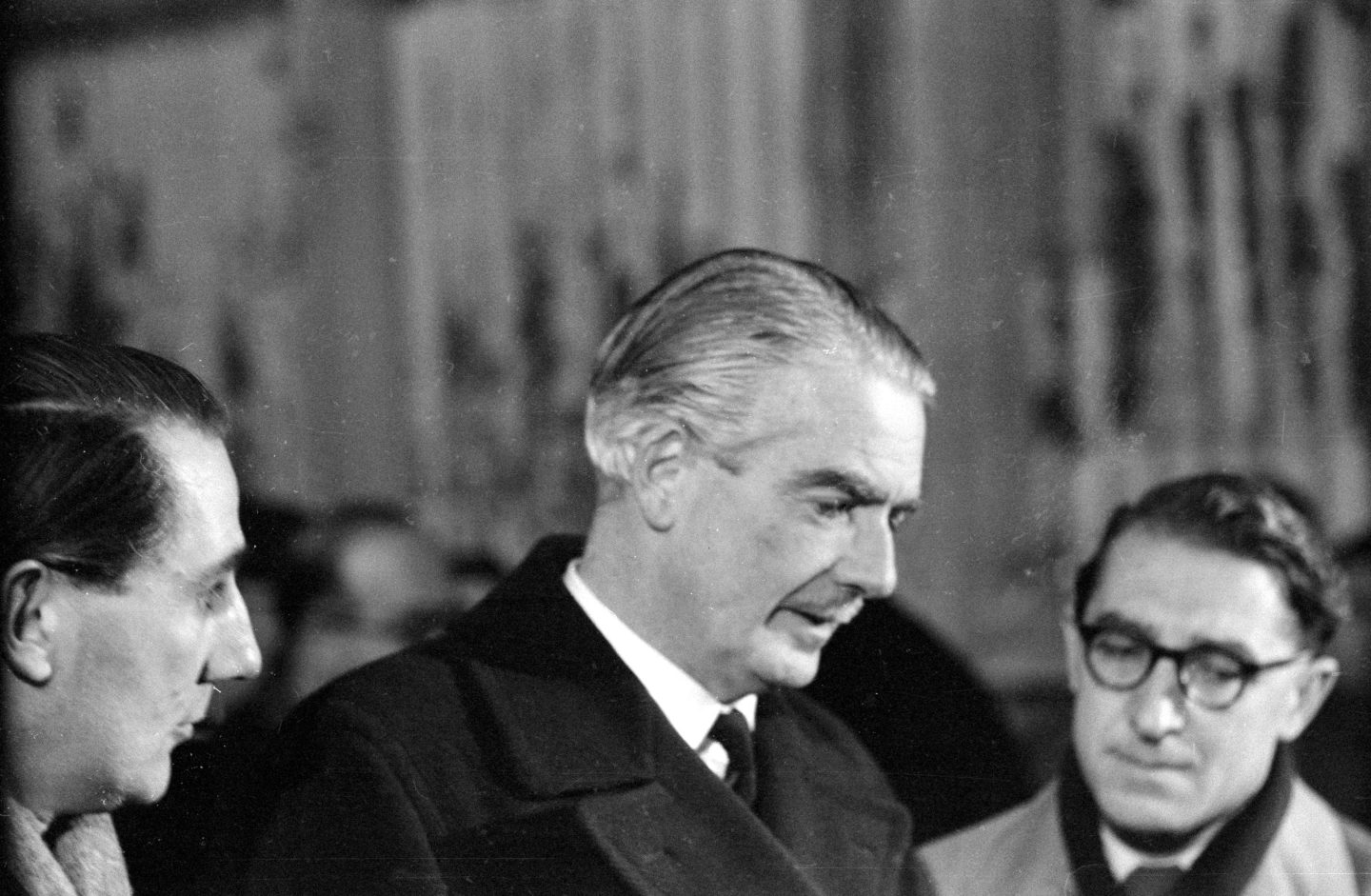
Robert Mundell, left, and Allan Meltzer
FORTUNE — Robert Mundell and Allan Meltzer rank among the most influential economists of the past half-century. Mundell, a professor at Columbia University, garnered a Nobel Prize in 1999, in part for his work in defining what he calls “optimum currency areas.” No academic has ever enjoyed such success seeing his theories into practice: He’s variously called the “father” or “godfather” of the euro. The intellectual architecture that Mundell created for the single currency was a major force in winning over skeptical politicians and economists, and, until the recent crisis, appeared to have transformed the 17-nation eurozone into a juggernaut rivaling the U.S.
Meltzer is a highly influential monetarist who authored A History of the Federal Reserve, lauded as the most comprehensive chronicle of the central bank. He served as a Treasury official in the Kennedy administration and on President Reagan’s Council of Economic Advisors. Meltzer strongly opposes what he views as our current, improvisational monetary policy targeted at such short-term goals as boosting housing or equity prices, when the inevitable price will be far higher inflation.
Mundell, 79, is the more theatrical of the pair, having serenaded folks at his Nobel banquet with a stanza from Frank Sinatra’s “My Way.”
Now, Mundell and Meltzer are taking diametrically opposed positions on today’s biggest economic issue, the future of the euro. I was unable to speak with Mundell, who emailed me to say he was in Europe, where he summers in a picturesque villa in Tuscany. But examining his many recent interviews and articles gives a clear view of both why he still believes in the euro’s benefits, and his solution to the crisis.
MORE: Why London bankers are shrugging off Standard Chartered threat
It’s important to examine Mundell’s arguments for the euro, justifications he presents to this day. In Mundell’s view, the weaker European countries relied excessively in devaluations to remain competitive, saddling them with high inflation and interest rates, and slow growth. The crutch of devaluation enabled them to maintain labor laws that made workers overly expensive because of heavy government-mandated benefits and ensured that wages would rise faster than prices. By making it impossible to reduce prices of computers, appliances or vacations on in the global marketplace by devaluing, nations would be forced to lift productivity, and moderate wages, as the only route to staying competitive. Hence, the euro would exert market pressure to banish restrictive labor laws that had been a European institution, and economic curse, for decades.
Mundell argued in a 2011 paper that the progress he predicted was actually following the theory. One of the euro’s big benefits, he stated, is enhanced wage discipline. “In Europe, a country is not able to change exchange rates. Thus, when labor or unions make claims, for example, for a 10% wage increase, and productivity growth is 2% to 3%, they know it will result in unemployment or bankruptcies. The impossibility of depreciation causes labor unions to moderate their demands.”
So why is Europe faring so miserably? Mundell insists that the euro “has performed spectacularly” and that the problem is reckless government spending and excessive deficits. If Europe moves to “a more perfect union” in which a central authority is empowered to enforce strict fiscal discipline on wayward governments––and Germany and other rich nations help finance their southern neighbors until that happens––the euro can be saved and growth will resume.
MORE: Business’s real problem: Uncertainty, uncertainty, uncertainty
Meltzer, 84, adamantly disagrees. For Meltzer, the main problem isn’t spending (though it’s excessive), but competitiveness. He points to a shocking decline in competitiveness in the weaker countries that’s a direct, and predictable, legacy of the euro. “The eurozone really isn’t the union that Mundell thought it would be,” Meltzer told me in a phone interview last week. “Greece and Germany were in different worlds before the euro was introduced, and they’ve stayed there. No one should have believed the euro story.”
For Meltzer, the central bankers and politicians facing the euro crisis are targeting the wrong issue. “They’re hammering away the debt problem,” he continues. “That’s not what they need to do. The bigger problem is cost of production.” The southern countries, Meltzer argues, will not grow “if production costs in Spain and Italy are 30% higher than in Germany, which is now the case.”
For Meltzer, the main rub is that the trend Mundell predicted, a convergence in productivity — the number of trucks or semiconductors a worker makes per hour — didn’t happen. The convergence went in the wrong direction: Wages rose far more rapidly in Spain, Italy, Ireland and Greece than in Germany. But the Germans, not their neighbors, were the ones who got more productive. From 2000 to 2008, labor costs rose 15% in Germany, versus 28% in Italy, 43% in Spain and 49% in Ireland.
Mundell recently nodded at the problem, admitting that the euro “might have brought about a too-rapid convergence in wages rates between areas where productivity was unequal.”
MORE: Are Fannie and Freddie on your side?
Why did wages keep rising, in defiance of Mundell’s predictions of a new era of restraint? The southern nations and Ireland learned fast that they could grow rapidly not by increasing their competitiveness, but by borrowing enormous sums at irresistibly low rates. A consumption boom, financed by cheap mortgages and credit card loans, powered inflation at almost twice the rate in Italy, Spain, Ireland, Greece and Portugal from 2000 to 2007 as in Germany, 3.2% compared to 1.7%.
But the southern countries and Ireland could borrow at the same rates as Germany, courtesy of the euro. Hence, they could load on debt at rates the same, or even lower, than the appreciation in their homes or ever-rising prices of their products. It was that excessive borrowing, frequently at costs lower than inflation, that enabled wages to explode. Cheap borrowing also proved powerfully seductive to governments, allowing them to keep raising pay in inefficient, state-controlled companies, further hitting productivity. From 2000 to 2008, government spending as a share of national income grew by an average of 3.8 percentage points in Italy, Spain, Greece and Portugal, and 12 points in Ireland. Says Meltzer: “It doesn’t help when the government is used to borrowing at 12% and suddenly it can borrow at 3% or 4%.”
In Germany, where interest rates dwarfed inflation, giving neither the government nor consumers an incentive to borrow excessively, state spending actually dropped one point over the same period.
So what’s Meltzer’s solution? He sees only two possibilities, a policy of grinding wage reductions, or devaluation that would at least temporarily dismantle the euro. The first option, he reckons, won’t work. “The Germans say the weaker countries need austerity,” says Meltzer. “But Greece has gone through five years of slow or no growth. Are they recommending five more years? The people of these countries won’t accept it. They’re asking for another Great Depression.”
MORE: Washington gets tough on Iran (sometimes)
Instead, Meltzer is advocating that southern countries, plus Ireland and perhaps France, join a separate, “soft-euro” area. “The soft euro would float down in value versus the current euro in Germany and the northern countries,” he says. “That would restore the competitiveness of the nations that can’t grow today.” For Meltzer, it’s the only way to keep the euro in any form. “It’s easier to make reforms when the economies are growing,” he adds. In Meltzer’s scenario, the southern countries could rejoin the “hard” euro later, once they’ve reformed their labor markets.
Which of these two legends makes the stronger case? The nod must go to Meltzer. The reason is fundamental. The heart of the problem is indeed the competitiveness issue. “The structural problems, the rigidity of the labor markets, didn’t change in the euro era,” says another outstanding economist, Uri Dadush of the Carnegie Endowment. “The euro just made it impossible to deal with the rigidities by devaluing. That robbed countries of their competitiveness.” Indeed, Europe never had a sovereign debt crisis in the decades before the euro was introduced. The tool of devaluation was a sign of weakness in an Italy or Spain, but it’s the euro, by removing that tool, that’s caused an historic upheaval.
The question surrounding Meltzer’s solution in whether the southern countries will actually make the reforms necessary to rejoin the euro in years to come. If so, Mundell’s dream might eventually materialize. If not, they’re far better off keeping the soft euro, whatever name is finally chosen.
Another Sinatra tune might be a better refrain for Mundell, “Put Your Dreams Away (for Another Day).”